Introduction
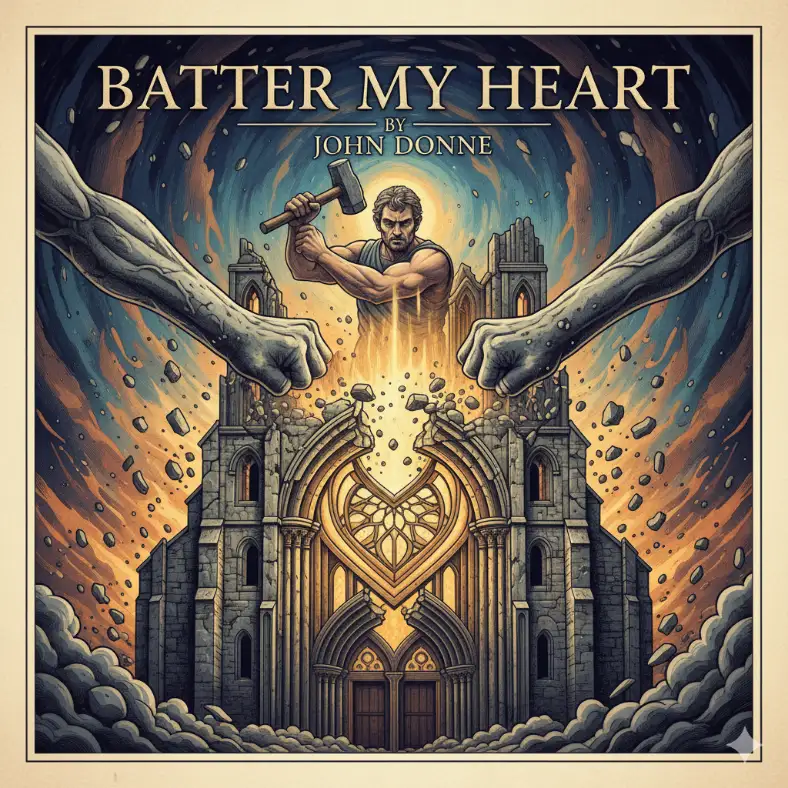
Batter My Heart by John Donne is one of his most powerful Holy Sonnets, often called Holy Sonnet 14. The poem shows a man struggling with faith, guilt, and his desire for redemption. John Donne speaks directly to God, asking Him to break, remake, and renew his heart. The poem combines passion, pain, and surrender. In just 14 lines, Donne captures the inner war between human weakness and divine grace.
Table of Contents
1. Historical Context
1.1 About John Donne
John Donne (1572–1631) was a leading poet of the Metaphysical School. His early poems focused on love and desire, but after his religious conversion, he turned to themes of faith and salvation. He later became a priest in the Church of England. This mix of passion and religion shaped his poetry.
1.2 The Period and Its Faith Conflicts
The early 1600s were full of religious turmoil. England was shifting from Catholicism to Protestantism. Donne, born a Catholic, lived with fear and doubt before he embraced Anglicanism. Batter My Heart reflects this tension. It is not only a personal plea but also a reflection of a time when faith itself felt uncertain.
1.3 Poetic Form and Structure
- Type: Sonnet (14 lines)
- Meter: Iambic pentameter
- Rhyme Scheme: ABBA ABBA CDCD EE
The poem mixes Italian (Petrarchan) and English (Shakespearean) sonnet forms. This blending reflects the poet’s divided state—a man caught between reason and passion, sin and grace.
2. Summary of Batter My Heart
2.1 A Call for Divine Force
The poem opens with a strong request:
“Batter my heart, three-person’d God; for you / As yet but knock, breathe, shine, and seek to mend;”
Donne asks the Holy Trinity to act upon him with full power. He feels that gentle efforts from God have failed. He needs a complete spiritual breakdown before renewal can happen.
2.2 The Image of a Captured Town
Donne compares himself to a town taken over by sin:
“I, like an usurp’d town, to another due, / Labor to admit you, but O, to no end.”
He sees his soul as occupied territory. Though he wants to admit God, sin controls him. He pleads for a divine invasion to reclaim his soul.
2.3 Reason and Faith in Conflict
“Reason, your viceroy in me, me should defend, / But is captiv’d, and proves weak or untrue.”
Reason, the power that should guide him toward God, has been defeated. The mind knows what is right, but the will cannot follow.
2.4 The Paradox of Love and Violence
The poem ends with one of Donne’s boldest paradoxes:
“Take me to you, imprison me, for I / Except you enthrall me, never shall be free, / Nor ever chaste, except you ravish me.”
He prays for God to imprison and ravish him. Freedom and purity, he says, can come only through divine control. This shocking image expresses how deep his surrender must be.
3. Themes in Batter My Heart
3.1 Inner Spiritual Conflict
The poem is an emotional outburst. The speaker feels trapped by sin but yearns for renewal. He cannot reform himself; he needs divine intervention.
3.2 Divine Violence and Grace
The verbs Donne uses—batter, break, burn, imprison—show how painful transformation can be. Donne sees God not as gentle but as forceful, reshaping him through suffering.
3.3 Reason vs. Passion
Donne shows how human reason fails when passion and sin take over. Only faith and surrender can bring salvation.
3.4 Love as Surrender
Donne turns spiritual love into something physical and emotional. Being “ravished” by God means being taken over completely—a symbol of total surrender.
4. Literary Devices and Imagery
4.1 Metaphysical Conceits
Donne uses conceits (extended metaphors) to express his ideas:
- The soul as a captured city
- God as a conqueror and lover
These comparisons link physical images with spiritual meaning.
4.2 Paradox
The poem is full of contradictions:
- Freedom through imprisonment
- Purity through ravishment
- Destruction leading to creation
Each paradox shows the struggle between body and soul.
4.3 Sound and Rhythm
The repetition of harsh sounds—b, br, bl, r—creates a forceful tone. It mirrors the plea for violent spiritual action.
4.4 Tone
The tone is urgent, intense, and emotional. It shifts between despair and hope.
5. Analysis of Key Lines
| Line | Meaning |
|---|---|
| Batter my heart, three-person’d God | The poet calls on the Trinity to strike him with spiritual power. |
| Break, blow, burn, and make me new | He seeks complete renewal through destruction. |
| Reason, your viceroy in me | Reason is God’s governor in man but has failed. |
| Except you enthrall me, never shall be free | True freedom comes only through divine possession. |
| Nor ever chaste, except you ravish me | The soul becomes pure only when overtaken by God’s love. |
6. Comparison with Donne’s Other Holy Sonnets
| Poem | Theme | Tone | Image of God |
| Batter My Heart | Renewal through divine violence | Desperate, pleading | Warrior and lover |
| Death Be Not Proud | Faith conquers death | Confident | Victorious conqueror |
| A Hymn to God the Father | Confession and forgiveness | Humble | Merciful father |
| At the Round Earth’s Imagined Corners | Judgment and redemption | Awe-filled | Judge and redeemer |
7. Relevance Today
7.1 Faith and Struggle
Even today, readers connect with Donne’s cry for help. It reflects how people feel when they try to change but cannot do it alone.
7.2 Power of Surrender
The poem teaches that surrendering pride or ego can bring peace. It applies to both spiritual and personal life.
7.3 Emotional Honesty
Donne’s honesty makes the poem timeless. It shows that faith is not calm or easy—it is a battle inside the heart.
For more on how poets express religious emotion, you can visit Gerard Manley Hopkins on LitGram.
You can also check Poetry Foundation’s John Donne page for background and text versions of his works.
8. Reading Tips for Students
- Read the poem slowly and aloud. Feel the rhythm of strong words like batter, break, and burn.
- Look for contradictions. They carry the main message.
- Compare this poem with Donne’s earlier love poems to see how his focus shifted from sensual to spiritual.
- Think of it as a conversation between human weakness and divine power.
9. Key Takeaways
- Poem Type: Religious sonnet
- Main Theme: Conflict between sin and salvation
- Tone: Urgent, desperate, intense
- Style: Metaphysical, full of paradox and strong imagery
- Message: Real freedom comes from surrender to divine will
10. FAQ Section
Q1. What is the theme of Batter My Heart by John Donne?
The theme is spiritual struggle—the speaker’s plea for divine renewal and forgiveness.
Q2. Why does Donne use violent imagery?
He shows that deep change often requires pain. The soul must be broken to be remade.
Q3. What does “three-person’d God” mean?
It refers to the Christian Holy Trinity—Father, Son, and Holy Spirit.
Q4. What is the tone of the poem?
It is desperate and passionate. The poet is pleading for mercy and transformation.
Q5. What makes this poem metaphysical?
It blends intellect and emotion, uses paradoxes, and draws bold comparisons between physical and spiritual experiences.
11. Key Takeaways Before You Go
- Donne’s Batter My Heart shows faith as a personal battle.
- The poem connects physical love and divine grace.
- It challenges readers to think of surrender as strength.
If you enjoyed this analysis, you might also like this related piece: With the Photographer ICSE Class 10 Summary
12. Conclusion
Batter My Heart by John Donne is not a calm prayer but a fierce cry. The speaker feels trapped by sin and pleads for God to break and rebuild him. The violent imagery shows that faith is a fight, not a comfort. Donne’s honesty and intensity make the poem as relevant now as it was four centuries ago.
It teaches that renewal often comes after destruction—and that freedom can only be found in surrendering the self.