Introduction
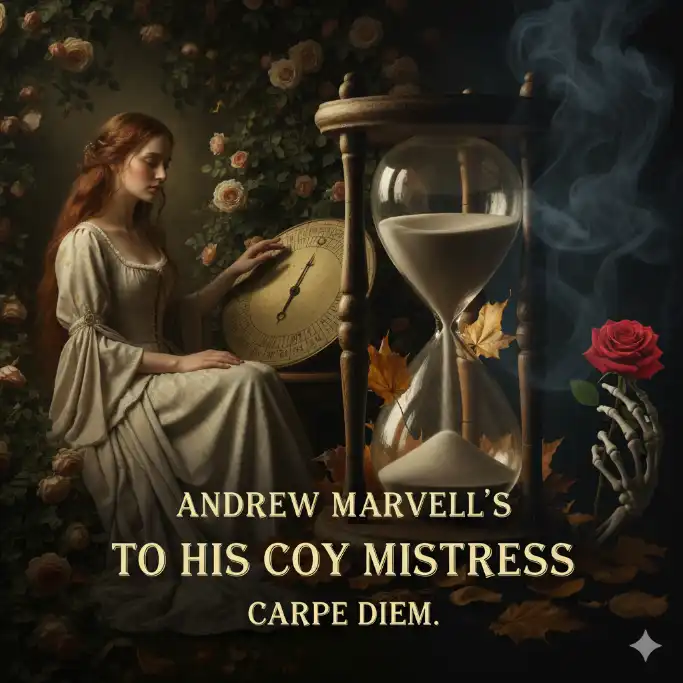
Andrew Marvell’s To His Coy Mistress is one of the most famous metaphysical poems in English literature. It captures a speaker’s persuasive argument to his beloved, urging her to seize the moment before time takes away their youth and chances of love. The poem blends wit, passion, and logic, making it a masterpiece of the 17th century. This post gives you a full analysis of To His Coy Mistress, explains its themes, and shows why it remains so powerful even today.
Table of Contents
Historical Context
Andrew Marvell wrote To His Coy Mistress during the 1650s, a time of great political and cultural change in England. The Puritan regime had replaced the monarchy, and moral strictness was common. Poetry, however, still reflected human desire and intellectual debate.
Marvell was part of the Metaphysical school of poets, like John Donne and George Herbert. These poets mixed emotion with reason and used sharp arguments and unusual comparisons. In Marvell’s poem, love is not just passion—it’s an argument against time.
Key historical points:
- Written during the English Commonwealth period
- Reflects metaphysical wit and reasoning
- Expresses “Carpe Diem” or “seize the day” philosophy
Structure and Summary
To His Coy Mistress is written in rhyming couplets of iambic tetrameter (AA, BB, CC…). This creates a fast, rhythmic tone—matching the urgency of the speaker’s argument.
The poem is divided into three clear parts:
1. If We Had Time (Lines 1–20)
The speaker starts by saying that if they had unlimited time, her coyness would not matter. He imagines spending thousands of years admiring every part of her body and praising her virtues.
“Had we but world enough, and time,
This coyness, lady, were no crime.”
This section shows romantic idealism. Love here is infinite and patient.
2. But Time is Running (Lines 21–32)
Then comes the reality check. The tone shifts to urgency and even fear. Time is short, and death is approaching. The image of the “winged chariot” behind him shows time chasing them.
“But at my back I always hear
Time’s winged chariot hurrying near.”
This part warns that beauty fades and love cannot survive in the grave.
3. Let’s Act Now (Lines 33–46)
Finally, the speaker urges his lover to act while they are young and alive. Passion becomes a way to defeat time.
“Now let us sport us while we may,
And now, like amorous birds of prey…”
He suggests that their love can burn fiercely and make time move faster, conquering death symbolically.
Major Themes
1. Carpe Diem – Seize the Day
The poem’s central idea is to enjoy love before time ends it. Marvell’s argument is both logical and emotional. He says love should not wait for the perfect moment because life is short.
2. The Power of Time
Time is the poem’s silent enemy. The “winged chariot” becomes a symbol of aging and mortality. Marvell’s speaker knows he cannot stop time, so he chooses to live fully now.
3. Love and Desire
Love in this poem is physical, passionate, and bold. Yet, Marvell’s clever tone keeps it balanced—it’s not pure lust but a mix of reason and emotion.
Literary Devices
Marvell’s writing style combines argument with imagination. Some important devices include:
- Hyperbole: “Love you ten years before the Flood.” exaggerates to stress endless devotion.
- Metaphor: Time as a “winged chariot” and lovers as “birds of prey.”
- Irony: The speaker’s logical argument for something emotional.
- Imagery: The shift from “Indian Ganges” (exotic beauty) to “deserts of vast eternity” (death).
| Device | Example | Effect |
|---|---|---|
| Hyperbole | “Love you ten years before the Flood” | Stresses exaggerated patience |
| Metaphor | “Time’s winged chariot” | Shows time as a relentless force |
| Allusion | “Flood” and “Conversion of the Jews” | Adds Biblical and historical depth |
| Imagery | “Deserts of vast eternity” | Evokes emptiness of death |
Analysis of Tone and Style
The tone moves from playful to serious, then to passionate urgency.
- The first part feels romantic and calm.
- The second part is dark and reflective.
- The third part bursts with energy and persuasion.
This change mirrors the progress of an argument—Marvell uses logic (logos), fear (pathos), and seduction (ethos) to convince his beloved.
The metaphysical wit is strong here. Marvell uses philosophy and poetic charm together. The reader sees both a lover and a thinker.
Relevance to Modern Readers
Even centuries later, To His Coy Mistress still speaks to modern readers. It reminds us that time moves quickly and that hesitation can cost us experiences.
In today’s world of digital distractions and endless waiting, Marvell’s “seize the day” message feels even more relevant. It urges readers to live with passion, honesty, and urgency.
You can read another piece related to love and metaphysical poetry on Sweetest Love, I Do Not Goe Summary on LitGram. Both poems share a witty and emotional reflection on time and affection.
For further insights, visit Poetry Foundation’s page on Andrew Marvell for critical essays and interpretations.
Key Quotes from the Poem
“Had we but world enough, and time,
This coyness, lady, were no crime.”
This opening line sets the tone for the entire argument.
“Time’s winged chariot hurrying near.”
A striking image that captures the rush of time.
“Now let us sport us while we may.”
The final call for action and passion.
Comparison: Marvell and Donne
| Aspect | Marvell (To His Coy Mistress) | Donne (The Flea) |
|---|---|---|
| Theme | Urgency of love and time | Seduction through wit |
| Tone | Logical and persuasive | Playful and teasing |
| Style | Balanced and rhythmic | Bold and surprising |
| Symbolism | Time and mortality | The flea as union metaphor |
Both poets use argument to express love. But Marvell’s poem feels broader and more philosophical.
Reading Recommendations
If you enjoyed To His Coy Mistress, read these too:
- The Flea by John Donne
- Love (III) by George Herbert
- The Definition of Love by Andrew Marvell
- Sonnet 18 by William Shakespeare
- Ode to a Nightingale by John Keats
These poems discuss love, time, and beauty in different tones—from playful to tragic.
FAQ
Q1. What is the main message of “To His Coy Mistress”?
It tells readers to enjoy love and life before time and death end both.
Q2. Why is the poem called metaphysical?
Because it combines emotion with logical reasoning and uses extended metaphors and wit.
Q3. What does “coy” mean in the title?
It means shy or hesitant. The woman is reluctant to respond to the speaker’s advances.
Q4. What is the tone of the poem?
It starts as gentle and romantic but ends in urgent passion.
Q5. How is time presented in the poem?
Time is shown as fast, dangerous, and always moving forward—something no one can escape.
Key Takeaways
- To His Coy Mistress blends logic and love in perfect balance.
- It’s one of the best metaphysical poems on time and passion.
- The speaker uses wit and reasoning to persuade his beloved.
- Its message—seize the day—remains timeless for readers today.
- Marvell’s imagery and tone shifts make the poem powerful and memorable.
Conclusion
Andrew Marvell’s To His Coy Mistress is not just about desire. It’s about how short life is and how easily we waste it waiting for the right moment. The poem’s argument still feels true—you cannot stop time, but you can fill it with passion and meaning. For students preparing for RPSC First Grade English or studying metaphysical poetry, understanding this poem gives insight into how reason and emotion work together in literature.