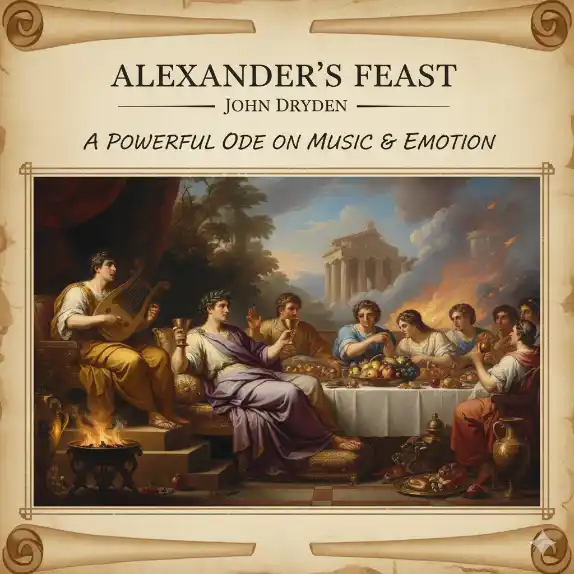
John Dryden’s “Alexander’s Feast” is a 1697 ode in which music moves Alexander’s emotions from triumph and desire to guilt and religious awe. The poem contrasts the destructive power of Timotheus’s music with the redemptive power associated with Saint Cecilia.
Introduction
Alexander’s Feast by John Dryden is one of the greatest English odes ever written. It celebrates the emotional power of music and poetry through the story of Alexander the Great and his musician, Timotheus.
Written in 1697 for Saint Cecilia’s Day, the poem explores how music influences human emotions. It answers one key question — how can art move the soul and shape action?
This poem perfectly reflects the Restoration age’s love for grandeur, harmony, and intellect. For students, it stands as an excellent example of Dryden’s poetic mastery and the blending of classical and Christian elements.
Table of Contents
Historical Context of Alexander’s Feast
The Restoration Period
After the fall of Puritan rule, England entered the Restoration era (1660–1700). This was a period when theatre, poetry, and art flourished again. John Dryden became the leading poet and critic of this age.
The Restoration poets admired wit, structure, and musicality. They often combined classical subjects with moral and spiritual ideas. Alexander’s Feast reflects all these features.
The Saint Cecilia Tradition
Every year, poets wrote odes to celebrate Saint Cecilia, the patron saint of music. These were performed with orchestras and choirs. Dryden had already written one such ode, A Song for St. Cecilia’s Day in 1687. But Alexander’s Feast went even further.
It was first set to music by Jeremiah Clarke. Later, in 1736, George Frideric Handel turned it into a powerful oratorio, proving its timelessness.
The Classical Background
The poem imagines Alexander the Great celebrating his victory over Persia at Persepolis. During the feast, his court musician Timotheus plays songs that stir Alexander’s heart. Each song changes the emperor’s mood — pride, love, pity, and rage — showing how music can command even a conqueror’s soul.
“The praise of Bacchus, then, the sweet musician sung;
Of Bacchus, ever fair, and ever young.”
This line sets the tone for the entire ode — a celebration of joy, wine, and art.
Structure and Summary of the Poem
Poetic Form
The poem consists of 120 lines divided into irregular stanzas. The rhythm, length, and rhyme vary according to the emotional tone. This flexibility makes the poem sound musical, echoing the flow of Timotheus’s melodies.
Dryden’s verse moves like an orchestra — soft and slow when gentle, fast and loud when intense.
The Feast Scene
The poem begins with Alexander sitting in his royal splendor, surrounded by warriors, wine, and beauty. Timotheus starts his music. At first, he praises Bacchus, the god of wine, filling the hall with laughter and pleasure.
“The listening crowd admire the lofty sound,
And shout their god applauded to the skies.”
Next, Timotheus changes the tune and sings of love. Alexander’s mind shifts from glory to desire. The music softens his heart as he gazes at Thais, the beautiful courtesan beside him.
Then comes sorrow. The musician sings of fallen heroes, making Alexander’s heart weep with pity.
Finally, Timotheus plays a fiery tune. He reminds Alexander of his dead comrades and the Persian king’s palace. Rage takes over, and the emperor orders the burning of Persepolis. Music has moved him from joy to destruction.
Saint Cecilia’s Appearance
In the last section, Dryden introduces Saint Cecilia, whose divine harmony surpasses Timotheus’s art. She represents spiritual music — pure, heavenly, and eternal.
“He raised a mortal to the skies;
She drew an angel down.”
The poem ends by placing Christian inspiration above pagan art. Dryden honors Cecilia as the true source of celestial music.
Major Themes in Alexander’s Feast
1. The Power of Music
The main idea is the emotional power of music. Dryden shows that sound can stir emotions stronger than logic or will.
Timotheus’s songs make Alexander laugh, love, cry, and rage — proving that art can rule the heart even more than kings rule nations.
2. Emotion and Control
Each shift in music shows how easily human emotions can change. Dryden warns that passion, though beautiful, can also be dangerous when it leads to violence or pride. Alexander’s burning of Persepolis becomes a symbol of art’s double edge.
3. Pagan Glory and Christian Faith
The poem contrasts two worlds — the glory of ancient Greece and the purity of Christianity. Timotheus represents human genius, while Saint Cecilia stands for divine grace.
Dryden suggests that art reaches perfection only when it becomes an instrument of faith.
4. The Artist as Creator
Timotheus is portrayed as a magician of sound. Through his music, he creates emotions as if he were shaping them out of air. Dryden raises the status of the poet and musician to that of a creator — a reflection of divine power.
Literary Devices and Techniques
1. Imagery
The poem is rich in visual and auditory imagery. Readers can almost hear the music, see the banquet, and feel the changing emotions.
Example:
“With ravished ears, the monarch hears,
Assumes the god, affects to nod.”
These lines make you see Alexander’s pride as he imagines himself divine.
2. Allusion
Dryden uses mythological and historical references — Bacchus, Jove, and Saint Cecilia — to connect pagan and Christian art traditions.
3. Symbolism
- Alexander — human pride and emotion.
- Timotheus — artistic genius.
- Saint Cecilia — divine inspiration.
- Music — the power of art to shape emotion.
4. Tone and Sound
Dryden uses variation in meter and rhyme to reflect musical shifts. His changes in pace mirror the emotional rhythm of the poem.
Key Quotes with Explanation
| Quote | Meaning |
|---|---|
| “The power of harmony too well they knew, He gave the charm of sound.” | Music has a magical ability to control emotions. |
| “He raised a mortal to the skies; She drew an angel down.” | Human art uplifts man, but divine music unites heaven and earth. |
| “Revenge, revenge, Timotheus cries!” | Music ignites Alexander’s anger and causes destruction. |
Comparison Table: Timotheus vs. Saint Cecilia
| Aspect | Timotheus | Saint Cecilia |
|---|---|---|
| Source of Inspiration | Human emotion | Divine grace |
| Purpose | To entertain and arouse passion | To uplift and purify the soul |
| Result | Leads to destruction (burning of Persepolis) | Leads to harmony and faith |
| Symbolism | Pagan art and earthly beauty | Christian art and spiritual music |
Relevance to Modern Readers
Even today, Alexander’s Feast speaks to anyone who values art and emotion. It reminds us that creativity can both heal and harm.
In today’s world of powerful media and music, Dryden’s warning still applies — sound and art influence how people think, feel, and act.
For students preparing for RPSC First Grade English, understanding this poem helps explain Restoration poetry and the transition from classical to Christian art.
If you wish to read another Restoration work analysis, you can check Mac Flecknoe Summary by Dryden on Litgram — it helps connect Dryden’s style across genres.
For broader background on odes and music in literature, you may explore this detailed piece from Poetry Foundation.
Key Takeaways
- Alexander’s Feast shows the power of art to influence human emotion.
- The poem blends classical and Christian traditions.
- Timotheus represents human art, while Saint Cecilia represents divine inspiration.
- The structure of the poem mirrors the rhythm of music.
- Dryden’s craftsmanship makes this ode a perfect study for Restoration poetry.
Reading Recommendations
If you enjoyed studying Alexander’s Feast, here are other related works and poems you can explore:
- A Song for St. Cecilia’s Day by John Dryden
- The Progress of Poesy by Thomas Gray
- Ode on Music by William Collins
- Ode to a Nightingale by John Keats
- L’Allegro by John Milton
You can read summaries of these and other English classics at Litgram.in/blog.
Sources and context: The poem’s form as an ode is explained through the Poetry Foundation glossary entry on the ode. Dryden’s literary background can be checked against the Encyclopaedia Britannica biography of John Dryden.
FAQ: Alexander’s Feast by John Dryden
Q1. When was Alexander’s Feast written?
It was written in 1697 for the annual celebration of Saint Cecilia’s Day.
Q2. What is the central theme of the poem?
The emotional and moral power of music — how it affects human feeling and action.
Q3. Who are the main figures in the poem?
Alexander the Great, Timotheus (the musician), and Saint Cecilia.
Q4. What moral lesson does the poem teach?
Human art is powerful but imperfect. True harmony comes from divine inspiration.
Q5. What kind of poem is Alexander’s Feast?
It is a Pindaric ode, known for its grand tone, irregular structure, and celebration of art and heroism.
Conclusion
Alexander’s Feast by John Dryden remains one of the most elegant and profound odes in English literature. It captures the grandeur of classical heroism and the grace of divine music.
Through Alexander’s shifting emotions, Dryden shows how art can command the soul — and how only spiritual harmony can surpass it.
For students of English literature, the poem is not just a historical piece but a timeless reflection on the beauty and danger of human creativity.
So next time you hear a song that moves you deeply, remember Dryden’s message — music has the power to rule hearts and minds.