What is LItGram AI
I have been teaching English literature for competitive exams for years. And the one thing I kept hearing from students was the same: “Sir, the syllabus is too vast. I don’t know where to start.”
That wasn’t a study problem. That was a tools problem.
Most students preparing for UGC NET English or RPSC School Lecturer were using the same PDFs that have been circulating for years. Static, unsearchable, and written for no particular exam. You’d open a PDF on Victorian poetry and find yourself reading things that have never once appeared in an RPSC paper.
I’ve seen students spend six months preparing and still feel unprepared on exam day. Not because they didn’t work hard. But because the material they were using wasn’t built for the exam they were sitting.
So I started building LitGram AI.
Table of Contents
What the problem actually looks like
A student preparing for RPSC First Grade English has to cover literary theory, language skills, prose, poetry, and drama. The UGC NET English syllabus adds another layer of depth. Now imagine preparing for both, using notes that weren’t made for either.
Most study material doesn’t know what exam you’re preparing for. It doesn’t know which topics carry more weight. It doesn’t tell you when you’ve covered enough of a topic or when you need to go deeper. It doesn’t help you test yourself. It just sits there.
There’s also the problem of scattered preparation. A student has a PDF open in one tab, a YouTube video running in another, handwritten notes somewhere in a notebook, and a question bank from some coaching institute that’s three years old. Nothing talks to each other. You finish a study session and you’re not sure what you actually retained.
That’s the gap LitGram AI tries to fill.
What LitGram AI actually does
The core of the platform is the Smart Reader. It organises content by syllabus. If you’re preparing for UGC NET, you follow the UGC NET structure. If it’s RPSC, you follow that. Topics are broken into readable sections, not long unbroken chapters. You always know where you are in the syllabus and what’s left.
For plays like As You Like It, the Smart Reader goes act by act and scene by scene. This matters in exams where a question can be as specific as what happens in Act 2, Scene 4. For poetry, key terms and critical context are embedded alongside the text so you’re not jumping between five different sources.
Alongside the Smart Reader is LitChat. It works as an AI literature companion. You can ask it a general question about Post-Colonial theory or New Criticism. Or you can open it while reading a specific topic, and it knows exactly what you’re studying. You don’t have to explain the context. It’s already there.
This is the part that students tell me they use most. A doubt at 11 PM used to mean waiting until the next class or posting in a group and hoping someone answered. Now it gets resolved in a minute.
Then there’s the MCQ engine. You can generate custom questions on any topic to test your retention right after reading. There are also 15 full-length mock tests for RPSC, each with 150 questions. The engine gives particular weight to Assertion-Reason questions because those are consistently the ones most students get wrong in the actual exam.
Scores are tracked across attempts. You can see which topics are weak and come back to them. There’s a leaderboard if you want a sense of where you stand among other users preparing for the same exams.
There’s also a revision corner where you can bookmark sections and save notes inside the app. No more sticky notes on a laptop screen.
The thinking behind it
I want to be honest about something. No app replaces actual study. You still have to read, think, and understand the texts. LitGram AI doesn’t change that.
What it changes is the quality of your practice hours. Competitive exam preparation needs active recall, not just passive reading. You have to test yourself regularly. You have to return to weak areas. You have to see your progress over time or you lose motivation.
Most students know this. But they don’t do it because it’s inconvenient. You’d have to manually create questions, mark yourself, track your scores, and then figure out what to revise. LitGram AI handles that side of things so you can focus on understanding the content.
I’ve been an educator long enough to know that the students who clear these exams aren’t always the most talented. They’re the ones who practice consistently and know where their gaps are. The platform is built around that.
A word on the AI side
Some people ask whether an AI literature tutor can actually understand literature. Fair question.
LitChat is trained specifically for English literature exams. It knows the texts, the theories, the critical schools, and the exam patterns. It won’t give you a generic Wikipedia-level answer when you ask about the unreliable narrator in a specific novel. It understands the exam context.
That said, I always tell students: use LitChat to clarify, not to replace reading. If you haven’t read the source material, no AI will save you in the exam hall.
Who it’s for
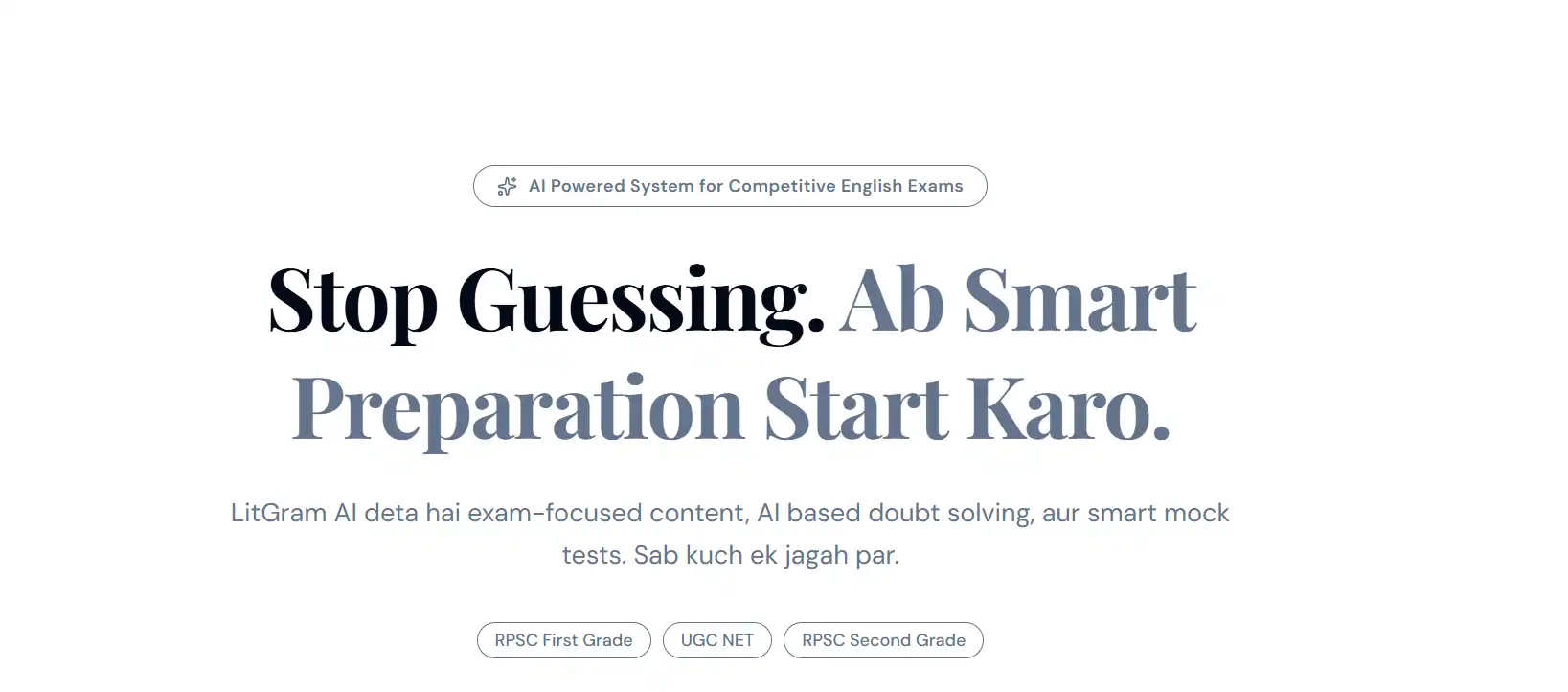
LitGram AI is built for students preparing for UGC NET English, RPSC First Grade English, and RPSC Second Grade English. If you’re preparing for something else, some of the content will still be useful. But those three exams are what the platform is built around.
You can start with the free version. It gives you access to around 40 percent of the premium content, enough to see how the Smart Reader and LitChat actually work before you commit to anything.
The platform is at litgramstudy.com.
I built this because I knew the problem from the inside, as a teacher who watched students struggle with the wrong tools. If you’re preparing for these exams, try the free version. See if it helps.
1 response