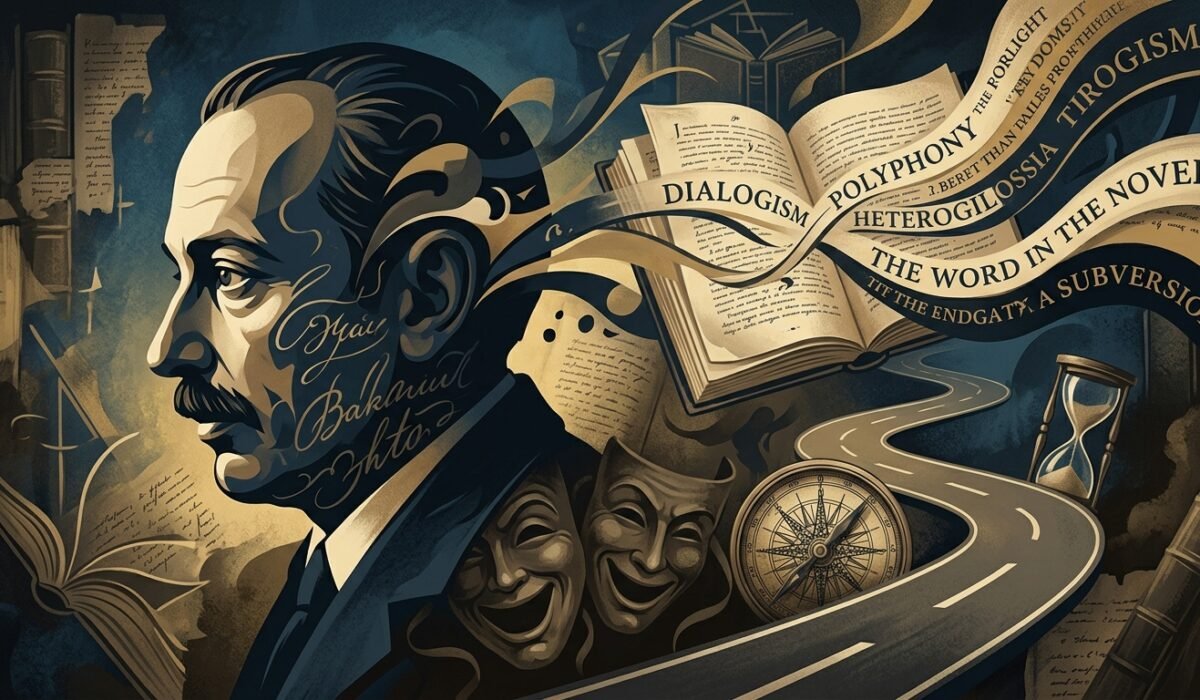
Mikhail Bakhtin remains one of the most frequently tested thinkers in Unit VIII (Literary Criticism) and Unit IX (Literary Theory) of the UGC NET English syllabus. In recent NTA examination cycles, questions have moved away from basic author-matching into conceptual distinctions: the exact difference between polyphony and heteroglossia, the specific essay where chronotope appears, and the disputed authorship of texts written within the Bakhtin Circle.
For candidates preparing for UGC NET English, SET, and RPSC College Lecturer examinations, this study guide lays out Bakhtin’s intellectual framework, his major texts, his four central concepts, and the common examination traps that cost candidates marks.
Key Revision Points for Quick Recall
- Dialogism: Language is never neutral or solitary. Every utterance responds to prior utterances and anticipates future replies.
- Polyphony: Introduced in Problems of Dostoevsky’s Art (1929, revised 1963). Characters speak as autonomous subjects with their own independent voices, not as authorial puppets.
- Heteroglossia (raznorechie): Coined in the essay “Discourse in the Novel” (written 1934–35). Refers to the coexistence of distinct social dialects, professional jargons, and ideological registers within a single language.
- Carnivalesque & Grotesque Realism: Developed in Rabelais and His World (completed 1940, published 1965, translated 1968). Celebrates the temporary suspension of social hierarchies and bodily renewal through laughter.
- Chronotope: Outlined in “Forms of Time and of the Chronotope in the Novel” (1937–38). The spatial and temporal coordinates woven together to organize narrative meaning.
- The Bakhtin Circle: Valentin Voloshinov authored Marxism and the Philosophy of Language (1929); Pavel Medvedev authored The Formal Method in Literary Scholarship (1928).
Major Texts and Publication Timeline
NTA frequently tests publication chronologies and translation histories. Bakhtin wrote during decades of political suppression and internal exile in Kazakhstan, meaning several of his foundational manuscripts appeared in Russian and English decades after their composition.
| Text Title | Written / First Russian Edition | Key English Translation | Primary Focus |
|---|---|---|---|
| Problems of Dostoevsky’s Art (expanded as Problems of Dostoevsky’s Poetics) | 1929 (revised 1963) | Caryl Emerson (1984) | Polyphony, unmerged consciousness, dialogic interaction in Dostoevsky vs. monologic novel in Tolstoy. |
| Rabelais and His World | Completed 1940; published Moscow 1965 | Hélène Iswolsky (1968) | Carnival laughter, grotesque realism, the lower bodily stratum, subversion of ecclesiastical dogma. |
| The Dialogic Imagination: Four Essays | Written 1930s–1941; Russian edition 1975 | Caryl Emerson & Michael Holquist (1981) | Contains “Epic and Novel”, “Prehistory of Novelistic Discourse”, “Forms of Time and of the Chronotope”, and “Discourse in the Novel”. |
| Speech Genres and Other Late Essays | Written 1950s–1970s; Russian 1979 | Vern W. McGee (1986) | Primary and secondary speech genres, addressivity, answerability, and dialogue in everyday speech. |
The Four Foundational Concepts
1. Dialogism and Double-Voiced Discourse
In Saussurean linguistics, language is often treated as an abstract, static system (langue). Formalists like Viktor Shklovsky focused on internal devices that defamiliarize ordinary perception. Bakhtin rejected both models. He argued that living language exists solely on the boundary between an addressor and an addressee.
An utterance always enters a social field already crowded with prior meanings, accents, and valuations. When a speaker uses a word, they must actively inhabit that word, wrestle with its existing historical baggage, and inflect it toward their own intention. This gives rise to double-voiced discourse, where a single speech act carries two distinct intentions: the direct intention of the speaker and the refringent intention of someone else (as seen in parody, irony, and stylized narration).
2. Monologism vs. Polyphony
Bakhtin draws a clear line between monologic texts and polyphonic texts. In a monologic work, a single authoritative consciousness orchestrates all perspectives. The author retains ultimate knowledge, and characters serve merely to illustrate points within the author’s ideological boundary. Bakhtin identified Leo Tolstoy as a master of the monologic novel.
In contrast, Fyodor Dostoevsky invented the truly polyphonic novel. Characters like Raskolnikov, Ivan Karamazov, and Myshkin do not function as mouthpieces for Dostoevsky. They stand alongside their creator as autonomous subjects capable of disagreeing with him. Their consciousness remains unfinalized (open-ended). This distinction frequently appears in NTA assertion-reason questions.
3. Heteroglossia: Centripetal vs. Centrifugal Forces
In “Discourse in the Novel”, Bakhtin introduces raznorechie (translated by Michael Holquist as heteroglossia). Heteroglossia describes the vast internal stratification within any living language: dialects of different age groups, socio-economic classes, academic disciplines, professional circles, and generational cohorts.
Bakhtin analyzes this internal division through two opposing forces:
- Centripetal Forces: Centralizing, official forces that attempt to impose a single, unitary, standard grammar and vocabulary. This is the language of legal codes, state decrees, and authoritative church doctrine.
- Centrifugal Forces: Decentralizing, stratifying forces that resist standardization. This includes street slang, popular parodies, regional accents, and the living speech of the marketplace.
For Bakhtin, traditional epic poetry aligns with centripetal unity, whereas the modern novel is the supreme vehicle for centrifugal heteroglossia because it incorporates letters, tavern dialogue, diary entries, and legal testimony side by side.
4. Carnivalesque and Grotesque Realism
In Rabelais and His World, Bakhtin examines the medieval folk culture of carnival. During medieval carnival seasons, ordinary civic and religious laws were temporarily suspended. Serfs could mock kings, peasants wore bishop vestments, and clowns were crowned mock-rulers in town squares.
The core elements of carnival include:
- Free and Familiar Contact: Normal social distances, rank privileges, and caste codes dissolve. People communicate as equals without deference to hierarchy.
- Eccentricity: Behaviors usually suppressed by polite society find legitimate expression.
- Carnival Misalliances: Uniting opposites: sacred with profane, noble with vulgar, wise with foolish.
- Sacrilege and Mock Decrownings: Official ecclesiastical sanctity is parodied through earthy laughter (smekh).
- Grotesque Realism: Exaggerating the “lower bodily stratum” (eating, defecating, drinking, coupling). In folk tradition, this degradation is regenerative, linking physical decay directly to rebirth and fertility.
The Chronotope: Time and Space in Narrative
Borrowing the concept from Albert Einstein’s theory of relativity, Bakhtin introduced the chronotope (literally “time-space”) in his 1937–38 essay. He defines it as the intrinsic connectedness of temporal and spatial relationships artistically expressed in literature.
In literary narrative, time thickens and becomes visible, while space responds to the movements of time, plot, and history. Bakhtin traces several historical chronotopes:
- The Road Chronotope: Found in picaresque and Greek romance novels. Space is linear; random encounters bring disparate social classes together along highways and inns.
- The Castle Chronotope: Dominant in Gothic fiction (Horace Walpole, Ann Radcliffe). Imbued with ancestral time, decayed feudal privilege, hidden passageways, and past crimes.
- The Salon / Parlor Chronotope: Characteristic of nineteenth-century realist fiction (Stendhal, Balzac). A confined interior where political intrigues, financial deals, and social gossip unfold.
- The Threshold Chronotope: Associated with Dostoevsky. The space of crisis, sudden moral revelation, and irrevocable decisions located on staircases, landings, and entranceways.
The Bakhtin Circle and the “Disputed Texts”
Between 1918 and 1929, Bakhtin collaborated with thinkers in Vitebsk and Leningrad. Two foundational works of Marxist cultural theory emerged from this circle that are frequently attributed partly or wholly to Bakhtin:
| Book Title | Published Author | Year | Core Argument |
|---|---|---|---|
| Freudianism: A Critical Sketch | Valentin Voloshinov | 1927 | Critique of Freud’s individualist psychoanalysis from a social-materialist perspective. |
| The Formal Method in Literary Scholarship | Pavel Medvedev | 1928 | Marxist evaluation of Russian Formalism; argues literature is a specific ideological superstructure. |
| Marxism and the Philosophy of Language | Valentin Voloshinov | 1929 | The sign is an arena of class struggle; consciousness is constructed through social dialogue, not private mind. |
While scholars such as Vyacheslav Ivanov attributed these books to Bakhtin using pseudonyms to survive Soviet censorship, modern researchers, including Caryl Emerson and Gary Saul Morson (see the Stanford Encyclopedia of Philosophy on Bakhtin), emphasize that Voloshinov and Medvedev made substantial, independent contributions to these texts.
Connections to Other Literary Movements
To retain maximum retention across Unit VIII and Unit IX, map Bakhtin against existing critical schools you have already revised:
- Against New Criticism: While close reading and Cleanth Brooks’s study of paradox treat the poem as a self-contained verbal icon, Bakhtin insists no text can be sealed off from its historical and social dialogue.
- Parallels with Roland Barthes: Compare Bakhtin’s polyphony with Barthes’ Death of the Author. While Barthes proclaims the author dead to free the reader, Bakhtin shows that authorial hegemony is already challenged internally by the multiple voices of the novel.
- Anticipating Post-Structuralism: Julia Kristeva coined the term “intertextuality” in her 1966 essay Word, Dialogue and Novel specifically after reading Bakhtin’s concepts of dialogism and heteroglossia (see Post-Structuralism and Landmark Figures).
- Environmental and Cultural Contexts: Compare Bakhtin’s grotesque body to the ecological interdependence discussed in our guide to Ecocriticism for UGC NET English.
Common UGC NET Exam Traps
- Trap 1: Thinking Bakhtin was an orthodox Russian Formalist. Incorrect. Bakhtin strongly criticized Formalists for neglecting social ideology and treating language as dead formal technique.
- Trap 2: Believing poetry is polyphonic in Bakhtin’s system. Incorrect. Bakhtin argued traditional poetry tends to be monologic and centripetal, striving for a unified, pure authorial voice. The novel is his prime example of dialogism.
- Trap 3: Confusing the coiner of “intertextuality”. Bakhtin formulated dialogism; Julia Kristeva coined “intertextuality” in her 1966 essay “Word, Dialogue and Novel”.
- Trap 4: Assigning Marxism and the Philosophy of Language directly to Bakhtin in single-choice questions. Unless the question specifically mentions the disputed pseudonym theory, choose Valentin Voloshinov as author.
- Trap 5: Misattributing the translation of The Dialogic Imagination. Translated in 1981 by Caryl Emerson and Michael Holquist, published by University of Texas Press.
Practice MCQs with Explanations
Question 1: Which of the following essays is NOT included in Mikhail Bakhtin’s collection The Dialogic Imagination (1981)?
A. “Epic and Novel”
B. “From the Prehistory of Novelistic Discourse”
C. “Discourse in the Novel”
D. “The Problem of Speech Genres”
Answer: D. “The Problem of Speech Genres” belongs to the later collection Speech Genres and Other Late Essays (1986). The Dialogic Imagination contains four essays: “Epic and Novel”, “From the Prehistory of Novelistic Discourse”, “Forms of Time and of the Chronotope in the Novel”, and “Discourse in the Novel”.
Question 2: The concept of “Grotesque Realism” in Bakhtin’s work is most thoroughly explored in:
A. Problems of Dostoevsky’s Poetics
B. Rabelais and His World
C. Toward a Philosophy of the Act
D. The Formal Method in Literary Scholarship
Answer: B. Rabelais and His World focuses on François Rabelais, the festive folk culture of the Middle Ages, laughter, and grotesque realism centred on the lower bodily stratum.
Question 3: In Bakhtin’s theory of narrative, “heteroglossia” refers to:
A. The psychological interiority of a tragic hero
B. The internal stratification of language into diverse social and professional dialects
C. The phonetic meter governing classical poetic lines
D. The grammatical unity imposed by state education
Answer: B. Heteroglossia (raznorechie) describes the coexistence of multiple socio-ideological languages and accents within a single national tongue.
Question 4: Which critic introduced Mikhail Bakhtin’s concepts to Western structuralism and coined the term “intertextuality”?
A. Gayatri Chakravorty Spivak
B. Julia Kristeva
C. Hélène Cixous
D. Luce Irigaray
Answer: B. Julia Kristeva introduced Bakhtin to Paris in the late 1960s, adapting his dialogic model into the concept of intertextuality.
Question 5: According to Bakhtin, the “threshold chronotope” is characteristic of the fiction of:
A. Walter Scott
B. Jane Austen
C. Fyodor Dostoevsky
D. Charles Dickens
Answer: C. The threshold chronotope is associated with Dostoevsky, marking points of crisis, unexpected turns of fate, and existential reckonings on doorsteps and stairwells.
Question 6: In Problems of Dostoevsky’s Poetics, Bakhtin contrasts Dostoevsky’s polyphony against which author’s monologic novels?
A. Nikolai Gogol
B. Leo Tolstoy
C. Ivan Turgenev
D. Anton Chekhov
Answer: B. Bakhtin repeatedly contrasts Dostoevsky’s multi-voiced polyphony with Tolstoy’s single, authoritative, monologic narrative control.
Question 7: Marxism and the Philosophy of Language (1929), often linked to the Bakhtin Circle, was published under the name of:
A. Pavel Medvedev
B. Valentin Voloshinov
C. Lev Vygotsky
D. Boris Eikhenbaum
Answer: B. Valentin Voloshinov published the text in 1929, exploring how the linguistic sign functions as an active site of social class struggle.
Question 8: Centripetal forces in language, according to Bakhtin, strive toward:
A. Linguistic decentralization and regional dialect proliferation
B. A unified, central, authoritative national language
C. Non-verbal semiotic gestures
D. Subversive marketplace laughter
Answer: B. Centripetal forces aim to centralize, unify, and homogenize language into an authoritative standard, while centrifugal forces push toward variation and division.
Frequently Asked Questions
Why did Bakhtin view the novel as superior to poetry?
Bakhtin did not claim poetry lacked aesthetic beauty, but argued that historical lyric poetry was monologic. In lyric verse, an individual poet seeks to absorb all language into a single, unified expressive voice. The novel, on the other hand, embraces multi-voiced heteroglossia, welcoming everyday speech, parodies, dialect, and competing social perspectives.
Is Bakhtin considered a Formalist or a Marxist?
Neither label fits neatly. He rejected Formalism because Formalists treated literary form in isolation from living social history. While his circle engaged deeply with Marxist concepts of ideology and class struggle, Bakhtin remained philosophically dedicated to phenomenology, ethics, and theology, making him a unique dialogic thinker.
What is the Russian term for heteroglossia?
The original Russian word is raznorechie (literally “differentspeechness” or “multispeechness”). Michael Holquist coined “heteroglossia” using Greek roots (hetero = different, glossa = tongue) when preparing the English edition in 1981.
Conclusion and Revision Strategy
When revising Mikhail Bakhtin for competitive examinations, keep your notes organized around his primary axes: text titles with correct dates, the four core terms (dialogism, polyphony, heteroglossia, chronotope), the distinction between centripetal and centrifugal forces, and the disputed authorship debates within the Bakhtin Circle.
Anchor each concept to its respective text: connect polyphony to Dostoevsky, carnivalesque to Rabelais, and heteroglossia to “Discourse in the Novel”. Pair this guide with your revision of Russian Formalism and Post-Structuralism to master twentieth-century critical theory for your upcoming exam.