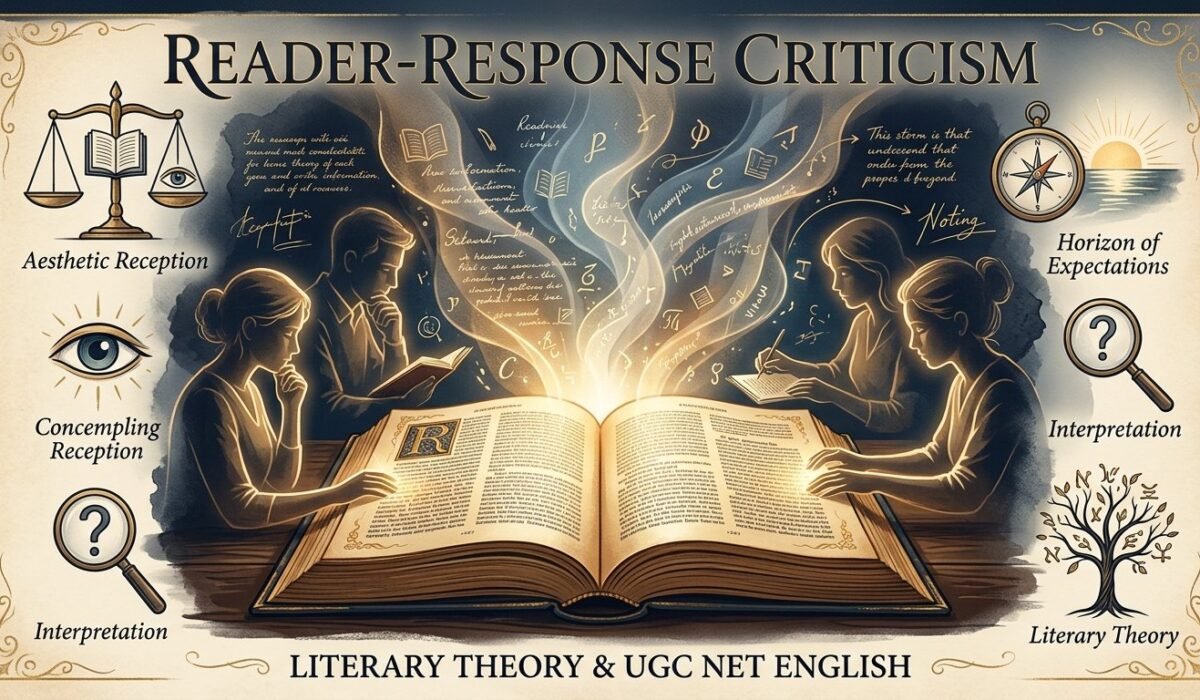
Reader-Response Criticism is a school of literary theory that asserts the meaning of a text is not an inherent, static property residing solely on the printed page, but an active event created through the transaction between the reader’s consciousness and the textual structure. Originating as a direct challenge to the formalist isolation of New Criticism, Reader-Response argues that literature exists only when it is read, experienced, and actualized in time.
For candidates preparing for UGC NET English (Unit VIII: Literary Criticism and Unit IX: Literary Theory), SET, and Assistant Professor exams, Reader-Response has become a high-weightage domain. Recent NTA test patterns have shifted from superficial author-matching into granular theoretical distinctions: the phenomenological gaps (Leerstellen) of Wolfgang Iser, the evolution of Stanley Fish from affective stylistics to interpretive communities, the historical horizon of expectations formulated by Hans Robert Jauss, and the pedagogical transactional theory of Louise Rosenblatt.
📌 Key Takeaways for UGC NET English Aspirants
- Core Definition: Meaning is not extracted from an autotelic text; it is produced dynamically during the temporal reading process.
- Louise Rosenblatt (1938, 1978): Formulated Transactional Theory, distinguishing efferent reading (reading to carry away information) from aesthetic reading (living through the immediate experience).
- Wolfgang Iser (1974, 1978): Advanced Phenomenological Criticism (Constance School), introducing the implied reader (textual pre-structuring), blanks/gaps (Leerstellen), and the wandering viewpoint.
- Hans Robert Jauss (1967, 1982): Established Reception Aesthetics (Rezeptionsästhetik), evaluating how texts encounter the historical horizon of expectations (Erwartungshorizont) and create aesthetic distance.
- Stanley Fish (1967, 1980): Pioneered micro-temporal affective stylistics in Milton’s poetry before establishing that interpretive communities govern both text and reader.
- Norman Holland & David Bleich: Explored psychoanalytic reader-response (Holland’s DEFT identity theme model) and subjective criticism (Bleich’s response statements).
- Gerald Prince & Jonathan Culler: Distinguished the fictional narratee inside the diegetic frame from the external reader, and formulated literary competence as the internalized grammar of reading.
1. Historical Origins: Dismantling the New Critical Monolith
To grasp Reader-Response Criticism, candidates must understand the intellectual orthodoxies it sought to overturn. Between 1930 and 1965, Anglo-American literary scholarship was dominated by New Criticism, spearheaded by figures such as Cleanth Brooks, John Crowe Ransom, W.K. Wimsatt, and Monroe Beardsley.
New Criticism held that a poem or novel is an autotelic text—a freestanding, autonomous verbal icon possessing objective meaning independent of any outside context. To safeguard this textual purity, Wimsatt and Beardsley erected two foundational theoretical barriers:
- The Intentional Fallacy (1946): The assertion that an author’s personal intentions, historical background, or psychological state are irrelevant and inadmissible when assessing the meaning of a literary work.
- The Affective Fallacy (1949): The claim that evaluating a work based on its emotional, psychological, or subjective effect upon the reader is a critical error, confusing what a poem is with what it does. (Explore our detailed notes on the Intentional Fallacy and Affective Fallacy).
By banishing both author and reader, New Criticism reduced literary study to technical close reading of linguistic paradox, irony, and tension. However, in the late 1960s, influenced by continental phenomenology (Edmund Husserl and Roman Ingarden), hermeneutics (Hans-Georg Gadamer), and Roland Barthes’ famous proclamation of the Death of the Author (“the birth of the reader must be ransomed by the death of the Author”), theorists argued that print on paper remains inert physical matter until activated by a human consciousness.
2. Major Theorists and Foundational Concepts
A. Louise Rosenblatt: Transactional Theory & Reading Stances
Louise Rosenblatt was an early American pioneer whose work predated the European reception movement. In Literature as Exploration (1938) and The Reader, the Text, the Poem: The Transactional Theory of the Literary Work (1978), she established that reading is neither reader-dominated nor text-dominated, but a reciprocal transaction (a term borrowed from philosopher John Dewey).
Rosenblatt’s most heavily tested concept is her distinction between two reading stances along a continuous spectrum:
| Dimension | Efferent Reading | Aesthetic Reading |
|---|---|---|
| Etymology | From Latin efferre (“to carry away”). | From Greek aisthesis (“sense perception”). |
| Primary Objective | Extracting practical facts, data, directives, or conclusions to retain after reading. | Experiencing the lived-through cognitive and emotional event during reading. |
| Attention Focus | Abstracted concepts, referents, and actionable information. | Rhythm, imagery, sound patterns, sensations, and emotional associations. |
| Classic Exam Example | Reading a train timetable, legal brief, or medical diagnosis. | Reading John Keats’s odes or William Shakespeare’s sonnets. |
B. Wolfgang Iser: Phenomenological Aesthetics & The Act of Reading
Wolfgang Iser, co-founder of the Constance School in Germany, anchored reader-response in Roman Ingarden’s phenomenology. In The Implied Reader (1974) and The Act of Reading: A Theory of Aesthetic Response (1978), Iser argued that a literary text is fundamentally incomplete without the reader’s active contribution.
Iser divided the literary work into two operational poles:
- The Artistic Pole: The actual text provided by the author.
- The Aesthetic Pole: The realization or concretization (Konkretisation) accomplished by the reader. The literary work itself sits in the virtual convergence between these two poles.
Key Iserian terms frequently appearing in NTA UGC NET questions include:
- The Implied Reader (Der implizite Leser): A textual structure that incorporates both the pre-structuring of potential meanings and the reader’s anticipated role in actualizing them. It is an internal textual property, not an actual person.
- Gaps and Blanks (Leerstellen): Unformulated spaces between textual perspectives where the narrative withholds full disclosure. Blanks create indeterminacy, compelling the reader to build bridges, generate hypotheses, and actively co-create meaning.
- The Wandering Viewpoint: The mobile perspective of the reader traveling through the chronological unfolding of the text. As reading proceeds, past recollections are continually modified by new sentences, generating a dynamic dialectic of expectation and retrospective revision.
C. Hans Robert Jauss: Reception Aesthetics & The Horizon of Expectations
While Iser examined the individual reader’s cognitive engagement, his colleague Hans Robert Jauss developed a historical and social approach known as Reception Aesthetics (Rezeptionsästhetik) (documented in detail by Encyclopædia Britannica’s study of Reception Theory). Presented in his 1967 inaugural address, “Literary History as a Challenge to Literary Theory” (in Toward an Aesthetic of Reception, 1982), Jauss argued that literary history must not be a mere chronological catalog of authors and texts, but the history of their historical reception by successive audiences.
- Horizon of Expectations (Erwartungshorizont): The shared system of criteria, genre standards, literary conventions, and moral assumptions that a given historical audience brings to a text.
- Aesthetic Distance: The gap between a text and its contemporary horizon of expectations. Conventional popular literature conforms comfortably to the prevailing horizon, offering instant gratification with zero aesthetic distance. In contrast, genuinely innovative masterpieces (such as Gustave Flaubert’s Madame Bovary in 1857 or James Joyce’s Ulysses in 1922) violate and shatter existing horizons, provoking initial public shock until the cultural horizon expands to appreciate them.
D. Stanley Fish: From Affective Stylistics to Interpretive Communities
American theorist Stanley Fish mounted the most direct frontal assault on Wimsatt and Beardsley’s condemnation of the affective fallacy. His intellectual trajectory represents two distinct phases:
Phase 1: Affective Stylistics (Temporal Syntax Analysis)
In Surprised by Sin: The Reader in Paradise Lost (1967) and “Literature in the Reader: Affective Stylistics” (1970), Fish argued that meaning is not an object embedded in a sentence, but an event that happens to the reader over time. Analyzing John Milton’s poetic syntax word-by-word, Fish illustrated how Milton intentionally entices the reader into admiring Satan’s eloquence, only to introduce subsequent grammatical clauses that expose that admiration as a manifestation of the reader’s own fallen, sinful human state.
Phase 2: Interpretive Communities (Social Pragmatism)
To refute critics who argued that affective stylistics leads to absolute solipsism, Fish published Is There a Text in This Class? The Authority of Interpretive Communities (1980). Here, Fish proposed that reading is neither purely objective nor purely subjective:
- Interpretive Communities: Groups of readers who share internalized reading habits, institutional interpretive strategies, and cultural frameworks.
- Texts do not contain intrinsic meaning that forces an interpretation; rather, the interpretive strategies of the community determine what counts as textual evidence. A New Critical community reads for irony; a feminist community reads for patriarchal power; a deconstructive community reads for aporia and textual fissures.
E. Psychological, Subjective & Structuralist Perspectives
Four additional theorists frequently appear in UGC NET matching pairs and theoretical grouping questions:
- Norman Holland (Psychoanalytic Reader-Response): In 5 Readers Reading (1975), Holland applied psychoanalysis to show that every reader possesses an invariant identity theme. Readers recreate texts in their own image using the DEFT mechanism: Defense (protecting ego boundaries), Expectation, Fantasy, and Transformation (sublimating unconscious fantasies into conscious intellectual appreciation).
- David Bleich (Subjective Criticism): In Subjective Criticism (1978), Bleich argued that objective textual truth is an illusion. He introduced classroom response statements, separating initial subjective response from subsequent communal negotiations of meaning.
- Jonathan Culler (Structuralist Poetics & Literary Competence): In Structuralist Poetics (1975), Culler adapted Noam Chomsky’s linguistic competence to formulate literary competence—the internalized grammar of conventions, genres, and motifs that enables trained readers to make sense of literary works.
- Gerald Prince (The Narratee): In “Introduction à l’étude du narrataire” (1973), Prince isolated the narratee—the fictional agent inside the narrative world whom the narrator addresses (such as Pip addressing the reader in Great Expectations). Prince introduced the zero-degree narratee as a theoretical baseline possessing linguistic mastery but devoid of personal background or moral prejudices.
3. Applied Literary Example: How Reader-Response Reads a Poem
To appreciate how Reader-Response operates in practice—and to answer exam questions exploring applied literary criticism—consider how different critical schools analyze Robert Frost’s celebrated poem “The Road Not Taken”:
| Critical School | Methodology | Interpretive Conclusion |
|---|---|---|
| New Criticism | Close verbal reading of paradox, meter, rhyme, and verbal tension in the text. | The poem resolves into an ironic tension: while the speaker claims taking the less traveled road made “all the difference,” earlier lines admitted the two roads were worn “really about the same.” |
| Iserian Phenomenology | Mapping the reader’s wandering viewpoint across the textual blanks (Leerstellen). | The reader must actively concretize what “all the difference” means because Frost deliberately withholds whether the outcome was positive, tragic, or indifferent. The gap forces the reader to supply their own life trajectory. |
| Stanley Fish’s Affective Stylistics | Tracking the reader’s temporal, linear adjustment from stanza to stanza. | The opening stanzas tempt the reader into romantic individualism (“two roads diverged”), only for subsequent lines to subvert that confidence (“as for that the passing there / Had worn them really about the same”), confronting the reader with their own self-deceptive romantic impulses. |
| Fish’s Interpretive Communities | Analyzing how institutional conventions construct the poem’s meaning. | An American high school graduation community interprets the poem as a celebration of nonconformity; an academic modernist community interprets the same poem as an epistemological critique of retrospective myth-making. |
4. The Reader Discrimination Matrix: Distinguishing the Six Types of Readers
A frequent exam pitfall is confusing different theoretical categories of the “reader.” The following table clarifies their exact ontological status:
| Reader Category | Pioneering Theorist | Core Examination Definition | Ontological Status |
|---|---|---|---|
| Real / Actual Reader | Empirical Reception Studies | The historical, flesh-and-blood individual holding the physical book; subject to personal moods and cultural biases. | Extra-textual (Real world) |
| Implied Reader | Wolfgang Iser | A textual structure anticipating and guiding the reader’s cognitive role through gaps and indeterminacy. | Intra-textual construct |
| Narratee | Gerald Prince | The explicit or implicit character inside the story addressed directly by the narrator. | Diegetic / Fictional agent |
| Informed Reader | Stanley Fish | A mature, linguistically competent reader with deep institutional knowledge of literary conventions. | Idealized methodological model |
| Super-Reader (Archilecteur) | Michael Riffaterre | A composite reader compiled from the collective consensus of multiple readers, annotations, and critical commentaries. | Aggregated critical construct |
| Resisting Reader | Judith Fetterley | A feminist reader who critically interrogates and refuses to identify with male-centric, patriarchal ideology encoded in texts. | Critical / Political stance |
5. Chronological Publication Timeline of Landmark Treatises
Chronology questions are a regular feature of UGC NET Paper II. Candidates should commit this chronological progression to memory:
| Year | Theorist | Landmark Treatise | Primary Theoretical Innovation |
|---|---|---|---|
| 1938 | Louise Rosenblatt | Literature as Exploration | Initial formulation of reader-text transactional pedagogy. |
| 1967 | Stanley Fish | Surprised by Sin: The Reader in Paradise Lost | Demonstrated temporal affective stylistics through Milton’s poetic syntax. |
| 1967 | Hans Robert Jauss | “Literary History as a Challenge to Literary Theory” | Inaugural Constance lecture establishing reception aesthetics and horizons of expectations. |
| 1972 | Wolfgang Iser | Der implizite Leser (English translation: 1974) | Coined and developed the concept of the implied reader through novelistic history. |
| 1973 | Gerald Prince | “Introduction à l’étude du narrataire” | Systematic narratological classification of the narratee and the zero-degree narratee. |
| 1975 | Jonathan Culler | Structuralist Poetics | Introduced literary competence by analogy to Chomskyan generative linguistics. |
| 1975 | Norman Holland | 5 Readers Reading | Psychoanalytic case studies demonstrating the DEFT identity theme model. |
| 1976 | Wolfgang Iser | Der Akt des Lesens (English translation: 1978: The Act of Reading) | Comprehensive phenomenological theory of blanks, indeterminacy, and reader concretization. |
| 1978 | Louise Rosenblatt | The Reader, the Text, the Poem | Detailed philosophical formulation of efferent vs aesthetic reading stances. |
| 1978 | David Bleich | Subjective Criticism | Pedagogy of subjective response statements and collective knowledge creation. |
| 1978 | Judith Fetterley | The Resisting Reader: A Feminist Approach to American Fiction | Feminist critique of female reader identification with patriarchal male characters. |
| 1980 | Stanley Fish | Is There a Text in This Class? The Authority of Interpretive Communities | Established that interpretive communities govern textual interpretation. |
| 1982 | Hans Robert Jauss | Toward an Aesthetic of Reception | Full English synthesis of reception aesthetics and aesthetic distance. |
6. Critical Exam Traps & Common Disambiguations
To avoid losing negative marks in UGC NET Paper II, keep these recurring traps in mind:
- Trap 1: Implied Reader vs. Implied Author. Wolfgang Iser created the Implied Reader (the textual structure guiding the audience). In contrast, Wayne C. Booth created the Implied Author in The Rhetoric of Fiction (1961) to designate the author’s “second self” created by the text.
- Trap 2: Narratee vs. Implied Reader. The narratee (Gerald Prince) is located inside the narrative frame (e.g., Marlow’s listeners aboard the *Nellie* in Joseph Conrad’s *Heart of Darkness*). The implied reader is an overarching textual structure operating at the broader communicative horizon of the entire book.
- Trap 3: Interpretive Communities Attribution. Do not attribute “interpretive communities” to the German reception theorists (Iser or Jauss). It belongs exclusively to American pragmatist Stanley Fish.
- Trap 4: Rosenblatt’s Stances are Not Rigid Binaries. Rosenblatt explicitly warned that efferent and aesthetic reading are opposite poles of a continuum. Readers continually shift stances depending on their purpose.
- Trap 5: Reception Aesthetics vs. Sociology of Literature. Jauss’s reception aesthetics is a philosophical and historical theory of literary value, not an empirical compilation of sales figures or library borrowing statistics.
7. High-Yield Practice Questions (UGC NET Pattern)
Test your mastery with these 10 representative, exam-calibrated questions:
Q1. Who among the following coined the term “interpretive communities” to argue that reading practices are culturally and institutionally governed?
(A) Wolfgang Iser
(B) Stanley Fish
(C) Hans Robert Jauss
(D) Norman Holland
Answer: (B) Stanley Fish. In Is There a Text in This Class? (1980), Fish argued that interpretive strategies shared by communities produce both the properties of texts and the shapes of readers’ minds.
Q2. In Wolfgang Iser’s phenomenological theory, what role do “blanks” or “gaps” (Leerstellen) play?
(A) They indicate structural defects in the narrative.
(B) They invite the reader to consult external authorial biographies.
(C) They trigger the reader’s active cognitive participation through imaginative concretization.
(D) They prevent future generations from reinterpreting the text.
Answer: (C). Iser argues that blanks and gaps are essential communicative catalysts that prompt the reader to connect disparate textual perspectives and actualize meaning.
Q3. Arrange the following landmark texts in chronological order of their original publication:
(i) Stanley Fish, Is There a Text in This Class?
(ii) Louise Rosenblatt, Literature as Exploration
(iii) Wolfgang Iser, The Act of Reading
(iv) Norman Holland, 5 Readers Reading
(A) (ii), (iv), (iii), (i)
(B) (ii), (iii), (iv), (i)
(C) (iv), (ii), (i), (iii)
(D) (ii), (i), (iv), (iii)
Answer: (A). Chronological order: Rosenblatt’s Literature as Exploration (1938) → Holland’s 5 Readers Reading (1975) → Iser’s The Act of Reading (1976/English 1978) → Fish’s Is There a Text in This Class? (1980).
Q4. Hans Robert Jauss defines “aesthetic distance” as:
(A) The physical separation between audience and actors in Bertolt Brecht’s Epic Theatre.
(B) The difference between the prevailing horizon of expectations and the appearance of a new literary work.
(C) The psychological detachment necessary for unbiased critical evaluation.
(D) The historical time elapsed between an author’s death and a work’s canonization.
Answer: (B). Aesthetic distance measures how far a groundbreaking new work challenges or shatters the prevailing horizon of expectations of its contemporary public.
Q5. The distinction between “efferent reading” and “aesthetic reading” was formulated by:
(A) David Bleich
(B) Jonathan Culler
(C) Louise Rosenblatt
(D) Judith Fetterley
Answer: (C) Louise Rosenblatt. In The Reader, the Text, the Poem (1978), Rosenblatt distinguished reading focused on carrying away information (efferent) from reading focused on living through the immediate aesthetic experience (aesthetic).
Q6. The concept of the “narratee” as the distinct entity addressed by the narrator within the narrative text was developed by:
(A) Gerald Prince
(B) Gérard Genette
(C) Wayne C. Booth
(D) Tzvetan Todorov
Answer: (A) Gerald Prince. In “Introduction à l’étude du narrataire” (1973), Prince established the typology of the narratee, isolating it from real and implied readers.
Q7. Jonathan Culler’s concept of “literary competence” is explicitly modeled on the linguistic theories of:
(A) Ferdinand de Saussure
(B) Noam Chomsky
(C) Roman Jakobson
(D) Edward Sapir
Answer: (B) Noam Chomsky. In Structuralist Poetics (1975), Culler adapted Chomsky’s grammatical competence into literary competence—the internalized system of rules that readers use to interpret literature.
Q8. In Norman Holland’s psychoanalytic model, what does the acronym DEFT stand for?
(A) Desire, Emotion, Form, Transcendence
(B) Defense, Expectation, Fantasy, Transformation
(C) Denial, Ego, Fiction, Transference
(D) Discourse, Enunciation, Figure, Textuality
Answer: (B). Holland’s DEFT model explains how readers process literature through their defense mechanisms, expectations, unconscious fantasies, and cultural transformations.
Q9. Match List I (Theorist) with List II (Key Concept):
List I: (a) Hans Robert Jauss, (b) Wolfgang Iser, (c) Michael Riffaterre, (d) Judith Fetterley
List II: (1) The Resisting Reader, (2) Horizon of Expectations, (3) The Implied Reader, (4) The Super-Reader
(A) (a)-2, (b)-3, (c)-4, (d)-1
(B) (a)-3, (b)-2, (c)-1, (d)-4
(C) (a)-2, (b)-4, (c)-3, (d)-1
(D) (a)-1, (b)-3, (c)-4, (d)-2
Answer: (A). Jauss → Horizon of Expectations; Iser → The Implied Reader; Riffaterre → The Super-Reader; Fetterley → The Resisting Reader.
Q10. Stanley Fish’s method of “affective stylistics” in his study of John Milton’s Paradise Lost directly challenged which New Critical doctrine?
(A) The Intentional Fallacy
(B) The Affective Fallacy
(C) The Heresy of Paraphrase
(D) The Autotelic Nature of Art
Answer: (B) The Affective Fallacy. Wimsatt and Beardsley condemned judging poetry by its emotional impact on readers. Fish inverted this by arguing that tracing the reader’s temporal psychological responses is where poetic meaning actually takes place.
8. Frequently Asked Questions (FAQ)
Q: What is the main premise of Reader-Response Criticism?
A: The main premise is that a literary work does not have a single, fixed, objective meaning residing solely in the text. Instead, meaning is an active process produced through the interaction or transaction between the text and the reader’s consciousness.
Q: How does Wolfgang Iser’s “Implied Reader” differ from an actual reader?
A: The implied reader is not a flesh-and-blood individual. It is a textual structure pre-programmed by the author that anticipates a certain role and guides the reading process through gaps and indeterminacies.
Q: What is Hans Robert Jauss’s “Horizon of Expectations”?
A: It is the collective system of literary conventions, cultural beliefs, genre assumptions, and moral norms that a specific historical audience brings to a text when reading it during a particular historical period.
Q: What are Stanley Fish’s “Interpretive Communities”?
A: Interpretive communities are groups of readers who share common institutional reading strategies and cultural conventions. These shared strategies produce both the properties of texts and the reader’s interpretation.
Q: What is the difference between efferent and aesthetic reading in Louise Rosenblatt’s theory?
A: Efferent reading focuses on carrying away information, data, or directions after the reading is completed (like reading a recipe or news article). Aesthetic reading focuses on experiencing the sensory, emotional, and cognitive event while reading (like reading a poem or novel).
For more foundational overviews, explore our Complete Guide to Literary Theory and Criticism and our dedicated analysis of Mikhail Bakhtin for UGC NET English.