Introduction
John Milton’s Paradise Lost is one of the greatest epics in English literature. The opening 124 lines of Book 1, which are included in the RPSC First Grade English syllabus, introduce the poem’s main ideas, tone, and purpose. Milton begins with “Of Man’s first disobedience, and the fruit…”—a direct reference to Adam and Eve’s fall.
These lines show Milton’s aim “to justify the ways of God to men” and introduce Satan’s rebellion and fall. This blog post gives a clear analysis of lines 1–124, focusing on what RPSC candidates must understand for their exam.
Table of Contents
Historical Context of Paradise Lost
The Time and the Poet
Milton wrote Paradise Lost after the English Civil War. Blind and disillusioned by political defeat, he turned to divine themes. His goal was to write an epic equal to those of Homer and Virgil but centered on Christian truth.
Purpose of the Poem
Milton states his purpose in lines 22–26:
“That to the height of this great Argument / I may assert Eternal Providence, / And justify the ways of God to men.”
He wanted to explain why humans fell and how divine justice still governs the world.
Literary Form
Milton used blank verse—unrhymed iambic pentameter—to achieve a grand yet flexible rhythm. His diction and biblical references make his poetry both spiritual and majestic.
Summary of Lines 1–124 (Prescribed for RPSC Exam)
The portion covered in the RPSC syllabus includes three main sections:
1. Invocation to the Heavenly Muse (Lines 1–26)
Milton opens by telling of “Man’s first disobedience.” The forbidden fruit brought sin and death into the world. The poet calls on the Heavenly Muse, the Holy Spirit who inspired Moses, to help him write about divine mysteries.
“Sing Heav’nly Muse, that on the secret top / Of Oreb, or of Sinai, didst inspire / That Shepherd…”
He prays for enlightenment:
“What in me is dark illumine, what is low raise and support.”
This prayer shows Milton’s humility and dependence on divine wisdom.
2. The Argument of the Poem (Lines 27–49)
Milton declares his subject: the fall of man and the restoration through Christ. He wants to go beyond all previous poetry (“Things unattempted yet in prose or rhyme”). The poet asks the divine spirit to help him speak truth that will teach readers to understand God’s justice.
3. The Fall of Satan and His Condition in Hell (Lines 50–124)
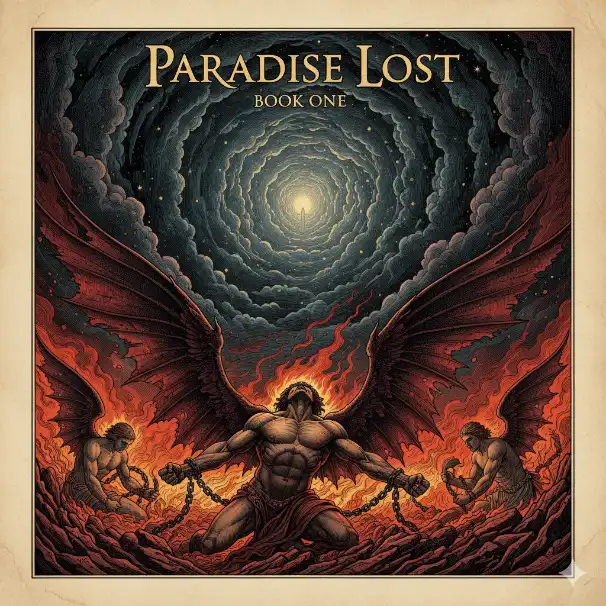
These lines describe how Satan and his followers were cast out of Heaven after rebelling. The Almighty hurled them “headlong flaming from th’ ethereal sky.” Satan lies vanquished in Hell, chained in “adamantine chains and penal fire.”
Milton’s image of Hell is unforgettable:
“A dungeon horrible, on all sides round / As one great furnace flam’d, yet from those flames / No light, but rather darkness visible.”
This paradox—darkness that can be seen—shows the pain and despair of Hell.
Satan awakens, surveys the fiery wasteland, and speaks to Beelzebub, his second-in-command. His first words reveal both loss and pride:
“If thou beest he; but O how fall’n! how chang’d / From him, who in the happy realms of light…”
Though defeated, Satan refuses to surrender:
“All is not lost; the unconquerable will, / And study of revenge, immortal hate…”
These lines show his determination to continue the fight against God. He prefers ruling in Hell to serving in Heaven. This defiant spirit defines his character.
Key Themes in Lines 1–124
1. Disobedience and Punishment
Milton presents disobedience as the root of suffering. Both Adam’s fall and Satan’s rebellion stem from pride.
2. Divine Justice and Providence
Even in tragedy, Milton shows that God’s justice prevails. Suffering exists for a higher reason.
3. Pride and Ambition
Satan’s pride is his downfall. His desire for equality with God leads him to ruin. Yet, his courage and resilience make him fascinating.
4. Good vs Evil
Heaven and Hell represent opposing forces—obedience and defiance. Milton invites readers to reflect on moral choices.
Literary Features
1. Epic Convention
Milton follows the epic tradition: invocation, statement of theme, and beginning in medias res (in the middle of the action).
2. Epic Simile
He compares Satan’s size to that of a giant sea creature, giving grandeur to the fallen angel.
3. Imagery and Symbolism
The contrast between light and darkness symbolizes good and evil, faith and despair.
4. Tone and Style
Milton’s tone shifts from devotional (in the invocation) to tragic and heroic (in Satan’s fall). His style blends spirituality and drama.
Character Sketch: Satan (Lines 84–124)
Satan stands out as a proud, intelligent, and defiant being. He refuses to yield to God, saying:
“To bow and sue for grace with suppliant knee… that were an ignominy and shame beneath this downfall.”
His traits include:
- Ambition and pride
- Leadership and eloquence
- Unyielding defiance
- Tragic grandeur
Though Milton condemns Satan, he portrays him with power and dignity. This complexity makes Satan one of literature’s most memorable figures.
Comparison Table: Heaven vs Hell
| Aspect | Heaven | Hell |
|---|---|---|
| Light | Divine radiance | Darkness visible |
| Emotion | Peace, love | Hatred, despair |
| Power | God’s authority | Satan’s false rule |
| Symbolism | Obedience | Rebellion |
| Tone | Order and grace | Chaos and punishment |
Relevance for RPSC First Grade English Students
For RPSC aspirants, Paradise Lost Book 1 (lines 1–124) is important for questions on themes, imagery, characters, and Milton’s purpose. Questions often ask about the invocation, depiction of Hell, or Satan’s speech.
Understanding the tone and meaning of these lines helps you answer both objective and descriptive exam questions.
You can also refer to Litgram.in’s Julius Caesar Act 2 Scene 1 Notes for similar detailed analysis of exam texts. For more background, visit Poetry Foundation’s Milton page.
Key Takeaways
- The RPSC syllabus includes lines 1–124 from Book 1 of Paradise Lost.
- The poem opens with Milton’s invocation and statement of purpose.
- Satan’s rebellion and punishment form the central event.
- Key ideas: pride, free will, justice, and moral order.
- Satan’s speech reveals his defiant yet doomed spirit.
FAQ
1. What lines of Paradise Lost are in the RPSC syllabus?
Lines 1–124 from Book 1 are included, covering the invocation, fall of Satan, and his first speech.
2. What is Milton’s purpose in these lines?
To explain human disobedience and divine justice—“to justify the ways of God to men.”
3. How is Hell described in these lines?
As a dark, fiery, and sorrowful place filled with eternal torment.
4. What is Satan’s reaction to his fall?
He feels pain but remains proud. He refuses to repent and chooses to fight back.
5. Why is this section important for RPSC students?
Because it includes the poem’s key ideas, imagery, and introduction of Satan—all central to exam questions.
Conclusion
Lines 1–124 of Paradise Lost set the stage for Milton’s entire epic. They introduce the fall of man, the rebellion of Satan, and the eternal conflict between good and evil. For RPSC First Grade English students, this passage is vital for understanding Milton’s vision and exam-related analysis.
By studying these lines closely, you not only prepare for the exam but also appreciate the grandeur and depth of one of English literature’s greatest poems.