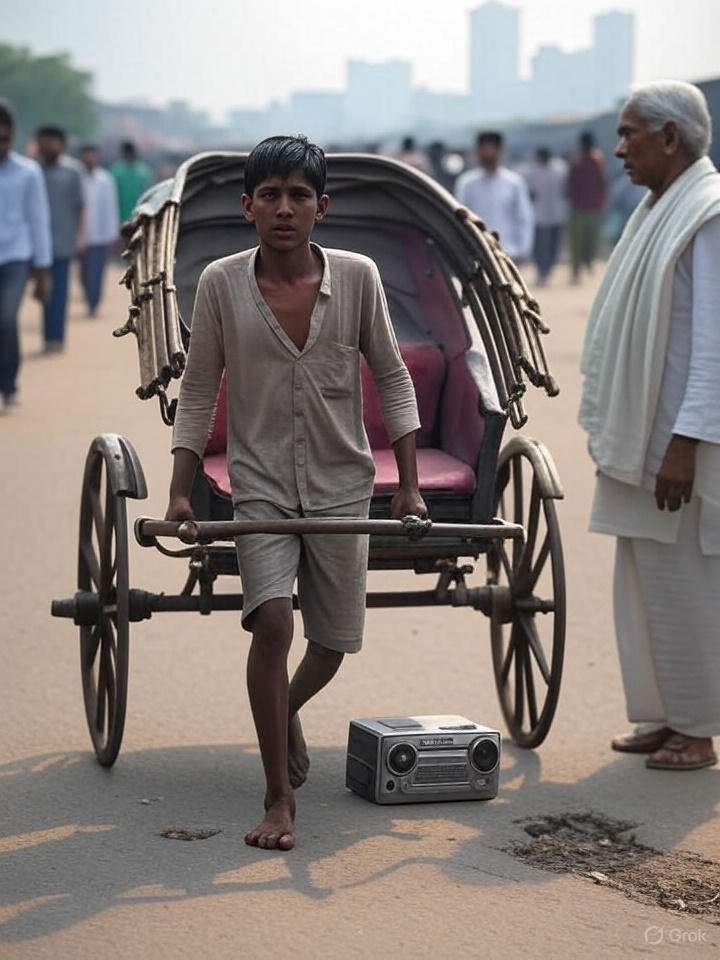
“The Free Radio” by Salman Rushdie stands as one of the most compelling short stories in his acclaimed collection “East, West.” This haunting narrative explores themes of exploitation, false promises, and the vulnerability of the marginalized through the story of Ramani, a young rickshaw driver who becomes the victim of a government sterilization program disguised as a generous offer.
The story showcases Rushdie’s masterful ability to blend social commentary with deeply personal human drama. Through its deceptively simple plot, “The Free Radio” reveals the complex power dynamics that exist between government institutions and ordinary citizens. For students of English literature, this story offers rich material for analyzing narrative technique, characterization, and the use of symbolism in postcolonial fiction.
Table of Contents
Historical Context and Political Background
India’s Family Planning Program
“The Free Radio” is set against the backdrop of India’s controversial family planning initiatives of the 1970s. During the Emergency period (1975-1977) under Prime Minister Indira Gandhi, the government implemented aggressive sterilization programs targeting the poor and marginalized communities.
The historical context includes:
- Forced sterilization campaigns targeting low-income populations
- Government incentives offered to encourage participation
- Widespread abuse of power by local officials
- Disproportionate impact on vulnerable communities
Emergency Period in India
The story reflects the authoritarian atmosphere of the Emergency period, when civil liberties were suspended and government programs were implemented with little regard for individual rights.
Key features of this period include:
- Suspension of democratic processes
- Censorship of press and media
- Arbitrary arrest and detention powers
- Coercive government programs
Social Hierarchy and Exploitation
Rushdie’s story illuminates the complex social hierarchies that enable exploitation of the powerless. The narrative reveals how education, economic status, and social connections determine one’s vulnerability to manipulation.
Social factors explored include:
- Literacy as protection against deception
- Economic desperation as vulnerability
- Authority figures exploiting trust
- Community complicity in individual suffering
Character Analysis and Development
Ramani: The Tragic Protagonist
Ramani serves as the central character whose journey from hope to despair drives the narrative. His characterization reveals the vulnerability of those who exist on society’s margins.
Ramani’s key characteristics include:
- Childlike innocence and trust in authority
- Dreams of upward mobility through material possessions
- Lack of education making him vulnerable to manipulation
- Desire for acceptance and belonging
The Narrator: Observer and Commentator
The story is told through the perspective of an educated narrator who observes Ramani’s situation with a mixture of sympathy and helplessness. This narrative choice creates distance while maintaining emotional engagement.
The narrator’s role includes:
- Providing social commentary on events
- Representing the educated middle class
- Serving as witness to injustice
- Maintaining objectivity while showing concern
Supporting Characters as Social Representatives
The supporting characters in the story represent different aspects of Indian society and their varying responses to the government program.
Character types include:
- Government officials as manipulative authority figures
- Community members as passive observers
- Family members as additional victims
- Local elites as beneficiaries of the system
Major Themes and Literary Analysis
Exploitation and False Promises
The central theme of “The Free Radio” revolves around the exploitation of vulnerable individuals through false promises and deceptive incentives. The radio itself becomes a symbol of the gap between promise and reality.
The exploitation manifests through:
- Misleading information about the sterilization procedure
- Targeting of economically desperate individuals
- Use of material incentives to mask coercion
- Abandonment of victims after achieving government objectives
Dreams and Disillusionment
Rushdie explores how dreams of material improvement can be manipulated to achieve political objectives. Ramani’s desire for the radio represents broader aspirations for a better life.
The theme develops through:
- Initial excitement about receiving the radio
- Gradual realization of the true cost
- Physical and emotional consequences of the procedure
- Final understanding of the deception involved
Power Dynamics and Social Control
The story examines how power operates in society, particularly how those with education and resources exploit those without. The government program serves as a mechanism of social control.
Power dynamics include:
- Information asymmetry between officials and citizens
- Economic coercion through incentive programs
- Medical authority used to legitimize harmful procedures
- Social pressure to participate in government initiatives
Language and Communication
Rushdie explores how language can be used as a tool of manipulation. The gap between official language and lived reality becomes a central concern.
Language themes include:
- Euphemistic language disguising harsh realities
- Literacy as protection against manipulation
- Oral traditions versus written documentation
- Translation of complex concepts into simple terms
Literary Techniques and Narrative Style
Narrative Voice and Perspective
Rushdie employs a first-person narrator who maintains distance from the events while providing intimate access to the community’s dynamics. This narrative strategy creates tension between involvement and detachment.
Narrative techniques include:
- Eyewitness account lending authenticity
- Retrospective narration allowing for reflection
- Limited omniscience creating uncertainty
- Cultural insider perspective providing credibility
Symbolism and Metaphor
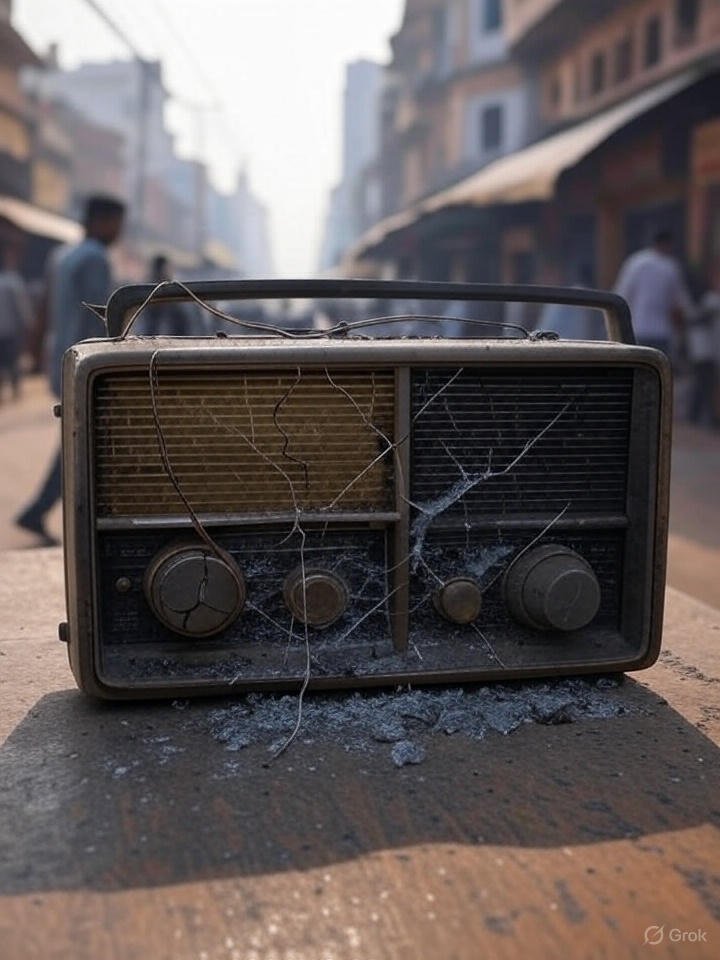
The story is rich with symbolic content, particularly the radio itself, which represents multiple layers of meaning throughout the narrative.
Key symbols include:
- The radio as false promise and manipulation
- The sterilization as violation of human dignity
- The government program as broader social control
- The community’s silence as complicity
Irony and Dark Humor
Rushdie employs irony to highlight the absurdity and cruelty of the situation. The story’s dark humor serves to emphasize the tragic nature of Ramani’s experience.
Ironic elements include:
- The “free” radio that costs everything
- Government care that destroys lives
- Progress programs that harm the vulnerable
- Educational initiatives that deceive the uneducated
Realistic Detail and Social Documentation
The story functions as both literary art and social documentation, providing detailed observations of life in a particular time and place.
Realistic elements include:
- Accurate portrayal of government programs
- Authentic dialogue and character interactions
- Detailed description of social conditions
- Historical accuracy in depicting the Emergency period
Contemporary Relevance and Modern Connections
Global Health Policy and Informed Consent
The themes explored in “The Free Radio” remain relevant to contemporary discussions about medical ethics, informed consent, and the targeting of vulnerable populations in health programs.
Modern parallels include:
- Pharmaceutical trials in developing countries
- Reproductive health programs targeting the poor
- Medical tourism and exploitation
- Vaccine hesitancy and trust in authority
Government Propaganda and Misinformation
The story’s exploration of how governments use incentives and misleading information to achieve policy objectives resonates with contemporary concerns about propaganda and misinformation.
Current connections include:
- Social media manipulation and fake news
- Government messaging during health crises
- Political advertising and voter manipulation
- Corporate marketing targeting vulnerable populations
Economic Inequality and Vulnerability
Rushdie’s focus on how economic desperation makes individuals vulnerable to exploitation remains highly relevant in discussions of global inequality and social justice.
Contemporary issues include:
- Predatory lending targeting the poor
- Employment exploitation of migrant workers
- Educational scams targeting disadvantaged communities
- Healthcare inequality and access issues
Similar to how contemporary Indian literature explores social issues through personal narratives, Rushdie’s story demonstrates the power of individual stories to illuminate broader social problems. For students interested in exploring how literature addresses social justice themes, resources like That Long Silence offer additional perspectives on marginalized voices in Indian fiction.
Critical Reception and Literary Impact
Academic Analysis and Interpretation
Scholars have praised “The Free Radio” for its sophisticated treatment of complex social and political themes. The story has been extensively analyzed in postcolonial literature courses and social justice studies.
Critical acclaim focuses on:
- Narrative craftsmanship and technical skill
- Effective use of symbolism and metaphor
- Authentic portrayal of social conditions
- Balance between entertainment and social commentary
Influence on Contemporary Writers
The story has influenced numerous writers who address themes of social justice and government overreach. Its techniques have been studied and adapted by authors worldwide.
Notable influences include:
- Use of specific historical events as literary material
- Combination of personal narrative with political commentary
- Exploration of power dynamics through individual stories
- Integration of social documentation with literary artistry
Educational Applications
Teachers use “The Free Radio” to explore various academic subjects, making it valuable for interdisciplinary study and critical thinking development.
Educational uses include:
- Medical ethics discussions
- Government policy analysis
- Social justice education
- Literature and human rights courses
For comprehensive analysis of postcolonial literature and its social implications, students can explore resources at Postcolonial Studies, which offers extensive materials on writers like Rushdie and their cultural contexts.
Comparative Analysis with Other Works
Rushdie’s Short Fiction vs. Novels
“The Free Radio” demonstrates Rushdie’s ability to compress complex themes into short narrative forms while maintaining the depth and richness of his longer works.
| Aspect | “The Free Radio” | “Midnight’s Children” | “The Satanic Verses” |
|---|---|---|---|
| Scope | Single incident | Historical epic | Religious controversy |
| Focus | Individual tragedy | National identity | Cultural conflict |
| Style | Realistic narrative | Magical realism | Experimental form |
| Theme | Social exploitation | Partition trauma | Religious freedom |
Comparison with Other Social Justice Literature
The story can be productively compared with other works that address government overreach and exploitation of vulnerable populations.
Comparative works include:
- George Orwell’s “1984” – government control
- Chinua Achebe’s “Things Fall Apart” – cultural destruction
- Arundhati Roy’s “The God of Small Things” – social hierarchy
- Khaled Hosseini’s “The Kite Runner” – personal and political trauma
Genre Conventions and Innovation
“The Free Radio” operates within established literary traditions while introducing innovative elements that enhance its impact and relevance.
Genre elements include:
- Social realism narrative techniques
- Postcolonial literary conventions
- Short story structural principles
- Political allegory frameworks
Reading Recommendations and Further Study
Essential Rushdie Works
Students should explore Rushdie’s complete “East, West” collection to understand how “The Free Radio” fits within his broader artistic vision.
Recommended reading sequence:
- “East, West” (1994) – complete collection
- “Midnight’s Children” (1981) – foundational novel
- “The Moor’s Last Sigh” (1995) – family saga
- “The Enchantress of Florence” (2008) – historical fiction
Complementary Social Justice Literature
Understanding “The Free Radio” benefits from familiarity with other works that explore similar themes of exploitation and resistance.
Suggested readings include:
- “The White Tiger” by Aravind Adiga
- “Behind the Beautiful Forevers” by Katherine Boo
- “Maximum City” by Suketu Mehta
- “Nine Lives” by William Dalrymple
Critical Studies and Historical Context
Academic readers should consult sources that provide historical context for the story’s setting and themes.
Important resources include:
- “The Emergency: A Personal History” by Coomi Kapoor
- “Democracy and Discontent: India’s Growing Crisis” by Atul Kohli
- “The Cambridge History of India” Volume 6
- “Salman Rushdie: A Critical Study” by M.D. Fletcher
Key Takeaways
“The Free Radio” by Salman Rushdie offers readers a powerful examination of how government programs can exploit vulnerable populations through deceptive incentives and false promises. The story demonstrates the importance of informed consent, education, and social awareness in protecting individual rights.
Essential points to remember:
- The story serves as both literature and social documentation
- Symbolism and irony enhance the narrative’s impact
- Historical context is crucial for understanding the story’s significance
- The themes remain relevant to contemporary social justice issues
- Individual stories can illuminate broader systemic problems
Understanding “The Free Radio” requires appreciating both its artistic merit and its social commentary. The story serves as an excellent example of how literature can address serious social issues while maintaining entertainment value and emotional engagement.
Frequently Asked Questions
What is the main message of “The Free Radio”?
The main message warns against the exploitation of vulnerable populations through deceptive government programs. Rushdie demonstrates how lack of education and economic desperation make individuals susceptible to manipulation by authority figures.
How does the radio function as a symbol in the story?
The radio symbolizes false promises and the gap between government claims and reality. It represents the material incentives used to disguise coercive programs and the ultimate emptiness of such promises when they come at the cost of human dignity.
What historical events inspired this story?
The story is based on India’s forced sterilization programs during the Emergency period (1975-1977). These programs targeted poor and marginalized communities, offering incentives like radios to encourage participation in government sterilization initiatives.
How does Rushdie’s narrative technique enhance the story’s impact?
Rushdie uses a first-person narrator who serves as both observer and commentator, creating distance while maintaining emotional engagement. This technique allows readers to understand the broader social implications while connecting with individual suffering.
What makes this story relevant to contemporary readers?
The themes of government manipulation, exploitation of vulnerable populations, and the importance of informed consent remain highly relevant. The story offers insights into how power operates in society and how individuals can be protected from exploitation.
Conclusion
“The Free Radio” stands as one of Salman Rushdie’s most powerful and accessible short stories, combining artistic excellence with urgent social commentary. The story demonstrates how literature can serve as both entertainment and education, helping readers understand complex social and political issues through the lens of individual human experience.
For students of English literature, this story offers valuable insights into narrative technique, thematic development, and the role of literature in addressing social justice issues. The story’s enduring relevance speaks to the universal nature of the struggles it depicts and the ongoing need for vigilance against exploitation.
The power of “The Free Radio” lies in its ability to transform a specific historical incident into a universal statement about human dignity, social responsibility, and the importance of protecting the vulnerable. As readers continue to grapple with issues of government overreach and social inequality, Rushdie’s story remains as necessary and powerful as ever.
Ready to explore more of Rushdie’s work? Start with “East, West” and discover how individual stories can illuminate the broader human experience while addressing the most pressing social issues of our time.