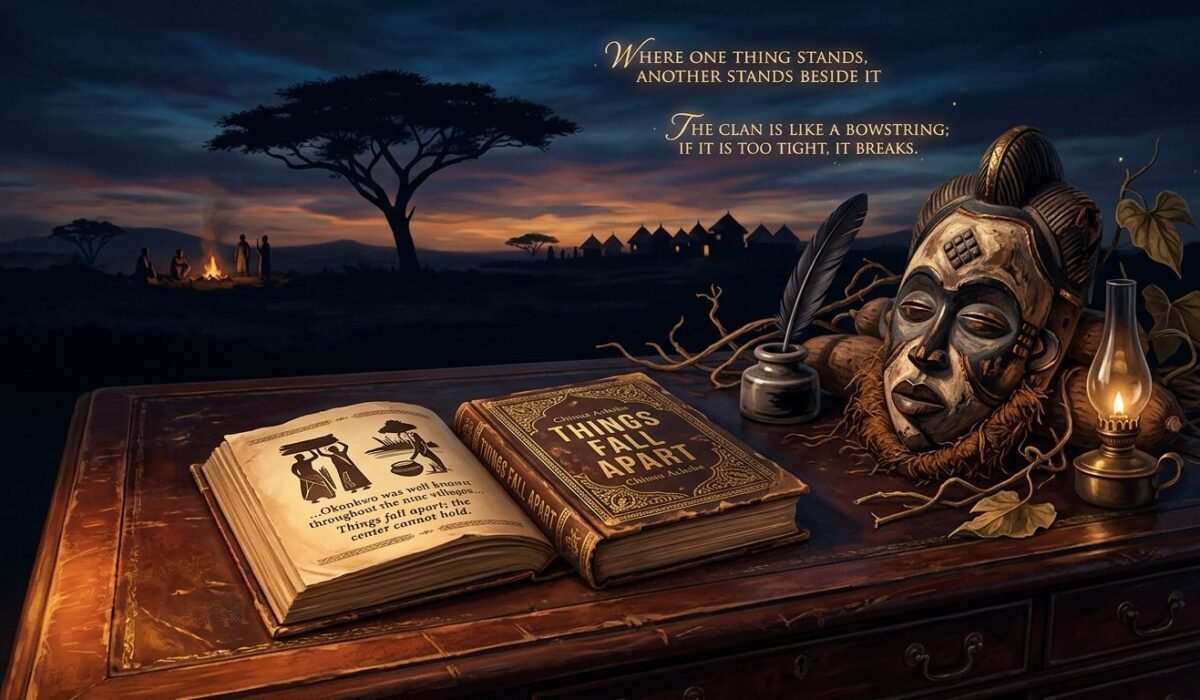
Things Fall Apart (1958) by Nigerian novelist Chinua Achebe is the founding masterpiece of modern African literature in English. Set in the late nineteenth-century pre-colonial and early-colonial Igbo community of Umuofia, the novel chronicles the meteoric rise and catastrophic downfall of Okonkwo—a fierce warrior, yam farmer, and wrestling champion whose unyielding terror of appearing weak like his improvident father ultimately blinds him to the irreversible historical transformations wrought by British colonial intrusion.
⚡ Key Takeaways at a Glance
- Publishing Landmark (1958): Published by William Heinemann Ltd. as the inaugural text (No. 1) of the celebrated African Writers Series, Things Fall Apart established African literary autonomy by narrating colonial conquest from the inside of an African society.
- The Title’s Significance: Drawn from the opening lines of W.B. Yeats’s apocalyptic modernist poem “The Second Coming” (1919), Achebe’s title inverts the European imperial gaze—showing that the collapse of civilization was experienced by colonized Africa at the hands of European expansion.
- Okonkwo’s Tragic Flaw (Hamartia): Okonkwo’s fatal flaw is not hatred of the white man, but a deep-seated, crippling fear of weakness and failure—specifically the terror of resembling his lazy, debtor, music-loving father, Unoka. This fear drives his pathological hyper-masculinity and emotional brutality.
- The Three-Part Tragic Structure: Part 1 (Chapters 1–13) establishes the organic, self-governing pre-colonial world of Umuofia; Part 2 (Chapters 14–19) depicts Okonkwo’s seven-year exile in Mbanta and the arrival of Christian missionaries; Part 3 (Chapters 20–25) charts the disintegration of clan solidarity and Okonkwo’s desolate suicide.
- Internal Cultural Fissures: The British missionaries succeed not merely through superior weaponry, but by exploiting pre-existing moral dilemmas within Igbo society—specifically the brutal abandonment of newborn twins in the Evil Forest and the severe marginalization of the osu (untouchable religious outcasts).
- Contrasting Missionary Faces: Achebe counterpoints the open-minded, dialogic approach of the first missionary, Mr. Brown (who listens to local elders and builds schools), with the rigid, fanatical zealotry of his successor, Reverend James Smith (who encourages zealots like Enoch to unmask the sacred egwugwu).
- Devastating Closing Irony: The novel concludes with the British District Commissioner reducing Okonkwo’s lifetime of heroic struggle and tragic downfall to a single, detached paragraph in his prospective racist administrative handbook, The Pacification of the Primitive Tribes of the Lower Niger.
1. Historical Context: Writing Back to the Colonial Center
Chinua Achebe wrote Things Fall Apart in 1958 as a conscious, deliberate literary counter-narrative against European colonial representations that consistently depicted Africa as an ahistorical, uncivilized void populated by savages without language or culture.
While studying English literature at University College, Ibadan, Achebe encountered European colonial fiction, most notably Joyce Cary’s 1939 novel Mister Johnson—which British critics had hailed as the definitive portrayal of Nigerian character. Cary’s novel presented an educated Nigerian clerk as a frivolous, childish buffoon who gladly accepts death at the hands of his British master. Achebe was infuriated by this patronizing caricature, declaring: “I knew that someone had to write our story from the inside.”
Similarly, Achebe later mounted a legendary critique of Joseph Conrad in his 1977 Chancellor’s Lecture, “An Image of Africa: Racism in Conrad’s ‘Heart of Darkness'”, exposing how European literature reduced Africa to a dark, sinister psychological backdrop designed to measure the European soul’s existential disintegration, depriving Africans of human speech and dignity.
“Until the lions have their own historians, the history of the hunt will always glorify the hunter.”
— Chinua Achebe, reflecting on the historical imperative of African storytelling
By situating the first two-thirds of Things Fall Apart entirely within the pre-colonial world of the 1890s, Achebe demonstrated that Igbo society had a functioning, highly sophisticated social architecture long before the arrival of white men: a decentralized, participatory democracy; a codified legal system arbitrated by ancestral masquerades (egwugwu); a rich agrarian economy based on yams; and a philosophical language saturated with poetry and proverbs. Much like Edward Said’s analysis of Orientalism, Achebe proved that African culture possessed its own complex internal coherence.
2. Title Significance: W.B. Yeats’s “The Second Coming”
The title of the novel is directly adapted from W.B. Yeats’s 1919 modernist poem “The Second Coming”, serving as a profound postcolonial inversion of Western apocalyptic prophecy.
Achebe selected the opening four lines of Yeats’s masterpiece as the epigraph to the novel:
“Turning and turning in the widening gyre
— W.B. Yeats, “The Second Coming” (1919)
The falcon cannot hear the falconer;
Things fall apart; the centre cannot hold;
Mere anarchy is loosed upon the world…”
In Yeats’s mystical-historical philosophy, history progresses through alternating two-thousand-year cycles or “gyres”. Writing in the bloody wake of World War I and the Russian Revolution, Yeats prophesied the apocalyptic collapse of Christian European civilization. Achebe adopts Yeats’s imagery, but repositions the historical locus: the catastrophic “anarchy” and loss of the “centre” occurred not in Europe, but in traditional African societies whose ancestral foundations were violently dismantled by European imperial expansion.
Furthermore, the metaphor functions on two simultaneous narrative levels throughout the novel:
- The Cultural Level: The clan of Umuofia loses its cohesive center when the British introduce colonial courts, prisons, trading posts, and churches, turning fathers against sons and brothers against brothers.
- The Psychological Level: Okonkwo’s own psyche falls apart because his rigid, single-minded obsession with hyper-masculinity leaves him incapable of emotional compromise or strategic adaptation.
3. Comprehensive Three-Part Plot Breakdown
Things Fall Apart is structured into twenty-five chapters organized into three distinct parts, tracing an inexorable trajectory from traditional stability to tragic ruin.
Part One (Chapters 1–13): Pre-Colonial Umuofia & Okonkwo’s Ascendancy
Part One establishes Okonkwo’s status as a self-made hero in Umuofia, his family dynamics, and the deep-seated psychological dread of weakness that precipitates his domestic violence and ritual transgressions.
The novel opens with an account of eighteen-year-old Okonkwo gaining fame across the nine villages by throwing Amalinze the Cat, an undefeated wrestling champion who had not been thrown for seven years. Okonkwo’s fame rests entirely on his personal industry. His father, Unoka, was an improvident debtor who died of a swelling in the stomach (an abominable disease) and was left to rot in the Evil Forest without a grave, leaving behind only debts.
Determined never to resemble his father, Okonkwo borrows eight hundred seed-yams from the wealthy elder Nwakibie, surviving the worst drought in living memory through relentless labor. He builds a large compound, marries three wives, fathers several children, and earns two clan titles, positioning himself to become one of the top lords of the clan.
When a daughter of Umuofia is murdered at the market of a neighboring village, Mbaino, the elders demand restitution to avert war. Mbaino offers a virgin girl and a fifteen-year-old boy named Ikemefuna. The boy is placed in Okonkwo’s household for three years while the elders deliberate. Okonkwo grows deeply fond of Ikemefuna, who becomes a positive, elder-brother influence on Okonkwo’s sensitive eldest son, Nwoye.
Okonkwo’s domestic life is punctuated by uncontrollable outbursts. During the sacred Week of Peace dedicated to the earth goddess Ani before planting season, Okonkwo severely beats his third wife, Ojiugo, because she went to plait her hair without preparing lunch. He is forced to pay a heavy sacrificial fine to the priest of Ani, Ezeani, for endangering the entire community’s harvest. Later, during the Feast of the New Yam, he beats his second wife, Ekwefi, and fires an old hunting gun at her, barely missing her.
The moral turning point of Part One occurs in Chapter 7. The Oracle of the Hills and the Caves (Agbala) decrees that Ikemefuna must be killed as retribution for the Mbaino murder. The venerable elder Ogbuefi Ezeudu visits Okonkwo privately and delivers an urgent warning: “That boy calls you father. Bear no hand in his death.”
“Dazed with fear, Okonkwo drew his matchet and cut him down. He was afraid of being thought weak.”
— Things Fall Apart, Chapter 7 (The execution of Ikemefuna)
When the elders lead Ikemefuna into the forest and strike him with a machete, the terrified boy runs toward Okonkwo crying, “My father, they have killed me!” Paralyzed by the terror of appearing soft in front of his peers, Okonkwo strikes the fatal blow himself. This act shatters his son Nwoye’s soul, permanently alienating him from traditional clan values, and leaves Okonkwo haunted by sleepless guilt.
In Chapter 13, Ogbuefi Ezeudu dies. During the frenzied funeral celebration with cannons and drums, Okonkwo’s rusted muzzle-loading gun accidentally explodes. A piece of shrapnel pierces the heart of Ezeudu’s sixteen-year-old son, killing him instantly. Because the killing was accidental, it is classified as a “female” crime (ochu). Nevertheless, clan law demands that the earth be cleansed: Okonkwo is stripped of his titles and banished into exile for seven years, while angry clansmen burn his compound and slaughter his animals to appease the Earth goddess.
Part Two (Chapters 14–19): Seven Years of Exile in Mbanta
Part Two shifts to Okonkwo’s maternal homeland of Mbanta, highlighting the role of the feminine in Igbo cosmology and charting the initial encroachment of European missionaries.
Okonkwo arrives in Mbanta broken-spirited and bitter, lamenting his ruined ambition. His wise maternal uncle, Uchendu, gathers the family and delivers a renowned philosophical lecture on the principle of Nneka (“Mother is Supreme”). Uchendu explains that while a child belongs to the father’s land in prosperity, it is the mother’s homeland that offers unconditional refuge and solace in times of tragedy and grief.
In the second year of exile, Okonkwo’s close friend Obierika visits with devastating news: the neighboring village of Abame has been completely obliterated. A white man had arrived on an “iron horse” (a bicycle); after the clan’s oracle warned that the white man would break their clan and bring others, the villagers killed him and tied his bicycle to a sacred tree. Months later, three white men guided by a large force surrounded the Abame market and massacred the unarmed population.
Soon after, Christian missionaries arrive in Mbanta, led by an interpreter named Mr. Kiaga and overseen by the British missionary Mr. Brown. When the missionaries ask for land to build a church, the Mbanta elders deliberately grant them a plot in the dreaded Evil Forest, expecting the malevolent spirits to destroy them within four market weeks (twenty-eight days). When the missionaries survive and prosper, the villagers are awestruck.
The church begins attracting the marginalized members of the clan: women whose newborn twin babies had been thrown into the Evil Forest, and the osu—hereditary religious outcasts who were forbidden to cut their hair or marry freeborn clansmen. To Okonkwo’s intense fury and shame, his eldest son Nwoye, captivated by the comforting hymns and moral refuge of the new faith, joins the Christians. Okonkwo violently assaults Nwoye, who leaves his father’s house forever, adopting the baptismal name Isaac.
Before his seven years of exile expire, Okonkwo hosts a lavish feast of gratitude for his mother’s kinsmen. An elder rises to thank him, ending with a chilling prophetic warning about the young generation forsaking their ancestors and allowing an alien faith to divide their households.
Part Three (Chapters 20–25): The Collapse of Umuofia & Okonkwo’s End
Part Three depicts Okonkwo’s return to a radically transformed Umuofia, the escalation of colonial aggression, and his tragic death.
Returning to Umuofia, Okonkwo discovers that the white men have not only built a church, but also a government administration headed by a District Commissioner, with native court messengers (called Kotma or “ashy-buttocks” due to their uniform shorts) and a prison packed with titled clansmen who broke white men’s laws. Trade in palm oil and palm kernels is flourishing, making many locals wealthy and reluctant to rebel.
When the benevolent Mr. Brown falls ill and returns to England, he is replaced by the fanatical Reverend James Smith, who views compromise as sinful. Encouraged by Smith’s uncompromising rhetoric, an overzealous convert named Enoch commits the ultimate sacrilege during an annual festival: he tears the mask off an egwugwu (ancestral spirit masquerade), symbolically murdering an ancestral god.
The outraged clan gathers, led by the remaining egwugwu, and despite Reverend Smith’s protests, razes Enoch’s compound and burns the Christian church to ashes. Days later, the District Commissioner deceitfully invites six leaders of Umuofia, including Okonkwo, to a peaceful conference. Once inside, the men are handcuffed, locked in a guardroom for three days, humiliated, and shaved bald by the corrupt court messengers until the village pays an exorbitant fine of two hundred and fifty bags of cowries.
The next morning, a massive meeting of the entire clan gathers at the marketplace. The great orator Okudo rises to urge war. Suddenly, five armed colonial court messengers arrive, with their head messenger ordering the assembly to disperse on the authority of the white man. In a flash of fury, Okonkwo draws his matchet and strikes the messenger, decapitating him with two swift blows.
Okonkwo stands waiting for the roar of his clan to join the uprising. Instead, absolute, terrified silence descends over the crowd. A frightened voice whispers in the panic: “Why did he do it?” In that agonizing instant, Okonkwo realizes the bitter truth: Umuofia will not fight; the clan’s warrior spirit has broken.
When the District Commissioner and his armed police arrive at Okonkwo’s compound to arrest him, they find Obierika and a group of solemn men sitting silently behind the compound. Obierika leads the Commissioner into the bush, where Okonkwo’s dead body hangs dangling from a tree.
“It is an abomination for a man to take his own life. It is an offence against the Earth, and a man who commits it will not be buried by his clansmen. His body is evil, and only strangers may touch it.”
— Obierika explaining the taboo to the District Commissioner, Chapter 25
Obierika turns to the Commissioner and passionately cries: “That man was one of the greatest men in Umuofia. You drove him to kill himself; and now he will be buried like a dog.”
The novel concludes with the famous, devastating perspective shift to the District Commissioner’s thoughts as he walks away. Contemplating the book he is writing, the Commissioner muses that Okonkwo’s suicide will make interesting reading:
“One could almost write a whole chapter on him. Perhaps not a whole chapter, but a reasonable paragraph at any rate… He had already chosen the title of the book, after much thought: The Pacification of the Primitive Tribes of the Lower Niger.”
— Closing lines of Things Fall Apart, Chapter 25
4. Character Analysis & Tragic Flaws
Achebe crafts multidimensional characters who represent distinct ideological perspectives on tradition, change, and morality.
| Character | Role in the Clan | Psychological Drive / Conflict | Thematic Significance |
|---|---|---|---|
| Okonkwo | Protagonist; wrestling hero, titled lord of Umuofia | Pathological fear of failure and weakness inherited from his father Unoka | Aristotelian tragic hero; embodies the unyielding, aggressive phase of Igbo masculinity that breaks rather than bends. |
| Unoka | Okonkwo’s father; flute player, debtor | Lover of music, peaceful conversation, wine; disdains physical labor and war | Represents the gentle, artistic, non-combative element of Igbo culture that Okonkwo violently represses. |
| Nwoye (Isaac) | Okonkwo’s eldest son | Haunted by the murder of Ikemefuna and the crying of twins in the forest | Represents the disillusioned younger generation alienated by rigid clan dogma; finds moral refuge in Christianity. |
| Ikemefuna | Hostage boy from Mbaino; foster son to Okonkwo | Vibrant, talented storyteller; trusts Okonkwo completely as a father | Innocent sacrificial victim; his murder marks the moral fissure within Okonkwo’s household and the clan. |
| Ezinma | Okonkwo’s favorite daughter by Ekwefi | An ogbanje child who survives illness; intelligent, bold, and perceptive | The child Okonkwo loves most, though he repeatedly laments: “She should have been a boy.” Destabilizes simple gender roles. |
| Obierika | Okonkwo’s loyal friend; titled elder | Reflective, questioning, pragmatic; loyal to Okonkwo while mourning clan blind spots | The philosophical moral center of the novel; questions why an innocent man must be banished for an accident. |
| Mr. Brown | First British missionary in Umuofia | Diplomatic, respectful; engages in theological dialogue with elder Akunna | Represents the subtle, seductive phase of colonial expansion through accommodation, education, and healthcare. |
| Reverend James Smith | Mr. Brown’s fanatical successor | Dogmatic, intolerant; sees the world as a battlefield between light and darkness | Represents the aggressive, violent phase of colonial religious zealotry that precipitates direct physical conflict. |
| The District Commissioner | British colonial magistrate and administrator | Arrogant, condescending, bureaucratically detached | Embodying the imperial gaze; reduces living African tragedy to an administrative paragraph in an anthropological book. |
5. Thematic Architecture & Postcolonial Symbols
To score high marks in competitive examinations, candidates must identify how Achebe weaves symbolic motifs into the novel’s thematic framework:
A. The Clash of Cultures & The Question of Agency
Achebe avoids simplistic melodrama: the British are not presented as cartoonish villains, nor is Umuofia depicted as an idyllic paradise. Rather, Achebe shows a complex, living society colliding with an aggressive foreign imperial apparatus. Crucially, Achebe emphasizes that the British did not triumph through military conquest alone. As Obierika insightfully reflects in Chapter 20:
“The white man is very clever. He came quietly and peaceably with his religion. We were amused at his foolishness and allowed him to stay. Now he has won our brothers, and our clan can no longer act like one. He has put a knife on the things that held us together and we have fallen apart.”
— Obierika, Chapter 20
B. Masculinity vs. Femininity in Igbo Cosmology
Okonkwo’s tragic failure is rooted in his catastrophic misunderstanding of gender in his own culture. In Igbo society, power is balanced between masculine and feminine principles. While war, title-taking, and yam farming are masculine domains, the most powerful cosmic entity in the clan is Ani, the Earth goddess, who presides over fertility and moral law. Furthermore, the supreme oracle is named Agbala—a word that also means “woman” or a man without titles.
Okonkwo rejects everything feminine as shameful weakness. By beating his wife during the Week of Peace, taking part in Ikemefuna’s sacrifice, and despising contemplation, Okonkwo offends the feminine divine principles. In Mbanta, Uchendu explicitly teaches him that without the maternal shelter of Nneka, masculine pride is sterile and doomed.
C. Fate (Chi) vs. Personal Will
In Igbo religion, every individual possesses a personal spiritual guardian or destiny called a chi. The novel presents two competing proverbs reflecting the tension between destiny and effort:
- “When a man says yes, his chi says yes also.” (Reflecting Okonkwo’s early belief that sheer grit and determination control destiny).
- “A man could not rise beyond the destiny of his chi.” (Reflecting Okonkwo’s realization in exile that his chi was destined for misfortune, a “bad chi”).
D. Key Symbolic Motifs
- The Locusts (Chapter 7): The arrival of the swarm of locusts—descending upon Umuofia, blackening the sky, settling on every leaf, and harvested as a delicacy by the unsuspecting villagers—functions as an ominous ecological foreshadowing of the white colonizers who will soon arrive and consume the culture.
- Fire and Ash (Chapter 17): Okonkwo is known as “Roaring Flame”. Yet as he sits contemplating his son Nwoye’s defection to Christianity, he looks into the hearth and realizes the tragic natural law: “Living fire begets cold, impotent ash.” His own ferocious fire produced the gentle, ash-like Nwoye.
- The Egwugwu Masquerade: The nine masked figures representing the ancestral spirits of the nine villages embody the clan’s judicial and religious integrity. When Enoch unmasks an egwugwu, it strips the mystery of the ancestral faith, reducing spiritual truth to mere cloth.
- Yams: The “king of crops”, yams require grueling physical stamina and symbolize masculinity, wealth, and social standing.
6. Landmark Igbo Cultural & Linguistic Glossary
Achebe deliberately infuses English prose with authentic Igbo terminology and proverbs. Memorize these terms for NTA UGC NET vocabulary and culture matching questions:
| Igbo Cultural Term | Literal / Cultural Meaning | Significance in the Novel |
|---|---|---|
| Agbala | Oracle of the Hills and Caves; also denotes a woman or titleless man | Chielo serves as its priestess; Okonkwo fears being called an agbala like his father. |
| Alu | An abomination; a heinous sacrilege against the gods | Beating a wife during the Week of Peace and committing suicide are both alu against Ani. |
| Chi | Personal god, spiritual guardian, or fate | Embodies the philosophical debate between individual agency and predestined fortune. |
| Egwugwu | A masquerader who impersonates one of the ancestral spirits of the village | Functions as the supreme judicial council of Umuofia; desecrated by Enoch. |
| Iba | Fever / Malaria | The illness that strikes Okonkwo’s beloved daughter Ezinma in Chapter 9. |
| Ikemefuna | Hostage boy from Mbaino; foster child | The innocent whose death marks the beginning of Okonkwo’s moral disintegration. |
| Iyi-uwa | A special sacred stone forming the link between an ogbanje and the spirit world | Medicine man Okagbue Uyanwa digs up Ezinma’s iyi-uwa to break her cycle of early death. |
| Kotma | Court messengers under British colonial administration | Nicknamed “Ashy-buttocks” due to their ash-colored shorts; deeply corrupt and despised. |
| Nneka | “Mother is Supreme” | Philosophical concept taught by uncle Uchendu to console Okonkwo during exile in Mbanta. |
| Ochu | Manslaughter or murder | Okonkwo’s accidental shooting of Ezeudu’s son is a “female” ochu, resulting in 7-year banishment. |
| Ogbanje | A child who repeatedly dies and returns to its mother to be reborn | Ekwefi loses nine children in infancy before Ezinma breaks the curse. |
| Osu | An untouchable outcast dedicated to a deity | Tabooed from cutting hair or marrying freeborn; among the first converts to Christianity. |
| Ozo | A prestigious title of high rank in the clan | Okonkwo plans to initiate his sons into the Ozo title upon returning to Umuofia. |
7. Critical Exam Traps & Disambiguations
Avoid these recurring traps commonly planted by NTA examiners in Paper 2:
- Trap 1: Confusing the Two Killings Committed by Okonkwo. Okonkwo kills three people in the text: Ikemefuna (ritual execution in the forest), Ezeudu’s son (accidental firearm explosion, resulting in 7 years of exile), and the colonial court messenger (intentional decapitation at the market meeting). Do not confuse the grounds for his exile (the accidental manslaughter of Ezeudu’s son) with the murder of Ikemefuna.
- Trap 2: Misinterpreting the “Female” Crime. When Okonkwo kills Ezeudu’s son, it is called a “female” crime (ochu) not because a female was harmed, but because the shooting was inadvertent and accidental. Deliberate, premeditated murder was classified as a “male” crime, punishable by lifelong exile.
- Trap 3: The Order and Characterization of the Two Missionaries. Remember the chronological sequence: Mr. Brown arrives first and practices cultural accommodation; Reverend James Smith arrives second and enforces uncompromising, fanatical dogma. Exam questions frequently invert their characteristics.
- Trap 4: Who Unmasks the Egwugwu? The convert who unmasks the ancestral spirit is Enoch, the son of the snake-priest, not Nwoye/Isaac.
- Trap 5: The District Commissioner’s Proposed Book Title. Memorize the exact wording: The Pacification of the Primitive Tribes of the Lower Niger. Examiners frequently introduce subtle distractors (e.g., substituting “Nations” for “Tribes”, or “Upper Niger” for “Lower Niger”).
8. 10 Authentic NTA-Calibrated Practice MCQs with In-Depth Rationales
Q1. Chinua Achebe took the title of his novel Things Fall Apart from which famous poem?
(A) T.S. Eliot’s “The Waste Land”
(B) W.B. Yeats’s “The Second Coming”
(C) W.H. Auden’s “September 1, 1939”
(D) Ezra Pound’s “Hugh Selwyn Mauberley”
Correct Answer: (B)
Rationale: The title is drawn from Yeats’s 1919 poem “The Second Coming” (“Things fall apart; the centre cannot hold; / Mere anarchy is loosed upon the world”), serving as the novel’s epigraph.
Q2. What is Okonkwo’s primary tragic flaw (hamartia) throughout Things Fall Apart?
(A) Greedy ambition for European material wealth
(B) Deep-seated dread of appearing weak, gentle, and failure-prone like his father Unoka
(C) Jealousy of his friend Obierika’s superior wisdom
(D) Hatred of the Earth Goddess Ani
Correct Answer: (B)
Rationale: Chapter 2 explicitly states that Okonkwo’s whole life was dominated by fear—not of an external enemy, but the fear of himself, lest he should be found to resemble his father Unoka.
Q3. Which elder warns Okonkwo: “That boy calls you father. Bear no hand in his death”?
(A) Obierika
(B) Ogbuefi Ezeudu
(C) Nwakibie
(D) Uchendu
Correct Answer: (B)
Rationale: The respected elder Ogbuefi Ezeudu visits Okonkwo in Chapter 7 to inform him of the Oracle’s decision regarding Ikemefuna, warning him not to take part in the killing.
Q4. Why is Okonkwo exiled to his mother’s village of Mbanta for seven years?
(A) He killed a sacred royal python
(B) His gun accidentally exploded and killed Ezeudu’s son during a funeral
(C) He beat his wife during the sacred Week of Peace
(D) He assassinated the British District Commissioner
Correct Answer: (B)
Rationale: In Chapter 13, Okonkwo’s defective gun explodes at Ezeudu’s funeral, accidentally killing the dead man’s 16-year-old son. Because it is an accidental (“female”) manslaughter, he is banished for seven years.
Q5. What Christian name does Okonkwo’s eldest son Nwoye adopt after converting?
(A) Peter
(B) Isaac
(C) Paul
(D) Joseph
Correct Answer: (B)
Rationale: In Chapter 20, we learn that Nwoye has been renamed Isaac, symbolizing the biblical son who was almost sacrificed by his father Abraham, mirroring his near-murder by Okonkwo.
Q6. In Igbo cosmology, what is an ogbanje?
(A) An untouchable caste dedicated to ancestral spirits
(B) A sacred stone buried under a tree
(C) A child who repeatedly dies in infancy and is reborn into the mother’s womb to torment the family
(D) A masquerader representing an ancestral spirit
Correct Answer: (C)
Rationale: Ezinma is believed to be an ogbanje child. Her mother Ekwefi suffered the death of nine consecutive children before Ezinma survived after medicine man Okagbue unearthed her iyi-uwa.
Q7. Which overzealous Christian convert commits the ultimate blasphemy of unmasking an egwugwu?
(A) Enoch
(B) Okeke
(C) Mr. Kiaga
(D) Akunna
Correct Answer: (A)
Rationale: In Chapter 22, Enoch publicly pulls the mask off an egwugwu during an annual ceremony, throwing Umuofia into complete crisis and leading to the burning of the church.
Q8. What is the title of the book the District Commissioner plans to write at the end of the novel?
(A) The Dark Heart of the Niger
(B) The Pacification of the Primitive Tribes of the Lower Niger
(C) Tribal Customs and Administration in British Nigeria
(D) The Fall of the Pagan Empires of West Africa
Correct Answer: (B)
Rationale: In the final sentence of Chapter 25, the District Commissioner decides on the title: The Pacification of the Primitive Tribes of the Lower Niger, encapsulating British colonial condescension.
Q9. Why does Obierika ask the British District Commissioner to cut down and bury Okonkwo’s corpse?
(A) The clan lacks the physical strength to carry a warrior
(B) Suicide is an alu (abomination against Ani, the Earth goddess), and touching his corpse defiles clansmen
(C) Okonkwo converted to Christianity right before dying
(D) British law forbids native funerals for criminals
Correct Answer: (B)
Rationale: Suicide is a supreme transgression against Ani. A man who hangs himself cannot be buried in the sanctified earth or touched by clan members; his body is desecrated and must be buried by strangers in the Evil Forest.
Q10. In his famous 1977 essay, Chinua Achebe attacked which European author as a “thoroughgoing racist”?
(A) Joyce Cary for Mister Johnson
(B) Joseph Conrad for Heart of Darkness
(C) E.M. Forster for A Passage to India
(D) Rudyard Kipling for Kim
Correct Answer: (B)
Rationale: In “An Image of Africa: Racism in Conrad’s ‘Heart of Darkness'” (1977), Achebe famously argued that Joseph Conrad was a “bloody racist” who dehumanized Africans to serve as a foil for European neurosis.
9. Frequently Asked Questions (FAQ)
Why is Things Fall Apart considered a tragic masterpiece?
Things Fall Apart combines the structure of classical Greek tragedy with authentic African oral history. Okonkwo is a heroic figure whose fatal flaw (hamartia)—an unyielding fear of weakness—causes his downfall, while simultaneously serving as an allegory for the historical destruction of traditional Igbo civilization by British imperialism.
What is the meaning of “Proverbs are the palm-oil with which words are eaten”?
This famous proverb from Chapter 1 highlights the supreme importance of oral eloquence in Igbo culture. Just as palm oil is an indispensable culinary staple that makes food palatable and smooth, proverbs provide the diplomatic grace, wisdom, and rhetorical elegance necessary for human communication and social negotiation.
How does Christianity succeed in dividing Umuofia?
Christianity succeeds because it offers sanctuary and human dignity to the dispossessed and marginalized members of Igbo society: mothers whose twins were abandoned to die, the untouchable osu outcasts, and thoughtful individuals like Nwoye who were alienated by traditional ritual violence.
What does the locust invasion symbolize in Things Fall Apart?
The locust invasion in Chapter 7 foreshadows the arrival of the white colonizers. Just as the locusts appear in dense, blinding swarms that settle on every blade of grass until branches snap under their weight, the European colonizers arrive in waves, infiltrating every level of community life until the culture collapses.
10. Author Authority & Scholarly Citations
This study guide was curated by Mukesh Kumar, Vice Principal and English Educator at Government Senior Secondary School (GSSS) Muklawa, Sri Ganganagar, Rajasthan. A Fulbright DAI Fellow, State Model Educator awardee, and author of 40+ books on English literature and competitive pedagogy, he specializes in high-yield world literature for NTA UGC NET, RPSC, and postgraduate scholars.
For authoritative historical archives and primary literary analysis, consult the British Library’s curated survey on Things Fall Apart and the Encyclopædia Britannica Guide to Chinua Achebe’s Masterpiece.
Continue your literary examination preparation on LitGram with our companion guides: explore our Postcolonial Theory Masterclass (Said, Bhabha, Spivak & Fanon), analyze George Orwell’s Animal Farm: Allegory and Characters, examine Nelson Mandela: Long Walk to Freedom Study Guide, and review To Kill a Mockingbird: Summary and Scottsboro Context.