**Harper Lee’s *To Kill a Mockingbird* (1960) is a Pulitzer Prize-winning American classic that explores racial injustice, moral courage, and the loss of childhood innocence in the fictional town of Maycomb, Alabama, during the Great Depression.** Narrated through the retrospective voice of young Jean Louise “Scout” Finch, the novel intertwines two central narrative strands: the Finch children’s childhood obsession with the reclusive Arthur “Boo” Radley, and the courtroom defense led by their father, lawyer Atticus Finch, on behalf of Tom Robinson, a Black farmhand falsely accused of raping a white woman.
⚡ Key Takeaways at a Glance
Publication & Recognition: Published on July 11, 1960, by J.B. Lippincott & Co.; awarded the 1961 Pulitzer Prize for Fiction; widely acclaimed as one of the most influential works of 20th-century American literature.
Historical Context: Set between 1933 and 1935 in Maycomb, Alabama; deeply influenced by the real-life 1931 Scottsboro Boys trials, where nine Black teenagers were falsely accused of rape without medical evidence.
The Mockingbird Symbol: Formulated by Atticus and Miss Maudie as a moral axiom—mockingbirds do nothing but sing for human pleasure; killing one is a grave sin. The symbol manifests through Tom Robinson (destroyed by racial bigotry) and Boo Radley (wounded by societal cruelty).
Dual Narrative Architecture: Part I explores domestic childhood folklore, the Radley knothole gifts, and moral lessons from Mrs. Dubose; Part II shifts into the public arena of the Maycomb courtroom trial and its violent aftermath.
The Lesson of Empathy: Atticus’s central ethical code: “You never really understand a person until you consider things from his point of view… until you climb into his skin and walk around in it.”
The Social Hierarchy of Maycomb: A rigid four-tier caste system: old-family town professionals (Finches), honest destitute farmers (Cunninghams), degraded poor whites (Ewells), and the disenfranchised Black community.
The Climax & Sheriff’s Cover-Up: Bob Ewell attacks the children; Boo Radley rescues them and kills Ewell; Sheriff Heck Tate insists Ewell fell on his knife to protect Boo from unwanted public exposure.
Watch LitGram’s 14-Slide Synchronized Masterclass on Harper Lee’s To Kill a Mockingbird—## 1. Author Biography, Monroeville Roots & Publication History### 1.1 Harper Lee and the Alabama Landscape
Nelle Harper Lee was born on April 28, 1926, in Monroeville, Alabama, the youngest of four children born to Amasa Coleman Lee and Frances Cunningham Finch Lee. Her father was a respected lawyer, state legislator, and newspaper editor who once defended two Black men—a father and son—accused of murder. After both men were convicted and hanged, Amasa Coleman Lee never took another criminal case, focusing instead on real estate and corporate law. His moral rectitude, intellectual quietude, and legal integrity formed the direct model for Atticus Finch.Growing up in Monroeville during the Great Depression, Lee was an inquisitive, non-conforming tomboy who befriended her eccentric next-door neighbor, Truman Persons (later celebrated as Truman Capote). The two children bonded over storytelling, shared typewriters, and imaginative games in the Alabama dust—a relationship faithfully dramatized in the friendship between Scout Finch and Charles Baker “Dill” Harris.“`
REAL-LIFE MONROEVILLE (1930s) FICTIONAL MAYCOMB COUNTY
┌───────────────────────────────┐ ┌───────────────────────────────┐
│ Amasa Coleman Lee (Lawyer) │ ──► │ Atticus Finch (Lawyer/Father) │
│ Nelle Harper Lee (Young Girl) │ ──► │ Jean Louise “Scout” Finch │
│ Truman Capote (Neighbor Boy) │ ──► │ Charles Baker “Dill” Harris │
│ Monroeville Courthouse │ ──► │ Maycomb County Courthouse │
│ Walter Lett Trial (1933) │ ──► │ Tom Robinson Trial │
└───────────────────────────────┘ └───────────────────────────────┘
“`### 1.2 The Genesis: From *Go Set a Watchman* to *Mockingbird*
In 1949, Lee moved to New York City, working as an airline reservation clerk while writing fiction during her evenings. In December 1956, her close friends Michael and Joy Brown presented her with an extraordinary Christmas gift: a year’s wages accompanied by a note reading, *”You have one year off from your job to write whatever you please. Merry Christmas.”*Lee used that year to produce a novel titled *Go Set a Watchman*, which depicted an adult Jean Louise returning from New York to Maycomb in the 1950s, only to be horrified by her aging father’s segregationist politics. Lippincott editor Tay Hohoff recognized Lee’s remarkable narrative gift but deemed the manuscript unfocused. Hohoff was captivated by the childhood flashbacks scattered throughout the text and urged Lee to rewrite the entire narrative from the perspective of the young girl.Over three arduous years of rewriting—during which Lee famously threw a manuscript out the window into the snow before retrieving it—the work transformed into *To Kill a Mockingbird*. Published on July 11, 1960, the novel was an instantaneous literary sensation, spending over 80 weeks on the bestseller list and winning the 1961 Pulitzer Prize for Fiction. In 1962, it was adapted into an Oscar-winning film starring Gregory Peck, whose performance was so definitive that Harper Lee presented him with her father’s pocket watch.—## 2. Historical Crucible: The Scottsboro Boys & Jim Crow Justice### 2.1 The 1931 Scottsboro Affair
While *To Kill a Mockingbird* is set between 1933 and 1935, its central judicial drama was directly informed by the notorious **Scottsboro Boys trials** of 1931. On a freight train near Scottsboro, Alabama, nine Black youths (aged thirteen to twenty) were arrested after a minor altercation with white hobos. To avoid arrest for vagrancy and prostitution, two white women aboard the train—Ruby Bates and Victoria Price—fabricated a claim that they had been violently raped by all nine youths.Despite overwhelming medical evidence provided by examining physician Dr. R.R. Bridges proving that neither woman had been assaulted, all-white, all-male juries convicted the youths within days, sentencing eight of them to the electric chair. Even after Ruby Bates recanted her testimony in 1933 and confessed that the charges were entirely fabricated, Alabama courts continued to retry and convict the defendants for decades under intense public pressure and lynch-mob hysteria.### 2.2 The Legal Lynching Code in Maycomb
In *To Kill a Mockingbird*, the trial of Tom Robinson mirrors the Scottsboro dynamic with precision:
– **The Accusation:** A poor white woman (Mayella Ewell) accuses a Black farmhand (Tom Robinson) of rape to conceal her own violation of Southern sexual taboos.
– **The Physical Impossibility:** Medical and forensic testimony proves that Mayella was beaten on the right side of her face by a dominant left hand; Tom Robinson’s left arm is withered and useless, having been mangled in a cotton gin.
– **The Verdict of Bloodlines:** Despite Atticus Finch obliterating the prosecution’s case through logic and evidence, the jury convicts Tom Robinson after several hours of deliberation.As Atticus tells Jem after the verdict, the courtroom is not an objective temple of justice, but a mirror of societal power:> *”In our courts, when it’s a white man’s word against a black man’s, the white man always wins. They’re ugly, but those are the facts of life.”*—## 3. Structural Breakdown: Part I vs. Part II Narrative ArcThe novel is formally divided into two distinct parts, mirroring Scout’s journey from childhood myth to adult comprehension.“`
TO KILL A MOCKINGBIRD: DUAL ARCHITECTURE
│
┌─────────────────────────────┴─────────────────────────────┐
▼ ▼
PART I PART II
CHILDHOOD & FOLKLORE THE PUBLIC ARENA
• Chapters 1–11 • Chapters 12–31
• The Myth of Boo Radley • First Purchase African M.E. Church
• The Tree Knothole Gifts • The Courthouse Trial of Tom Robinson
• Mad Dog Tim Johnson (Shooting) • The All-White Jury Verdict
• Mrs. Dubose’s Moral Courage • Bob Ewell’s Night Assault & Boo’s Rescue
• Domestic & Moral Education • Standing on the Radley Porch (Empathy)
“`### 3.1 Part I: The World of Childhood & Domestic Morality#### The Legend of Boo Radley (Chapters 1–4)
The novel opens with an elderly Scout reflecting on the events that led to her brother Jem’s broken elbow at age thirteen. The early chapters establish the sleepy, sun-drenched pace of Maycomb, an ancient Alabama county seat where *”people moved slowly… there was no hurry, for there was nowhere to go.”*Scout, Jem, and their summer companion Dill become obsessed with the mysterious Radley house, situated down their street. Legend paints Arthur “Boo” Radley as a malevolent ghoul who was locked away by his puritanical father after youthful indiscretions:
– Children whisper that Boo eats raw squirrels and cats.
– Touching the Radley house is considered a fatal test of childhood bravery.
– Dill invents games dramatizing the Radley family history, which Atticus sternly forbids, demanding that the children respect their neighbor’s privacy.#### The Gifts in the Knothole (Chapters 4–7)
Gradually, the terrifying phantom begins reaching out in tenderness:
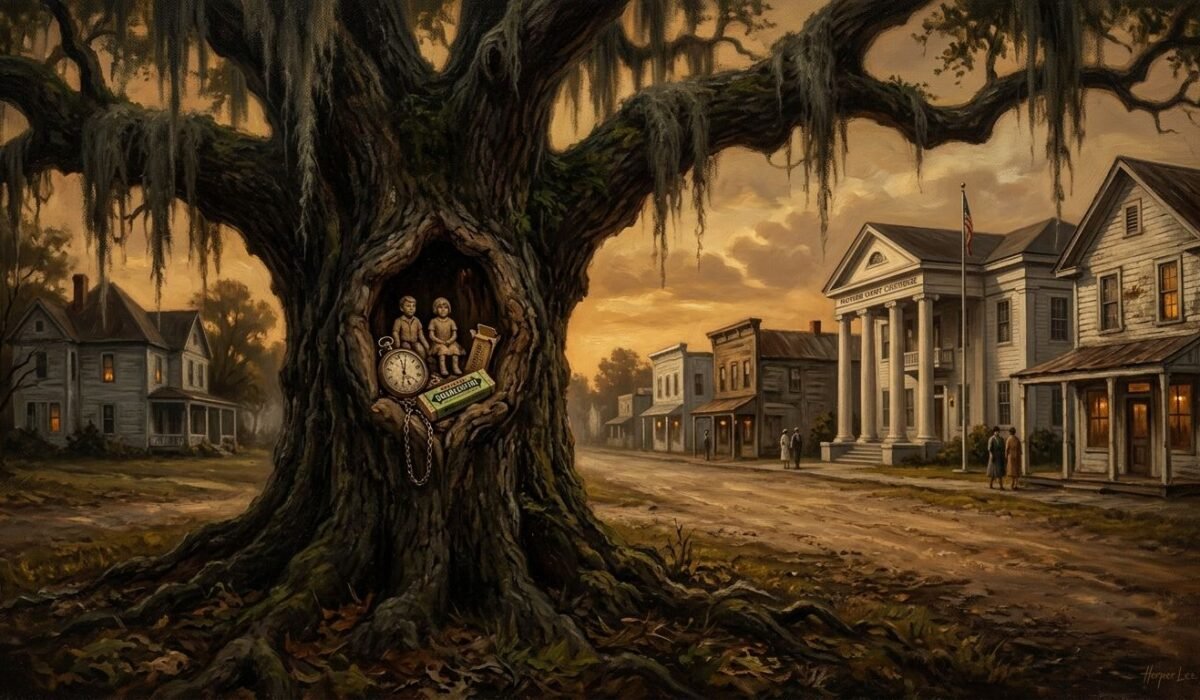
1. Scout finds two sticks of Wrigley’s Doublemint chewing gum tucked into a knothole of the ancient oak tree on the Radley lot.
2. Soon after, the children discover two meticulously carved miniature soap figures—one wearing short pants like Jem, the other with bangs like Scout.
3. Subsequent gifts include a tarnished medal from a spelling bee, a broken pocket watch with a chain, and a pocket knife.When Jem and Scout write a letter of thanks to the anonymous benefactor, they discover that Boo’s elder brother, Nathan Radley, has filled the knothole with solid cement, claiming the tree was dying. Jem touches the cold, hard cement and weeps quietly on the porch, mourning the cruel severance of human connection.#### The Mad Dog & Mrs. Dubose: Redefining Courage (Chapters 8–11)
Two critical episodes in Part I dismantle the children’s superficial understanding of heroism:
– **Tim Johnson (The Mad Dog):** When a rabid dog wanders down Maycomb’s street, Sheriff Heck Tate hands his rifle to Atticus, who kills the beast in a single shot from extraordinary distance. The children are stunned to learn their quiet, bookish father was once the deadest shot in Maycomb County (“One-Shot Finch”). Yet Atticus gave up shooting because he realized his marksmanship was an unfair divine gift over living things.
– **Mrs. Henry Lafayette Dubose:** A venomous, bedridden elderly neighbor who relentlessly taunts Jem and Scout about Atticus defending Black people. Jem loses control and hacks down her prized camellia bushes with Scout’s baton. As punishment, Atticus forces Jem to read to her every afternoon for a month. Only after her death does Atticus reveal that Mrs. Dubose was battling a terminal illness and had resolved to break her morphine addiction before dying:> *”I wanted you to see what real courage is, instead of getting the idea that courage is a man with a gun in his hand. It’s when you know you’re licked before you begin, but you begin anyway and see it through no matter what.”*—### 3.2 Part II: The Public Arena & The Trial of Tom Robinson#### The Gathering Storm (Chapters 12–15)
With Atticus away at the state legislature, Calpurnia takes Jem and Scout to First Purchase African M.E. Church. The children experience the warmth, music (*linin’* hymn singing), and vibrant community of Maycomb’s Black citizens, while learning that Tom Robinson has been accused of raping Mayella Ewell.Tensions escalate when Atticus takes a chair and lamp to sit outside the county jail to protect Tom Robinson from a nocturnal lynch mob led by Walter Cunningham Sr. Jem, Scout, and Dill sneak into town and witness the standoff. Unaware of the deadly peril, Scout spots Mr. Cunningham and politely asks him about his son Walter and his legal entailment:> *”Hey, Mr. Cunningham. How’s your entailment gettin’ along?… I go to school with Walter… He’s a good boy.”*Shamed by a child’s innocent recognition of his shared humanity, Cunningham calls off the mob, proving Atticus’s principle that a lynch mob is always composed of individual men who can be reached by conscience.#### The Courtroom Drama (Chapters 16–21)
The trial occupies the psychological center of the novel. Forbidden from attending, the children slip into the packed courtroom and sit in the colored balcony alongside Reverend Sykes.Through surgical cross-examination, Atticus systematically dismantles the prosecution’s case:
1. **Sheriff Heck Tate’s Testimony:** Admits that nobody called a doctor to examine Mayella; her bruises were concentrated on the **right side** of her face, neck, and arms.
2. **Bob Ewell’s Testimony:** An arrogant, spiteful drunkard who signs his name for Atticus with his **left hand**, establishing that he is entirely left-handed.
3. **Mayella Ewell’s Testimony:** A pathetic, friendless nineteen-year-old who lives in squalor behind the town dump. She breaks down under Atticus’s gentle questioning, unable to explain how a man with an amputated left arm could hold her down and choke her neck with two hands.
4. **Tom Robinson’s Testimony:** An honest, soft-spoken family man whose left arm was shredded in a cotton gin at age twelve. Tom testifies that Mayella invited him into her yard to chop up an old chiffarobe, lunged at him, and kissed him on the cheek, declaring she had never kissed a grown man before. Bob Ewell saw them through the window and screamed: *”I see you, damn whore, I’ll kill ya!”*Tom made no attempt to harm her and fled in terror. However, under cross-examination by prosecutor Mr. Gilmer, Tom is asked why he performed so many unpaid chores for Mayella. Tom replies honestly: *”I felt right sorry for her, she seemed to try more’n the rest of ’em.”*In the Jim Crow South, a Black man expressing pity for a white woman was an intolerable violation of racial caste. Despite hours of deliberation—a triumph in itself, proving some jurors fought for acquittal—the jury returns a verdict of **guilty**. As Atticus packs his briefcase and walks down the center aisle, Reverend Sykes whispers to Scout:> *”Miss Jean Louise, stand up. Your father’s passin’.”*#### The Tragic Aftermath & The Night Walk (Chapters 22–31)
– **Tom’s Death:** Despairing of legal appeals, Tom Robinson attempts to climb the fence during exercise hour at Enfield Prison Farm and is shot seventeen times by guards. Maycomb’s white society dismisses his death as a typical Black impulse, while Mr. Underwood publishes a scathing editorial comparing Tom’s slaughter to the *”senseless slaughter of songbirds.”*
– **Bob Ewell’s Revenge:** Embittered that Atticus exposed his depravity and domestic abuse to the town, Bob Ewell spits in Atticus’s face, harasses Helen Robinson, and ambushes Jem and Scout on Halloween night as they walk home from the school pageant through the dark woods.
– **The Assault & Rescue:** Bob Ewell tackles the children, breaking Jem’s arm and attempting to squeeze Scout to death inside her wire-framed ham costume. Suddenly, a mysterious rescuer intervenes, pulling Ewell away. Scout sees a man carrying Jem’s limp body toward the Finch home.
– **The Reveal:** In Jem’s bedroom, Scout recognizes the pale, silent rescuer standing in the corner: Arthur “Boo” Radley. Bob Ewell lies dead under the oak tree with a kitchen knife lodged under his ribs.“`
[Bob Ewell Attacks Children] ──► Breaks Jem’s Arm
│
▼
[Boo Radley Stabs Bob Ewell]
│
▼
┌────────────────────────┴────────────────────────┐
▼ ▼
ATTICUS FINCH HECK TATE
Believes Jem killed Ewell in Knows Boo Radley killed Ewell to
self-defense; insists on an open save the children; insists:
trial to prevent rumors. “Bob Ewell fell on his knife.”
│ │
└────────────────────────┬────────────────────────┘
▼
[SCOUT’S MORAL EPIPHANY]
“It’d be sort of like shootin’ a mockingbird, wouldn’t it?”
“`Sheriff Heck Tate insists on recording that Bob Ewell fell on his own knife. Atticus protests, mistakenly believing Jem killed Ewell and refusing to let his son receive special legal favors. Tate corrects him bluntly: Jem never touched Ewell; Boo Radley did. Tate argues that dragging a painfully reclusive hero into the spotlight would be a monstrous cruelty:> *”To my way of thinkin’, Mr. Finch, taking the one man who’s done you and this town a great service an’ draggin’ him with his shy ways into the limelight—to me, that’s a sin. It’s a sin and I’m not about to have it on my head.”*Scout turns to Atticus and reassures him: *”Mr. Tate was right… it’d be sort of like shootin’ a mockingbird, wouldn’t it?”*Scout walks Boo back to the Radley porch. As she stands on the porch and looks out over Maycomb, she sees the street as Boo saw it over the years—watching the children play, seeing them in snow and fire, guarding them in danger. She realizes: *”Atticus was right. One time he said you never really know a man until you stand in his shoes and walk around in them. Just standin’ on the Radley porch was enough.”*—## 4. Comprehensive Character Matrix & Cast Profiles| Character | Social / Symbolic Role | Primary Action & Contribution | Key Defining Quote |
| :— | :— | :— | :— |
| **Jean Louise “Scout” Finch** | Protagonist & Narrator; The Nonconforming Child | Observes Maycomb’s hypocrisy; matures from aggressive tomboy to empathetic young woman. | *”I think there’s just one kind of folks. Folks.”* |
| **Atticus Finch** | Moral Anchor; Father & Defense Attorney | Mounts a principled defense of Tom Robinson; teaches his children empathy, courage, and equality before the law. | *”You never really understand a person until you consider things from his point of view…”* |
| **Jeremy “Jem” Finch** | Coming-of-Age Protagonist (Bildungsroman) | Idolizes Atticus; shattered by the jury’s racist verdict; permanently scarred by Bob Ewell’s attack. | *”It ain’t right, Atticus… It’s like being a caterpillar in a cocoon, that’s what it is.”* |
| **Arthur “Boo” Radley** | The Reclusive White Mockingbird | Leaves small tokens of affection in the tree knothole; rescues Jem and Scout from murder; kills Bob Ewell. | *”Will you take me home?”* |
| **Tom Robinson** | The Innocent Black Mockingbird | Falsely accused of rape; crippled in left arm; shot 17 times attempting escape from Enfield Prison. | *”I felt right sorry for her, she seemed to try more’n the rest of ’em.”* |
| **Charles Baker “Dill” Harris** | Childhood Outsider; Truman Capote Avatar | Sparks the children’s fascination with Boo; weeps at the prosecutor’s cruel badgering of Tom Robinson. | *”It just makes me sick, why folks do like that…”* |
| **Calpurnia** | Finch Family Cook & Maternal Figure | Bridges the white and Black communities; introduces Scout and Jem to First Purchase Church. | *”It’s not necessary to tell all you know. It’s not ladylike—in the second place, folks don’t like to have somebody around knowin’ more than they do.”* |
| **Robert E. Lee “Bob” Ewell** | Antagonist; Maycomb’s “White Trash” Depravity | Abuses Mayella; frames Tom Robinson; attempts to murder Scout and Jem on Halloween. | *”I see you, damn whore, I’ll kill ya!”* |
| **Mayella Violet Ewell** | The Abused Accuser | Pathetic, lonely daughter of Bob Ewell; breaks Southern racial taboos by kissing a Black man. | *”I got somethin’ to say an’ then I ain’t gonna say no more… if you fine fancy gentlemen don’t wanta do nothin’ about it then you’re all yellow stinkin’ cowards.”* |
| **Miss Maudie Atkinson** | Open-Minded Neighbor & Finch Ally | Treats children as equals; clarifies the mockingbird metaphor; celebrates small racial progress. | *”Mockingbirds don’t do one thing but make music for us to enjoy… That’s why it’s a sin to kill a mockingbird.”* |
| **Aunt Alexandra** | Southern Aristocracy & Traditionalism | Moves in to instill “proper” ladylike behavior in Scout; fiercely protective of Finch family bloodlines. | *”I can’t say I approve of everything he does, Maudie, but he’s my brother, and I just want to know when this will ever end.”* |
| **Sheriff Heck Tate** | Legal Pragmatism & Maycomb Lawman | Testifies objectively at the trial; covers up Boo Radley’s lethal intervention to protect his fragile humanity. | *”Let the dead bury the dead this time, Mr. Finch. Let the dead bury the dead.”* |—## 5. The Mockingbird Symbolism: Innocent Victims in a Fallen WorldThe mockingbird is the unifying moral metaphor of the novel, explicitly introduced in Chapter 10 when Atticus gives air rifles to Jem and Scout for Christmas:> *”I’d rather you shot at tin cans in the back yard, but I know you’ll go after birds. Shoot all the bluejays you want, if you can hit ’em, but remember **it’s a sin to kill a mockingbird**.”*When Scout asks Miss Maudie why killing a mockingbird is uniquely sinful, Miss Maudie elaborates:> *”Your father’s right… Mockingbirds don’t do one thing but make music for us to enjoy. They don’t eat up people’s gardens, don’t nest in corncribs, they don’t do one thing but sing their hearts out for us. That’s why it’s a sin to kill a mockingbird.”*“`
THE MOCKINGBIRD METAPHOR
│
┌─────────────────────────────┴─────────────────────────────┐
▼ ▼
TOM ROBINSON BOO RADLEY
The Black Mockingbird The White Mockingbird
• Did no harm to anyone • Damaged by domestic cruelty
• Helped Mayella out of pure kindness • Watched over children in secret
• Destroyed by white racial malice • Delivered gifts in the knothole
• Equated to songbird by Mr. Underwood • Shielded from public trial by Tate
“`### 5.1 Tom Robinson as the Black Mockingbird
Tom Robinson is the tragic manifestation of the symbol. Like a mockingbird, he lived a harmless, gentle, and productive life. He offered assistance to a lonely, neglected white woman out of human decency without accepting payment. For this act of Christian charity, he was falsely accused, publicly humiliated, unjustly convicted, and shot seventeen times in the back. In his newspaper editorial following Tom’s death, B.B. Underwood explicitly links Tom to the metaphor, writing that it was a sin to kill crippled people, likening Tom’s murder to the *”senseless slaughter of songbirds by hunters and children.”*### 5.2 Arthur “Boo” Radley as the White Mockingbird
Boo Radley is the surviving manifestation of the symbol. A recluse whose spirit was fractured by a domineering, puritanical father, Boo lives in total isolation, wishing harm on no one. In secret, he provides companionship to the children through carved soap figures, a pocket watch, and a blanket on a freezing night. When the children’s lives are threatened by Bob Ewell, Boo emerges from darkness to kill the predator. If Sheriff Heck Tate were to arrest Boo and put him on public trial, the community’s sensationalist gossip would destroy his delicate psychological equilibrium. Scout recognizes this truth intuitively: putting Boo on trial would be *”sort of like shootin’ a mockingbird.”*—## 6. Social Stratification & Caste Architecture in MaycombHarper Lee dissects Southern society with anthropological rigor, demonstrating that Maycomb is divided into four distinct socioeconomic and racial strata:“`
┌─────────────────────────────────────────────────────────────┐
│ TIER 1: The Town Gentry (Finches, Miss Maudie, Judge Taylor) │
│ Old-family lineage, educated, landed ancestry, civic power │
├─────────────────────────────────────────────────────────────┤
│ TIER 2: The Honest Working Farmers (Cunninghams) │
│ Landowners impoverished by Depression; fiercely independent │
├─────────────────────────────────────────────────────────────┤
│ TIER 3: The Degraded White Underclass (Ewells) │
│ Live by town dump, illiterate, violent, rely on white bias │
├─────────────────────────────────────────────────────────────┤
│ TIER 4: The Black Community (Robinsons, Calpurnia, Rev. Sykes)│
│ Deeply moral and hardworking, yet disenfranchised by law │
└─────────────────────────────────────────────────────────────┘
“`1. **The Town Aristocracy (Finches):** Educated, professional families with deep local roots. Atticus represents civic morality, while Aunt Alexandra represents genealogical obsession, believing that *”the longer a family had been squatting on one patch of land the finer it was.”*
2. **The Country Farmers (Cunninghams):** Proud, hardworking white families hit devastatingly by the Great Depression. They refuse church or government charity; Walter Cunningham Sr. pays Atticus for legal entailment work using hickory nuts, stovewood, smilax, and turnip greens.
3. **The Disgraced Poor Whites (Ewells):** Living in a shack adjacent to the Maycomb dump, the Ewells are described as the *”disgrace of Maycomb for three generations.”* They live off welfare checks, hunt out of season, and practice domestic cruelty. In Maycomb’s social ecology, their only claim to status is the artificial privilege of white skin, which Bob Ewell leverages to destroy Tom Robinson.
4. **The Disenfranchised Black Community:** Situated at the absolute bottom of the legal and social ladder, forced to live in the “colored quarters” beyond the town dump. Despite being morally upright, spiritually cohesive, and hardworking, they are completely vulnerable to the whims of white power.—## 7. Critical Perspectives: *Go Set a Watchman* & The White Savior Debate### 7.1 The 2015 Discovery of *Go Set a Watchman*
In July 2015, HarperCollins published *Go Set a Watchman*, a previously lost manuscript discovered in Lee’s safe-deposit box. Set twenty years after *To Kill a Mockingbird*, the novel portrays a 72-year-old Atticus Finch who attends a meeting of the White Citizens’ Council and questions the readiness of African Americans for full civil equality:> *”Do you want Negroes by the carload in our schools and churches and theaters? Do you want them in our world?”*The revelation triggered an international literary earthquake. Readers who viewed Atticus as an unblemished saint of racial justice felt betrayed. However, literary scholars argue that *Watchman* provides vital historical realism:
– Atticus was never an aggressive 1960s civil rights radical; he was an aristocratic 1930s Southern paternalist who believed in procedural courtroom fairness and gradualist progress.
– Understanding *Watchman* enhances our appreciation of *To Kill a Mockingbird* as an artistic triumph, demonstrating how editor Tay Hohoff helped Lee transform a bitter adult reckoning into a timeless fable of moral education.### 7.2 The “White Savior” Critique in Modern Academia
Contemporary postcolonial, African American, and feminist critics offer several sharp critiques of *To Kill a Mockingbird*:
– **Lack of Black Agency:** The narrative focuses almost exclusively on white moral growth. Tom Robinson is depicted as passive, saintly, and helpless, serving primarily as an instrument through which white characters (Atticus, Scout, Jem) test and demonstrate their virtue.
– **Paternalistic Reform:** Atticus defends Tom out of professional and gentlemanly duty, yet he does not actively challenge the overarching structures of white supremacy. He famously tells Scout that Walter Cunningham’s lynch mob was made up of *”good people, they just have blind spots.”*
– Despite these critiques, the novel remains an essential, honest chronicle of the limits and possibilities of white Southern conscience during the Jim Crow era.—## 8. High-Yield Solved MCQs (NTA NET / GATE English Literature)#### Q1. In what year is *To Kill a Mockingbird* set, and in what year was it published?
(A) Set in 1960; Published in 1960
(B) Set in 1933–1935; Published in 1960
(C) Set in 1941–1945; Published in 1955
(D) Set in 1929; Published in 1965**Correct Answer:** **(B) Set in 1933–1935; Published in 1960**
**Detailed Rationale:** The novel is set during the historical depths of the Great Depression (1933–1935), indicated by references to FDR’s presidency (“nothing to fear but fear itself”). It was published on July 11, 1960, during the height of the modern American Civil Rights Movement.—#### Q2. Which historical trial in 1930s Alabama served as the real-life analogue for the trial of Tom Robinson?
(A) The Scopes Monkey Trial
(B) The Rosenberg Trial
(C) The Scottsboro Boys Trial
(D) The Sacco and Vanzetti Trial**Correct Answer:** **(C) The Scottsboro Boys Trial**
**Detailed Rationale:** The Scottsboro affair (1931) involved nine young Black men falsely accused of raping two white women on an Alabama train. Despite no medical evidence and recanted testimonies, all-white juries repeatedly convicted them, mirroring Maycomb’s persecution of Tom Robinson.—#### Q3. Why does Atticus Finch describe shooting mockingbirds as a sin?
(A) They are protected under Alabama wildlife conservation law
(B) They are an ancient Christian symbol of resurrection
(C) They do no harm to crops or gardens, only making music for humans to enjoy
(D) They eat crop-destroying insects on Southern cotton farms**Correct Answer:** **(C) They do no harm to crops or gardens, only making music for humans to enjoy**
**Detailed Rationale:** As explained by Atticus in Chapter 10 and amplified by Miss Maudie, mockingbirds do not nest in corncribs or destroy crops; they merely sing their hearts out. Killing a harmless, generous creature is a grave moral sin.—#### Q4. What physical injury does Tom Robinson possess that renders the assault allegations physically impossible?
(A) He is blind in his right eye
(B) His left arm is twelve inches shorter and paralyzed from a cotton gin accident
(C) He walks with a pronounced limp from polio
(D) He lost three fingers on his right hand during World War I**Correct Answer:** **(B) His left arm is twelve inches shorter and paralyzed from a cotton gin accident**
**Detailed Rationale:** Tom Robinson’s left arm was mangled in a cotton gin when he was a boy, leaving it limp and completely useless. Since Mayella’s attacker left deep bruises on the right side of her face, the assailant had to be dominant in the left hand—identifying her father, Bob Ewell.—#### Q5. Who is the real-life childhood friend upon whom Harper Lee modeled the eccentric character of Charles Baker “Dill” Harris?
(A) William Faulkner
(B) Flannery O’Connor
(C) Tennessee Williams
(D) Truman Capote**Correct Answer:** **(D) Truman Capote**
**Detailed Rationale:** Truman Capote was Harper Lee’s real-life neighbor and closest childhood companion in Monroeville, Alabama. Lee modeled Dill Harris directly after young Capote’s photographic imagination, theatrical antics, and unique personal flair.—#### Q6. What does Sheriff Heck Tate decide regarding the death of Bob Ewell on Halloween night?
(A) He arrests Jem Finch for manslaughter in defense of his sister
(B) He arrests Arthur “Boo” Radley for second-degree murder
(C) He insists Bob Ewell fell on his own knife, shielding Boo Radley from public exposure
(D) He rules that Bob Ewell died of natural heart failure during the scuffle**Correct Answer:** **(C) He insists Bob Ewell fell on his own knife, shielding Boo Radley from public exposure**
**Detailed Rationale:** Sheriff Tate recognizes that Boo Radley killed Bob Ewell to protect the children. Knowing that dragging the painfully shy Boo into the public eye would be akin to “shootin’ a mockingbird,” Tate exercises moral discretion and rules that Ewell fell on his own blade.—#### Q7. What secret battle was Mrs. Henry Lafayette Dubose fighting, which Atticus used to teach Jem the true meaning of courage?
(A) Breaking her long-standing addiction to morphine before her death
(B) Hiding a Black refugee family in her cellar
(C) Secretly paying Walter Cunningham’s debts to the bank
(D) Defending the local church from Ku Klux Klan vandals**Correct Answer:** **(A) Breaking her long-standing addiction to morphine before her death**
**Detailed Rationale:** Mrs. Dubose was a morphine addict due to chronic pain. She resolved to break her addiction before dying so she would owe nothing to anyone. Atticus praises her as the bravest person he ever knew, teaching Jem that courage is persevering when defeat is inevitable.—#### Q8. What item does Nathan Radley use to permanently seal the knothole in the oak tree?
(A) Tar
(B) Cement
(C) Wooden planks and iron nails
(D) Barbed wire**Correct Answer:** **(B) Cement**
**Detailed Rationale:** Nathan Radley fills the knothole with cement to sever the quiet communication between Boo Radley and the Finch children. When questioned by Jem, Nathan falsely claims the tree is dying.—#### Q9. How does Tom Robinson die in Chapter 24?
(A) He is lynched outside the Maycomb courthouse by Bob Ewell’s mob
(B) He dies of pneumonia in the Maycomb county jail
(C) He is shot seventeen times by guards while trying to climb the fence at Enfield Prison Farm
(D) He is executed in the electric chair at Kilby State Prison**Correct Answer:** **(C) He is shot seventeen times by guards while trying to climb the fence at Enfield Prison Farm**
**Detailed Rationale:** Despairing of justice through appeals, Tom attempts to escape during daily exercise by running toward the fence. Prison guards shoot him seventeen times, an excessive display of violence demonstrating the total devaluation of Black life.—#### Q10. What action does Scout take in the final chapter that symbolizes her complete adoption of Atticus’s philosophy of empathy?
(A) She attends Tom Robinson’s funeral service
(B) She stands on the Radley porch and looks out over Maycomb from Boo’s perspective
(C) She burns her overalls and wears a traditional lady’s dress
(D) She writes an essay defending integration for the Maycomb newspaper**Correct Answer:** **(B) She stands on the Radley porch and looks out over Maycomb from Boo’s perspective**
**Detailed Rationale:** After escorting Boo Radley home, Scout turns and gazes at the neighborhood from the porch. She visualizes the past three years through Boo’s eyes, fulfilling Atticus’s teaching that one only understands another person by climbing into their skin and walking around in it.—## 9. Frequently Asked Questions (Structured PAA Schema)### Why is it a sin to kill a mockingbird?
In Harper Lee’s novel, killing a mockingbird is considered a sin because mockingbirds do no harm to human society. They do not eat agricultural crops, devour garden vegetables, or build nests in grain corncribs. Their sole existence is dedicated to making beautiful music for humans to enjoy. The phrase functions as the novel’s core moral metaphor for innocence: destroying a harmless, defenseless, and benevolent being is an unconscionable crime against nature and morality.### Who are the two metaphorical mockingbirds in the novel?
The two mockingbirds are **Tom Robinson** and **Arthur “Boo” Radley**:
– **Tom Robinson:** Represents the Black mockingbird. He offered honest, unpaid assistance to Mayella Ewell out of compassion. He was destroyed by the institutional bigotry of an all-white jury and shot seventeen times.
– **Boo Radley:** Represents the white mockingbird. A gentle, traumatized recluse who provided gifts to the children and saved their lives by killing Bob Ewell. Exposing him to the public legal system and town gossip would destroy his fragile humanity.### How did Bob Ewell die?
Bob Ewell was stabbed to death on Halloween night by **Arthur “Boo” Radley**. Ewell ambushed Jem and Scout in the dark woods to take revenge on Atticus Finch. When Ewell tackled the children and broke Jem’s arm, Boo Radley intervened and stabbed Ewell in the ribs with a kitchen knife. To protect Boo from publicity, Sheriff Heck Tate officially ruled that Bob Ewell accidentally fell on his own knife.### Why did Mayella Ewell accuse Tom Robinson of rape?
Mayella Ewell accused Tom Robinson to protect herself from her abusive, violent father, Bob Ewell. Lonelier and more isolated than any character in Maycomb, Mayella broke the rigid racial and sexual taboos of the Jim Crow South by attempting to seduce and kiss a Black man. When her father caught her in the act, he beat her severely. To conceal her shame and avoid further domestic violence, Mayella and her father framed Tom Robinson for rape.### What is the connection between To Kill a Mockingbird and Go Set a Watchman?
*Go Set a Watchman* was the original manuscript Harper Lee submitted to Lippincott in 1957. Set in the 1950s, it depicts an adult Scout returning to Alabama and discovering her aging father Atticus attending segregationist meetings. Her editor, Tay Hohoff, advised Lee to discard the contemporary plot and expand the childhood flashbacks into an independent novel, which became *To Kill a Mockingbird*. *Watchman* remained unpublished until July 2015.—## 10. Scholarly References & Recommended Reading
1. **Lee, Harper.** *To Kill a Mockingbird.* J.B. Lippincott & Co., Philadelphia, 1960.
2. **Lee, Harper.** *Go Set a Watchman.* HarperCollins, New York, 2015.
3. **Johnson, Claudia Durst.** *To Kill a Mockingbird: Threatening Boundaries.* Twayne Publishers, New York, 1994.
4. **Shields, Charles J.** *Mockingbird: A Portrait of Harper Lee.* Henry Holt and Co., New York, 2006.
5. **Bloom, Harold, editor.** *Harper Lee’s To Kill a Mockingbird.* Chelsea House Publishers, New York, 2007.
6. **Goodman, James.** *Stories of Scottsboro.* Vintage Books, New York, 1995.
2 responses