Last updated: April 28, 2026
The Chicago School Neo-Aristotelians were a group of literary critics based at the University of Chicago from the 1930s onward who revived Aristotle’s method of analyzing literature — especially his focus on plot, form, and the whole work rather than isolated passages. Led by R.S. Crane, they pushed back against the dominant New Criticism of their era and argued that understanding a text means understanding how all its parts work together to produce a specific emotional effect on the reader.
Key Takeaways 📚
- Who they were: R.S. Crane, Elder Olson, Norman Maclean, Richard McKeon, and Wayne Booth were the core figures of the Chicago School.
- Their foundation: They drew directly from Aristotle’s Poetics, especially his ideas about mimesis, plot (mythos), and unified action.
- Their main argument: A literary work is a whole, and every element — character, diction, thought — serves the overall form.
- Their target: They criticized New Critics like I.A. Richards for focusing too narrowly on verbal texture and ignoring larger structural questions.
- Wayne Booth’s contribution: His 1961 book The Rhetoric of Fiction introduced the concept of the “implied author,” still widely used today.
- Their legacy: Chicago School ideas influenced narrative theory, rhetorical criticism, and how literature is taught in universities worldwide.
- Best for: Readers who want to understand why a story works — not just what its words mean on the surface.
- Relevance in 2026: Their emphasis on authorial intention and unified form has seen renewed interest as a counterweight to purely ideological readings.
Table of Contents
Who Were the Chicago School Neo-Aristotelians?
The Chicago School Neo-Aristotelians were a loosely organized group of scholars at the University of Chicago who, starting in the late 1930s, developed a systematic approach to literary criticism grounded in Aristotle’s Poetics. They believed that literary analysis should begin with the work as a whole — its form, its purpose, and the emotional response it aims to produce.
The core members included:
| Scholar | Key Contribution |
|---|---|
| R.S. Crane | Leader of the group; edited Critics and Criticism (1952) |
| Elder Olson | Applied Aristotelian method to lyric poetry and drama |
| Norman Maclean | Extended the approach to Shakespeare and narrative |
| Richard McKeon | Provided the philosophical backbone through Aristotelian pluralism |
| Wayne Booth | Brought the method into narrative theory with The Rhetoric of Fiction |
They are called “Neo-Aristotelians” because they didn’t simply repeat Aristotle — they adapted his analytical framework to address modern literature and the critical debates of the 20th century.
What Did Aristotle Have to Do With It?
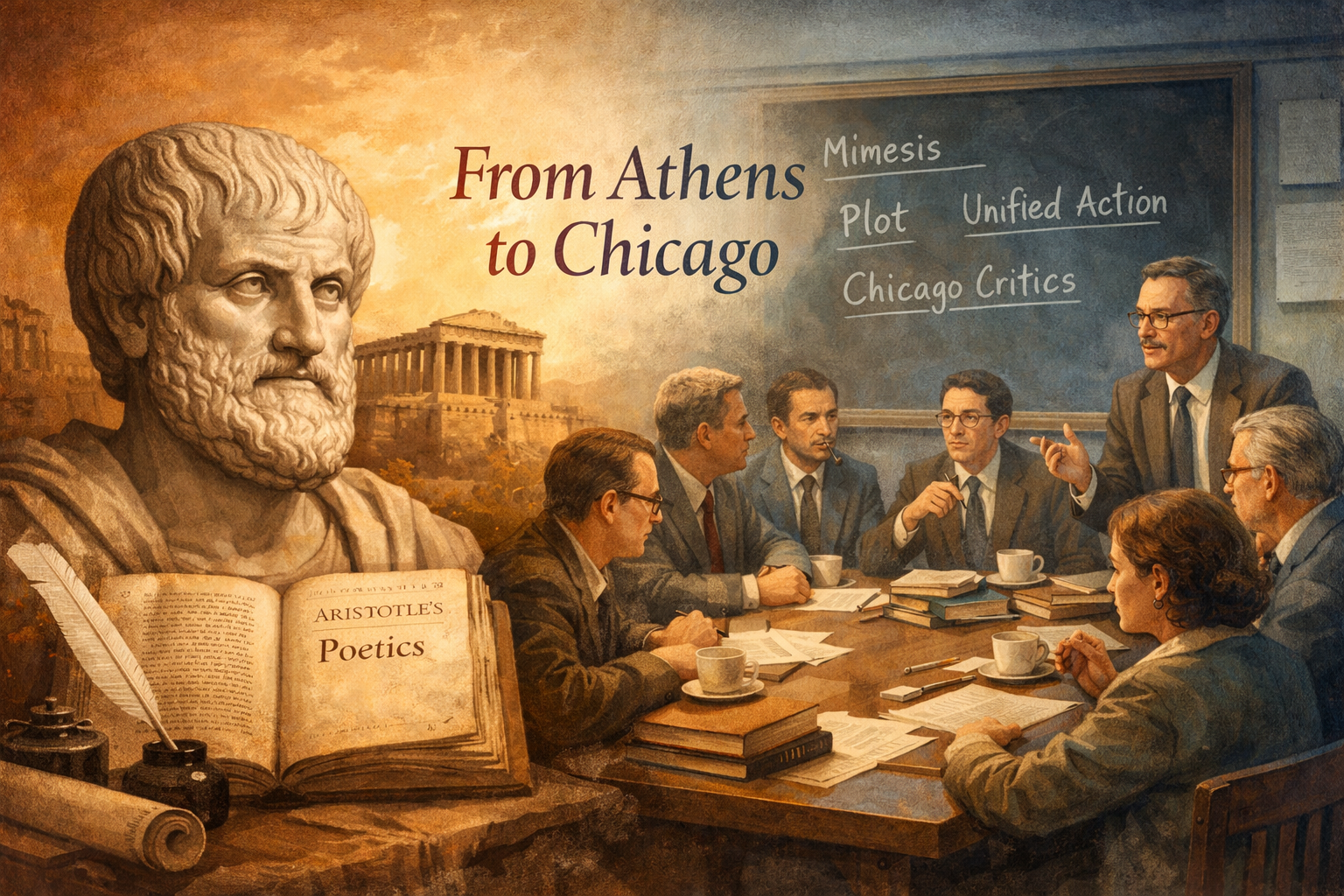
Aristotle’s Poetics — written around 335 BCE — is the starting point for understanding what the Chicago School Neo-Aristotelians were doing. Aristotle argued that tragedy works by imitating human action (mimesis) and that plot (mythos) is the “soul” of tragedy. Character, thought, diction, music, and spectacle all serve the plot.
The Chicago critics found this framework far more useful than what they saw as the fragmented approaches of their contemporaries. For them, Aristotle offered something rare: a method that asked how a work achieves its effect, not just what it says.
“A poem is not a collection of beautiful lines. It is a constructed whole whose parts exist in relation to each other and to the total effect.” — R.S. Crane (paraphrased from Critics and Criticism, 1952)
This is directly relevant to anyone studying what literary theory is and how different schools approach a text differently.
How Did They Differ From the New Critics?
The Chicago School Neo-Aristotelians had a clear and sometimes sharp disagreement with the New Critics — figures like Cleanth Brooks, Robert Penn Warren, and I.A. Richards.
New Critics focused on:
- Close verbal analysis of individual words and images
- Irony, ambiguity, and paradox as marks of literary value
- The “text alone” — biographical and historical context were largely irrelevant
Chicago School critics argued that:
- Focusing only on verbal texture misses the larger structural whole
- Plot and form determine how individual elements function
- Different works require different critical tools — there is no single universal method
R.S. Crane called this pluralism: the idea that no single critical vocabulary can cover all literary works. This was a genuinely radical position. For more on how close reading works as a method, and where it fits within broader critical traditions, it helps to see it alongside the Chicago approach.
The Chicago critics weren’t anti-close reading. They were against only close reading, divorced from questions of form and purpose.
What Is the “Whole Work” Argument?
The central claim of the Chicago School Neo-Aristotelians is that a literary work is an organic whole — every part exists to serve the total form. This sounds simple, but it has real consequences for how you read.
Practical example: In a tragedy like Macbeth, the witches’ prophecies, Macbeth’s soliloquies, and Lady Macbeth’s sleepwalking scene don’t just carry symbolic weight in isolation. They each contribute to the tragic movement — the shift from ambition to destruction — that produces the audience’s emotional response of pity and fear. For a deeper look at how this plays out, see this comprehensive analysis of Shakespeare’s Macbeth.
The Chicago method asks three questions:
- What kind of work is this? (Genre and form)
- What is the work trying to do? (Its emotional or cognitive purpose)
- How do the parts contribute to that purpose?
This is different from asking “What does this symbol mean?” or “What ideology does this text reinforce?” — the questions more common in other critical schools.
Wayne Booth and the Rhetoric of Fiction
Wayne Booth is probably the most widely read of the Chicago School Neo-Aristotelians today, largely because his 1961 book The Rhetoric of Fiction introduced concepts that became standard in narrative studies.
His key contributions:
- Implied author: The version of the author constructed by the reader from the text — distinct from the real author and from the narrator.
- Unreliable narrator: A narrator whose account the reader cannot fully trust, because their values or perceptions differ from those of the implied author.
- Rhetoric of fiction: The idea that all narrative choices — point of view, tone, structure — are rhetorical acts aimed at producing specific effects in readers.
Booth’s work connects the Chicago School’s Aristotelian roots to modern narrative theory. His concept of the unreliable narrator, for instance, is now used in discussions of everything from Don Quixote (see this literary analysis of Cervantes’ masterpiece) to contemporary autofiction.
What Is Aristotelian Pluralism?
Richard McKeon, one of the less-discussed but philosophically important members of the Chicago School, developed what he called “philosophical pluralism.” The idea is that different critical methods are valid for different purposes — no single method has a monopoly on literary truth.
This is actually a generous and open-minded position. It means the Chicago critics weren’t saying “our method is the only right one.” They were saying: “Use the right tool for the job. And when you’re analyzing how a narrative produces emotional effects, Aristotle’s tools are very good ones.”
This pluralism also explains why the Chicago School has remained relevant even as major literary movements have shifted dramatically — from New Criticism to structuralism, deconstruction, and cultural studies.
What Is the Legacy of the Chicago School Neo-Aristotelians?
The Chicago School Neo-Aristotelians shaped literary studies in ways that are still visible in 2026, even if the school itself is no longer a unified movement.
Their lasting contributions include:
- Narrative theory: Booth’s concepts are standard in courses on fiction and storytelling.
- Genre criticism: The idea that genre shapes meaning is now widely accepted.
- Rhetorical criticism: The Chicago approach influenced how scholars analyze the relationship between texts and audiences.
- Authorial intention: Their insistence that authorial design matters has gained new relevance as a counterpoint to reader-response and deconstructive approaches.
- Pedagogy: Their emphasis on asking “how does this work?” rather than “what does this mean?” has influenced how literature is taught at university level.
The school also influenced critics well beyond Chicago. F.R. Leavis’s focus on the moral seriousness of great literature — explored in The Great Tradition — shares some of the Chicago School’s concern with how literary form shapes human experience, even if Leavis’s method was quite different.
FAQ: Chicago School Neo-Aristotelians
Q: Why are they called “Neo-Aristotelians” rather than just “Aristotelians”?
A: Because they adapted Aristotle’s method rather than simply repeating it. They applied his analytical framework to modern literature and 20th-century critical debates, going beyond what Aristotle himself addressed.
Q: Is the Chicago School the same as the “Chicago Critics”?
A: Yes. “Chicago Critics” and “Chicago School Neo-Aristotelians” refer to the same group. Both terms are used in literary studies.
Q: Did the Chicago School have any influence outside the United States?
A: Yes. Wayne Booth’s The Rhetoric of Fiction became widely read internationally and influenced narrative theory in Europe and beyond.
Q: What is the best starting point for reading Chicago School criticism?
A: R.S. Crane’s edited volume Critics and Criticism (1952) is the foundational text. Wayne Booth’s The Rhetoric of Fiction (1961) is more accessible and still widely assigned.
Q: How does the Chicago School relate to Russian Formalism?
A: Both schools focus on form and structure rather than content or ideology. But Russian Formalists were more interested in literary devices and “defamiliarization,” while the Chicago School focused on how the whole work produces emotional effects.
Q: Are Chicago School ideas still taught today?
A: Yes, especially Booth’s narrative concepts. The broader Aristotelian approach to form and genre is also common in courses on narrative theory and rhetoric.
Q: What did the Chicago School think about lyric poetry?
A: Elder Olson extended the Aristotelian method to lyric poetry, arguing that even short poems have a unified action and a specific emotional purpose — not just beautiful language.
Q: What is the “implied author” in simple terms?
A: It’s the image of the author that a reader constructs from reading the text — the values, tone, and personality implied by the writing choices — as distinct from the real person who wrote it.
Conclusion: Why the Chicago School Still Matters
The Chicago School Neo-Aristotelians gave literary criticism something it often lacks: a clear, systematic method for asking why a work succeeds or fails on its own terms. By returning to Aristotle’s focus on form, plot, and emotional effect, they offered a way to analyze literature that respects the work’s internal logic rather than imposing an external framework onto it.
Actionable next steps for literature enthusiasts:
- Read Aristotle’s Poetics — even a short translation gives you the foundation the Chicago critics built on.
- Pick up Wayne Booth’s The Rhetoric of Fiction — his concept of the implied author will change how you read novels.
- Apply the “whole work” question next time you analyze a text: ask how each element serves the overall form, not just what it symbolizes.
- Explore related critical schools — compare the Chicago approach with Russian Formalism or New Criticism to sharpen your understanding of what makes each method distinctive.
- Look at genre — the next time you read a tragedy like Macbeth as a tragic hero, use the Chicago framework to ask how the genre shapes the emotional experience.
The Chicago School reminds readers that a story isn’t just a collection of meanings to decode. It’s a constructed experience — and understanding how it’s built is one of the deepest pleasures of reading.
References
- Crane, R.S. (Ed.). Critics and Criticism: Ancient and Modern. University of Chicago Press, 1952.
- Booth, Wayne C. The Rhetoric of Fiction. University of Chicago Press, 1961.
- Olson, Elder. “An Outline of Poetic Theory.” In Critics and Criticism, 1952.
- McKeon, Richard. “The Philosophic Bases of Art and Criticism.” In Critics and Criticism, 1952.
- Richter, David H. (Ed.). The Critical Tradition: Classic Texts and Contemporary Trends. Bedford/St. Martin’s, 2007.