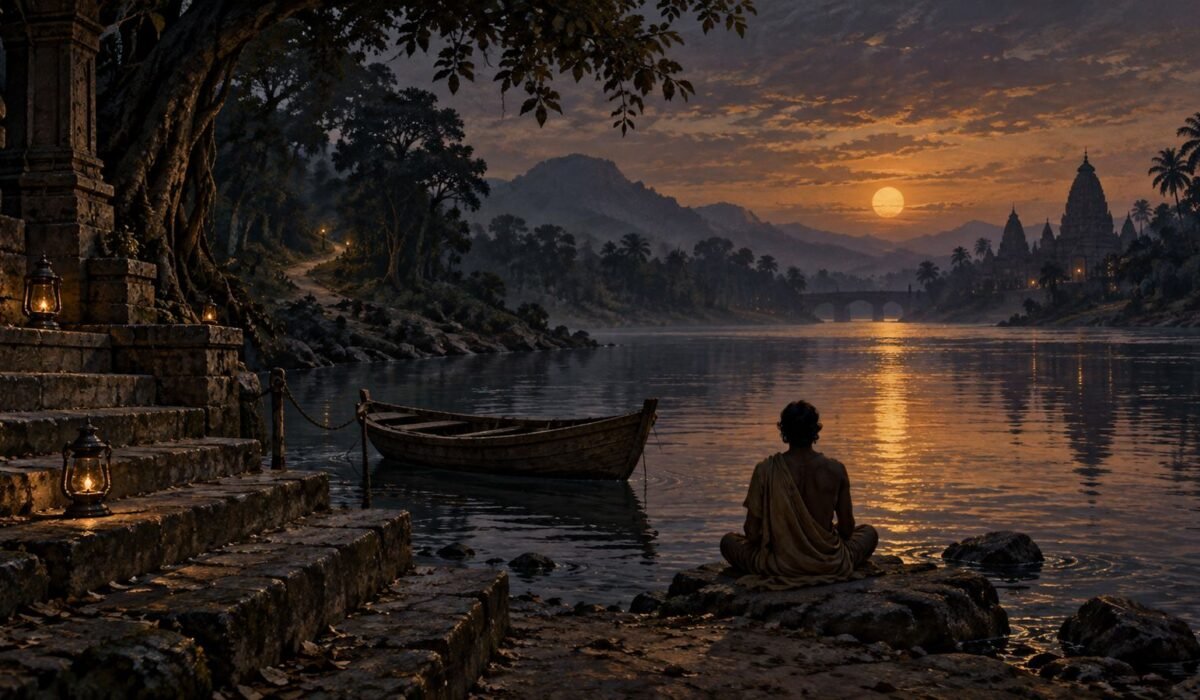
Hermann Hesse’s Siddhartha follows a Brahmin’s son who leaves inherited religious certainty, tries asceticism and worldly success, and finally learns to listen beside a river. The protagonist meets Gotama, the Buddha, but is a separate fictional character. The novel’s central question is whether another person’s teaching can give us the wisdom that must be lived.
First published in German in 1922 as Siddhartha: Eine indische Dichtung (An Indian Poem), the work unfolds in two parts and twelve chapters. Hesse’s own account of the novel’s development, preserved by the Hermann Hesse archive, dates its composition from December 1919 to May 1922. For students, the essential pattern is clear: each apparent solution helps Siddhartha grow, then reveals its limits. The final river scenes bring those earlier, seemingly opposed experiences into one view.
⚡ Key takeaways at a glance
- Author and date: Hermann Hesse; German first edition, 1922. Hesse received the Nobel Prize in Literature in 1946, not for this book alone.
- Protagonist: Hesse’s Siddhartha is a fictional Brahmin’s son, distinct from Gotama, the Buddha whom he meets.
- Narrative shape: Two parts, twelve chapters; spiritual inheritance and renunciation give way to sensual life, loss, and listening.
- Central symbol: The river flows and yet can be experienced as a whole, allowing Siddhartha to rethink time, separation, and judgment.
- Character contrast: Govinda follows a teacher; Siddhartha admires Gotama but refuses to borrow another person’s realization.
- Exam distinction: The novel draws on Indian traditions but should not be presented as a direct statement of Buddhist doctrine.
Watch the Siddhartha masterclass on YouTube
What happens in Siddhartha? A short summary
Siddhartha leaves his Brahmin family with his friend Govinda, joins the Samanas, meets Gotama, and then travels alone into a city where he learns love and commerce. Disgusted with his acquisitive life, he returns to a river. The ferryman Vasudeva teaches him to listen; grief over his son deepens that lesson. At the end, Govinda sees his friend’s transformed face.
This summary gives the sequence but not the force of its repetitions. Siddhartha begins by rejecting a family path because he cannot equate correct ritual with inward peace. He later rejects an ascetic path for much the same reason: escaping the self temporarily has not resolved his relation to it. His decision not to follow Gotama is therefore part of a pattern of inquiry, not a declaration that Gotama’s teaching is false. The publisher’s reading guide likewise emphasizes how the novel makes each apparent ending into a fresh beginning.
Part One: Leaving, fasting, and awakening
Part One tests inherited learning and renunciation. Siddhartha is respected as a gifted Brahmin’s son, but the prayers and philosophical formulas he knows have not given him the direct realization he seeks. He asks his father for permission to join wandering Samanas. Govinda goes with him. Both learn hunger, meditation, and severe self-denial. Siddhartha’s remarkable discipline, however, cannot permanently extinguish dissatisfaction.
News of Gotama draws the friends to his teaching. Govinda joins the Buddha’s community. Siddhartha praises the coherence of Gotama’s teaching and the serenity of his life but parts from him: the Buddha’s experience is real; an account of that experience is not the experience itself. He then recognizes that he has been trying to flee his own particular existence. The chapter called “Awakening” ends Part One with the decision to encounter the world as it is.
Part Two: Love, commerce, loss, and the river
Part Two tests experience without discipline and then discovers an ethic of attention. Siddhartha meets Kamala, who teaches him the art of love, and Kamaswami, who introduces him to trade. His ability to think, wait, and fast initially gives him a distance from wealth. Over time, gambling, possessions, and anxiety begin to shape him. His earlier composure turns into spiritual exhaustion. A dream of Kamala’s dead songbird helps reveal what his city life has cost him.
He leaves the city and reaches the river in despair. The remembered sound Om interrupts his impulse toward self-destruction. Govinda briefly encounters him there without recognizing his old friend. Siddhartha later lives with Vasudeva, a ferryman who does not answer every question with a theory. Kamala arrives with Siddhartha’s son, is bitten by a snake, and dies. The boy refuses his father’s way of life and runs away. Siddhartha’s inability to keep him reopens the pain he once caused his own father. Listening to the river, he comes to hear many lives and voices without treating one as the whole truth. The novel closes when Govinda visits and glimpses a vision of interrelated lives in Siddhartha’s face.
Chapter map: the twelve stages of the journey
The book has four chapters in Part One and eight in Part Two. Chapter titles vary slightly across English translations, so use the narrative event as well as the title when revising for an exam. The structure itself matters: Hesse devotes more chapters to Siddhartha’s encounters with love, money, family, and the river than to his formal religious training.
| Part and chapter | Key event | What changes in Siddhartha’s understanding |
|---|---|---|
| I. The Brahmin’s Son | He leaves his family with Govinda. | Inherited learning no longer feels sufficient. |
| I. With the Samanas | He practices extreme self-denial. | Temporary escape from the self is not freedom. |
| I. Gotama | Govinda joins the Buddha; Siddhartha departs alone. | A teacher’s truth cannot simply be transferred. |
| I. Awakening | He begins to attend to the visible world and himself. | The world is no longer merely a distraction. |
| II. Kamala | He enters the city and learns love. | Desire becomes an experience he must understand. |
| II. Among the Child-People | He works with Kamaswami and acquires wealth. | Detachment erodes as habits of possession grow. |
| II. Sansara / Samsara | He sees the emptiness of his routine. | Repetition without insight becomes captivity. |
| II. By the River | In despair he hears Om and falls asleep. | The river becomes a place of return and renewal. |
| II. The Ferryman | He joins Vasudeva and learns to listen. | Patient attention matters more than a formula. |
| II. The Son | Kamala dies; their son resists him and leaves. | Love includes limits, grief, and letting go. |
| II. Om | He hears the river’s many voices together. | He ceases dividing life into approved and rejected fragments. |
| II. Govinda | His friend returns and perceives a vision. | Their different paths meet without becoming identical. |
The Hesse archive’s outline confirms the two-part, twelve-chapter structure. “Sansara” and “Samsara” are translation and transliteration variants, rather than separate chapters. Do not infer a fixed number of years from the table: Hesse is more interested in experiential stages than in supplying a dated biography of his protagonist.
Who are the main characters?
Each major character offers Siddhartha a way of living, a possible teacher, or a relationship he cannot control. Hesse refuses the easy scheme in which only the ferryman is valuable. Siddhartha learns from his father, the Samanas, Gotama, Kamala, Kamaswami, Govinda, Vasudeva, and his son, even when he cannot remain with them.
| Character | Role in the plot | Interpretive function | Common exam confusion |
|---|---|---|---|
| Siddhartha | Brahmin’s son and seeker | Tests the limits of every borrowed path | He is not Gotama Buddha. |
| Govinda | Childhood friend who joins Gotama’s order | A sustained contrast between discipleship and solitary seeking | He is not merely a foolish foil; his devotion is sincere. |
| Gotama | Buddha encountered in Part One | Embodies a realized teacher whose teaching Siddhartha respects | Siddhartha questions transmission of wisdom, not Gotama’s serenity. |
| Kamala | Courtesan, lover, mother of Siddhartha’s son | Introduces art, intimacy, and later loss | She is more than a symbol of temptation. |
| Kamaswami | Merchant who employs Siddhartha | Brings him into commerce and accumulation | Do not confuse him with Kamala. |
| Vasudeva | Ferryman by the river | Models listening and patient attention | He does not hand Siddhartha a doctrinal answer. |
| Siddhartha’s son | Boy who leaves after Kamala’s death | Makes Siddhartha experience attachment and his father’s pain | The son’s departure is not a failure that a clever lesson reverses. |
Siddhartha and Gotama: two names, two characters
The protagonist is not the historical Buddha. Siddhartha was also the birth name associated with the historical Buddha, Siddhartha Gautama, which makes the novel’s naming deliberate and potentially confusing. Hesse’s fictional Brahmin’s son meets Gotama as another person. The story can therefore test the difference between following a realized teacher and arriving at insight through one’s own life. Both the Hesse archive and the publisher’s guide make this distinction explicit.
Siddhartha’s conversation with Gotama is easy to flatten into “books are useless” or “teachers cannot help.” Neither is accurate. The encounter prompts Siddhartha’s most important change: he no longer wants to imitate another person’s completed path. Yet he continues to learn from people and from the river. His argument concerns transferable doctrine versus lived wisdom, not a ban on conversation, reading, or disciplined thought.
Govinda and Siddhartha: why the contrast matters
Govinda seeks a reliable teacher; Siddhartha seeks the experience behind teaching. Govinda chooses Gotama’s order when Siddhartha departs. The difference could look like a simple victory for independence, but the final chapter does not humiliate Govinda. His longing and devotion bring him back to Siddhartha and make the ending possible. The friends’ reunion also prevents Siddhartha’s insight from remaining a purely private possession.
Notice the narrative symmetry. At the beginning, they travel together and then separate at Gotama’s teaching. Near the end, Govinda seeks instruction from the ferryman’s companion without at first grasping that he has returned to his old friend. The final vision gives Govinda an experience that cannot be reduced to an exam-ready slogan. It dramatizes, rather than merely states, Siddhartha’s claim about the limits of words.
Kamala, Kamaswami, and Vasudeva
Kamala and Kamaswami are Siddhartha’s teachers in the city; Vasudeva is his companion at the river. Kamala requires the young ascetic to dress, earn, speak, and attend to another person. Kamaswami teaches trade, bargaining, and the habits of prosperity. Siddhartha initially treats the city as a game but gradually becomes entangled in it. Describing this period as “sin followed by purity” oversimplifies the novel: it gives him experiences that later help him recognize suffering and tenderness in others.
Vasudeva’s teaching is striking because it is so little like Kamaswami’s instructions or a Brahmin’s discourse. He listens first. His ferry carries people between banks, an apt image for the novel’s repeated crossings between restraint and desire, solitude and relationship. He does not force Siddhartha’s son to stay, and he does not rescue Siddhartha from grief through a tidy explanation. Their shared labor beside the river gives Siddhartha a practice in which attention can mature.
What does the river symbolize in Siddhartha?
The river symbolizes movement and wholeness at once. Its water changes from moment to moment, yet Siddhartha can attend to the river as a single presence. Returning to it at different crises lets him hear joy, anguish, childhood, old age, and death together. The river is therefore a figure for time, connected lives, and the possibility of listening without rejecting painful experience.
There are three pivotal river encounters. On his first crossing into the city, the river marks a threshold; Vasudeva ferries him toward a life he does not yet understand. When he returns exhausted and nearly destroys himself, the sound of Om interrupts his despair. Finally, living beside Vasudeva, he listens to the water through his grief for his son. These scenes do not repeat a single static symbol. The same place becomes legible differently as Siddhartha changes.
The river’s lesson about time is particularly easy to misstate. Hesse does not present a scientific claim that clock time has stopped. Siddhartha hears source and mouth, youth and age, pleasure and grief as belonging to one pattern. The publisher’s reading guide reads Vasudeva’s passage between opposite banks as an emblem of the unity Siddhartha has sought. That is an interpretation of the novel’s imagery, not an empirical account of rivers.
Why does Om matter?
Om is a sacred sound that recalls wholeness at moments when Siddhartha’s awareness has narrowed. By the river after his departure from the city, he remembers it at the edge of despair. Later, the chapter titled “Om” brings together the river’s many voices. In the narrative, the sound is neither a magic password nor proof that Hesse is reproducing one Indian religion exactly. It marks a shift from self-absorption toward attention to a larger whole.
This is also a useful example of Hesse’s technique. A brief sound recurs in different emotional settings, so its meaning is built through the story rather than supplied once in a definition. An exam answer that says “Om means unity” is a starting point. A stronger answer explains why Siddhartha hears it at the river when despair makes him see only his own failed life.
The major themes: wisdom, desire, love, and time
The novel’s themes are held in productive tension. Siddhartha must question inherited instruction without pretending he learned nothing from it; enter the world without staying trapped in appetite; love his son without owning him; and listen to time without dividing his life into a good half and a wasted half.
Knowledge and lived wisdom
The distinction between knowledge and wisdom organizes the Gotama episode and returns at the end. A proposition can be remembered, explained, and argued about. Siddhartha doubts that his teacher’s realization can be given to him in the same way. Hesse makes this a question about the forms of experience literature can show. The reader hears many statements about insight, but the last scene asks the reader to imagine Govinda’s perception rather than memorize another doctrine.
This theme does not make teaching irrelevant. Gotama’s example is powerful; Vasudeva’s patient presence matters; Kamala and Kamaswami teach practical skills; even the son’s refusal teaches his father something painful. The point is that teaching, however valuable, cannot remove the learner’s responsibility to live and judge. For comparison, LitGram’s guide to reader-response criticism considers how a reader’s activity participates in making meaning, although Hesse’s novel is not itself a work of reader-response theory.
Asceticism and sensual life
The Samana years and the city years are mirror images. In one, Siddhartha tries to deny the body and ego; in the other, he risks being consumed by pleasure, property, and repetition. Neither experience can simply be deleted from his story. The later Siddhartha can recognize suffering in the “child-people” he once looked down upon because he has lived among them and become vulnerable himself.
Calling this simply the Buddhist “Middle Way” can mislead. The historical Buddhist teaching has its own context and discipline; Hesse is writing a modern European novel in an imagined ancient Indian setting. The Hesse archive cites the author’s later description of the book as “very European” despite its Indian milieu. The safer literary claim is that the plot moves through extremes and refuses to discard either bodily experience or spiritual inquiry.
Love and the son’s departure
Siddhartha’s relationship with his son is the novel’s strongest test of his serenity. He wants to protect the boy from the life he himself led, but that wish conflicts with the boy’s freedom. Vasudeva sees that the child cannot be kept beside the ferry by persuasion or force. When the boy leaves, Siddhartha feels the ache that his own departure once caused his father. The episode connects generations without making them identical.
This matters because a purely intellectual version of enlightenment could look like emotional detachment. Hesse makes Siddhartha suffer. His understanding grows when he can hear his grief as one voice among the river’s many voices, not when he proves that the son does not matter. An exam response should resist the cliché that “true wisdom means having no attachments” unless it also accounts for the novel’s emphasis on love and compassion.
Time, opposites, and the ending
At different stages Siddhartha sorts experience into opposed categories: sacred and worldly, teacher and seeker, success and failure. The river imagery puts pressure on such divisions. Its source, course, and mouth can be imagined together even though water is moving. Similarly, the person who fasted, gambled, loved, and grieved is one life. The ending presents insight as a widened perception of that life, not a prize that cancels its earlier chapters.
The novel’s last gesture belongs to Govinda as much as to Siddhartha. In a story concerned with the limits of verbal teaching, Govinda’s vision provides a formal answer: a literary image communicates more than a neat maxim. This does not mean every image has only one authorized interpretation. The scene asks readers to relate what Govinda perceives to the plot’s recurring contrasts and to Siddhartha’s practice of listening.
Is Siddhartha a Buddhist novel?
It is a novel in dialogue with Buddhist and other Indian religious ideas, not a textbook of Buddhism. Gotama appears, Govinda joins his order, and the plot questions suffering and release. Yet the protagonist declines discipleship and follows a strongly individualized path. Hesse’s India is also filtered through a twentieth-century European writer’s concerns about personality, crisis, and spiritual autonomy.
The distinction protects readers from two opposite errors. It would be wrong to say that the book has nothing to do with Indian traditions: Brahmin learning, Samanas, Gotama, Om, and the setting are central to its design. It would also be wrong to treat Siddhartha’s every conclusion as a doctrinal statement by the historical Buddha. The publisher’s reading guide explicitly notes the work’s Western intellectual inheritance as well as its Asian references. For a comparison with a pilgrimage framed by a very different religious tradition, see LitGram’s guide to The Pilgrim’s Progress.
For literary analysis, ask what Hesse’s arrangement of those traditions does inside the novel. The independent seeker is set against the devoted disciple. A silent ferryman is set against systematic teachers. The river is at once a landscape and a formal device that allows apparently opposed life stages to be heard together. That analysis is more precise than labeling the book “Eastern wisdom” and stopping there. Readers interested in cultural framing can compare LitGram’s introduction to postcolonial theory, while keeping the distinct historical setting and purpose of Hesse’s text in view.
A close reading of the final reunion with Govinda
The final scene turns the novel’s argument about teaching into an event between two friends. Govinda asks for a formulation of Siddhartha’s wisdom, but Siddhartha’s attempts to express it in words sound paradoxical to him. The decisive moment comes when Govinda kisses Siddhartha’s forehead and sees a succession of faces and lives. What he receives is a vision, not a portable rule.
Three details sharpen the reading. First, Govinda comes as a seeker even after years with Gotama’s order, so formal discipleship has not ended his longing. Second, Siddhartha’s face recalls Gotama’s smile, linking the paths without making the two men literally the same person. Third, the vision contains distressing as well as consoling forms of life. The ending does not claim that pain was an illusion; it asks whether Govinda can perceive it without tearing it out of the whole.
Compare this with the novel’s opening. The Brahmin’s son originally wants a trustworthy answer to questions about the self. At the end, his friend encounters a face rather than a definition. Hesse uses the difference between explanation and perception as part of the novel’s form. A strong exam paragraph should connect the scene to the earlier Gotama conversation, the river’s many voices, and Govinda’s role as listener. It need not claim that Hesse has resolved every philosophical problem he raises.
Publication timeline and exam facts
The secure publication facts are that Hesse drafted the work between 1919 and 1922 and the German book appeared in 1922. The timeline below separates events in Hesse’s life and the book’s publication from events inside its undated fictional world.
| Date | Event | Why it matters |
|---|---|---|
| 1877 | Hermann Hesse is born in Calw, Germany. | Author identification. |
| 1919–1922 | Hesse writes Siddhartha in Montagnola. | The ancient setting belongs to a modern work. |
| 1920–1922 | Individual chapters appear in periodicals before the book. | Do not confuse first extracts with the book edition. |
| 1922 | S. Fischer publishes Siddhartha: Eine indische Dichtung in Berlin. | Original-language first book publication. |
| 1946 | Hesse receives the Nobel Prize in Literature. | The prize honors his writing as a whole. |
The composition, serial-publication, and first-edition details come from the Hesse archive; the Nobel Foundation confirms the award and its date. The story itself supplies no calendar years for Siddhartha’s movements. Treat his stages as narrative sequence, not a dated historical chronology.
Common exam traps and disambiguations
Most errors come from collapsing distinct people or treating literary symbols as literal doctrine. Use the following checks when revising short answers or multiple-choice questions.
| Tempting answer | More accurate answer | Reason |
|---|---|---|
| Siddhartha is Gotama Buddha. | Hesse’s protagonist meets Gotama. | The scene requires two separate characters. |
| Govinda follows Siddhartha into the city. | Govinda joins Gotama’s order. | Their choices create the central contrast. |
| Kamala and Kamaswami are the same character. | Kamala teaches love; Kamaswami teaches commerce. | Their roles in the city are distinct. |
| Vasudeva gives Siddhartha a finished doctrine. | He teaches chiefly by listening and sharing life beside the river. | The form of learning is the point. |
| The river means only change. | It also suggests continuity, simultaneity, and many voices heard together. | A single-word gloss misses the ending. |
| The son’s departure proves Siddhartha has learned nothing. | It becomes the painful test through which his compassion deepens. | Growth does not remove grief. |
| Hesse’s plot states Buddhist doctrine exactly. | It stages a European novelist’s conversation with Indian ideas. | Literary representation and religious teaching differ. |
Ten solved MCQs on Siddhartha
These practice questions test the plot, character distinctions, publication history, and interpretation. They are original revision questions in a competitive-exam style, not claims to reproduce a past NTA paper.
1. Who is the author of Siddhartha: Eine indische Dichtung?
A. Thomas Mann B. Hermann Hesse C. Rainer Maria Rilke D. Stefan Zweig
Answer: B. Hesse’s German work appeared as a book in 1922. Mann, Rilke, and Zweig were prominent German-language contemporaries, which makes them plausible distractors, but none wrote this novel.
2. Which statement correctly distinguishes the protagonist from Gotama?
A. They are alternate names for one character. B. Gotama is Siddhartha’s son. C. Siddhartha meets Gotama but does not join his order. D. Gotama teaches commerce.
Answer: C. The fictional seeker meets the Buddha as a separate figure. Govinda, not Siddhartha, joins Gotama’s community.
3. Who accompanies Siddhartha when he first leaves his Brahmin home?
A. Vasudeva B. Kamaswami C. Govinda D. Kamala
Answer: C. Govinda is his childhood friend and early fellow seeker. The other characters enter later phases of the journey.
4. What is Siddhartha’s chief objection to becoming Gotama’s disciple?
A. He considers Gotama dishonest. B. He thinks religious language is impossible. C. He doubts that another person’s realized wisdom can be transferred through teaching. D. He has already become a merchant.
Answer: C. Siddhartha respects Gotama, but believes a disciple must discover the reality behind a teaching through life. The answer does not imply that all teaching has no value.
5. Which pair correctly matches the teachers Siddhartha meets in the city?
A. Kamala—trade; Kamaswami—ferrying B. Kamala—love; Kamaswami—commerce C. Govinda—trade; Kamala—ferrying D. Vasudeva—love; Kamaswami—asceticism
Answer: B. Kamala introduces Siddhartha to erotic and social life; Kamaswami employs him in business. The roles are frequently confused because their names are similar.
6. What does the dead songbird most directly help Siddhartha recognize?
A. The end of Gotama’s order B. The inner cost of his repetitive, acquisitive life C. The death of Vasudeva D. The location of his son
Answer: B. The image precedes Siddhartha’s departure from the city and signals spiritual depletion, not a literal report about the other characters.
7. Which character best models the practice of listening beside the river?
A. Kamaswami B. Govinda C. Vasudeva D. Siddhartha’s father
Answer: C. Vasudeva, the ferryman, guides Siddhartha less by formal lecture than by attentive presence and work at the river.
8. What is the central symbolic force of the river in the final part of the novel?
A. Only the danger of travel B. The rejection of all other people C. Flux and the simultaneous connectedness of lives D. Proof of a historical event
Answer: C. The water moves, yet its voices can be heard together. This double quality lets Siddhartha reconsider time, grief, and division.
9. Which event most directly makes Siddhartha experience the pain of a parent who must let a child go?
A. Govinda’s decision to follow Gotama B. His son’s departure from the ferry C. Kamaswami’s business offer D. His first Samana fast
Answer: B. His son’s refusal echoes Siddhartha’s own earlier departure from his father, but now he bears the parent’s grief.
10. Which publication pairing is correct?
A. Original German book—1922; Hesse’s Nobel Prize—1946 B. Original German book—1946; Nobel Prize—1922 C. Original German book—1877; Nobel Prize—1919 D. Original German book—1951; Nobel Prize—1962
Answer: A. The German first edition appeared in 1922, and Hesse received the Nobel Prize in Literature in 1946. The award was for his writing overall, not a prize category for this single title.
Frequently asked questions
Is Hesse’s Siddhartha the Buddha?
No. Hesse gives his fictional Brahmin’s son a name associated with the historical Buddha, but he places Gotama Buddha in the same story as a separate character. Siddhartha encounters Gotama, admires him, and then continues his own search. The encounter is central to the book’s question about whether wisdom can be taught.
Why does Siddhartha leave Govinda?
Govinda chooses to join Gotama’s order. Siddhartha believes he must test life for himself rather than enter another person’s path to realization. Their separation creates a contrast that the final reunion revisits; it does not mean that Govinda’s sincerity is worthless.
What does the river teach Siddhartha?
Through Vasudeva’s example and his own listening, Siddhartha begins to hear the river’s many voices together. Its movement and continuity give him a way to understand change, time, sorrow, love, and the connectedness of different lives. The meaning develops across several visits rather than in one revelation.
What happens to Kamala and Siddhartha’s son?
Kamala returns toward Gotama with the boy, is bitten by a snake, and dies near the ferrymen. Siddhartha tries to keep his son with him, but the boy runs away. The loss forces Siddhartha to confront attachment and to understand more deeply what his own father felt when he left home.
What does Om mean in the novel?
Om is a sacred sound that recurs at moments of crucial attention. At the river, Siddhartha remembers it as he emerges from despair; later the chapter titled “Om” brings the river’s conflicting voices into a perceived whole. It is a literary motif in Hesse’s story, not a shortcut that by itself explains Indian religious traditions.
How does the novel end?
Govinda visits Siddhartha at the river. Siddhartha cannot give him a neat verbal formula for wisdom, but Govinda experiences a vision of many lives when he kisses his old friend’s forehead. The ending returns to their early friendship and dramatizes the novel’s concern with the limits of words.
Conclusion
Siddhartha is memorable because its plot makes the reader revise each apparent answer. The Brahmin’s learning, the Samanas’ renunciation, Gotama’s example, Kamala’s love, Kamaswami’s trade, and Vasudeva’s listening each reveal something while leaving further work to do. The river does not erase these episodes. It allows Siddhartha to hear them as parts of one life, including the grief of losing his son. For revision, keep the character distinctions, two-part structure, 1922 publication date, and river imagery in view; for interpretation, ask why Hesse lets the final insight appear as Govinda’s vision rather than a concluding rule.
Sources and further reading
- Hermann Hesse archive: Siddhartha — composition, publication, plot, and Hesse’s later comments
- Penguin Random House: Siddhartha reader’s guide — structure and interpretive questions
- Nobel Prize: Hermann Hesse facts — author biography and 1946 award
Written for LitGram by Mukesh K Sharma. This guide is a literary interpretation; it distinguishes Hesse’s fictional presentation from the teachings of living religious traditions.