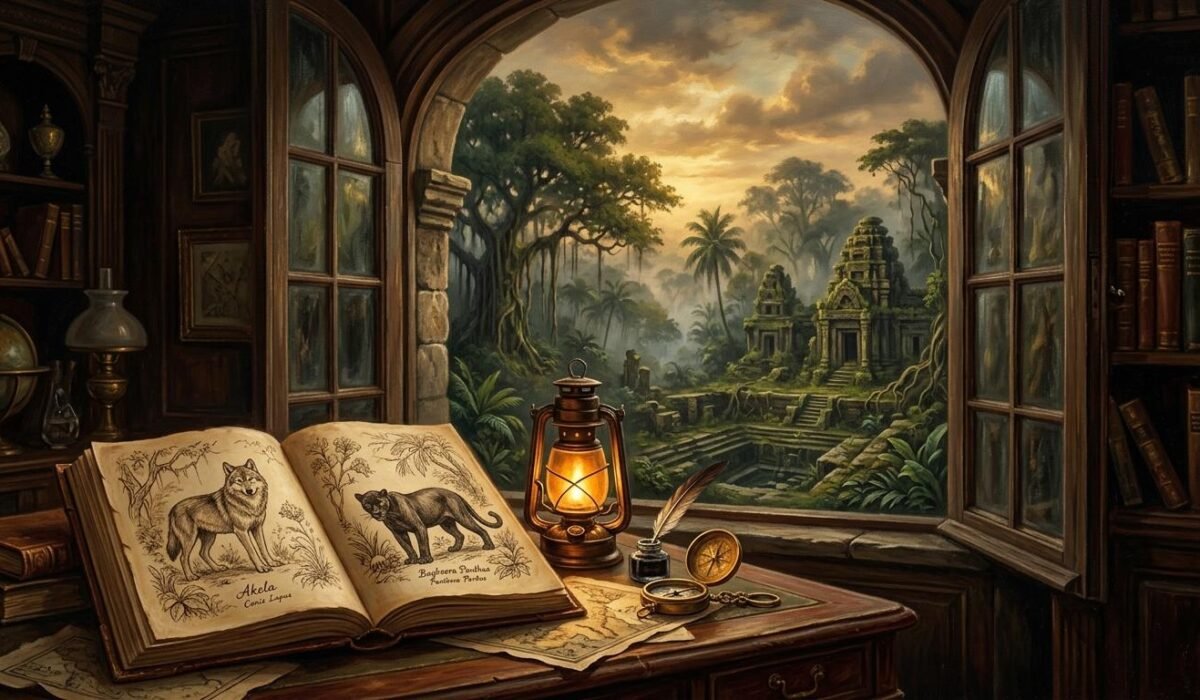
⚡ Key Takeaways at a Glance
- Kipling’s Original Literary Blueprint: Published in 1894 (followed by The Second Jungle Book in 1895), Rudyard Kipling’s work is a collection of moral apologues, animal fables, and imperial allegories set primarily in the Seoni (Seeonee) forests of Madhya Pradesh, Central India.
- The Kaa Disambiguation: In Kipling’s original text, Kaa the Indian Rock Python is a wise, revered, century-old mentor and protector who rescues Mowgli from the Bandar-log at Cold Lairs; Walt Disney’s 1967 animation radically inverted Kaa into a comedic, hypnotic antagonist.
- Baloo the Stern Ascetic: Far from Disney’s carefree, lazy bohemian singing “The Bare Necessities”, Kipling’s Baloo is a strict, elderly brown sloth bear who serves as the sole non-wolf on the Council and physically disciplines Mowgli to teach him the sacred Law of the Jungle.
- Bagheera’s Secret Captivity: Bagheera the black panther was born in captivity within the King’s palace cages at Oodeypore (Udaipur); his experience with human locks, collars, and cruelty gives him unique insight into Mowgli’s dual human-animal nature.
- King Louie is a Disney Invention: The jazz-singing orangutan King Louie does not exist in Kipling’s books; orangutans are not native to India, and the Bandar-log (Monkey People) explicitly have no leader, personifying chaotic lawlessness and mob mentality.
- Linguistic Hindustani Etymologies: Kipling derived nearly every character’s name directly from Hindi and Hindustani animal words: Baloo (भालू / Bhalu = Bear), Bagheera (बघीरा / Baghira = Leopard/Panther), Hathi (हाथी = Elephant), Shere Khan (शेर खान = Tiger King), and Akela (अकेला = Alone).
- The Law of the Jungle: Rather than savage survival of the fittest, Kipling’s Law is an intricate constitutional and ethical code mandating conservation, peaceful water truces during drought, strict hunting protocols, and mutual respect encoded in the universal Master Words: “We be of one blood, ye and I.”
🎬 Video Masterclass: The Jungle Book Characters Explained
Watch our 7-minute synchronized masterclass breaking down Kipling’s original 1894 text versus the Disney adaptations, character etymologies, the Law of the Jungle, and NTA exam traps:
The Jungle Book Characters Explained: Names, Roles & Symbolism
The Jungle Book characters represent an intricate ecosystem of moral discipline, social duty, and natural law created by Rudyard Kipling in 1894. Centered on Mowgli (“Little Frog”), a human feral child raised by the Seeonee Wolf Pack, the narrative pits disciplined guardians—such as Bagheera the panther, Baloo the bear, Kaa the python, and Akela the lone wolf—against the lawless chaos of Shere Khan the tiger and the anarchic Bandar-log monkeys.
Table of Contents
Kipling’s Biographical & Imperial Context: The Seoni Forest
Although born in Bombay (Mumbai) in 1865 and spending his formative journalistic career in Lahore and Allahabad, Rudyard Kipling composed The Jungle Book (1894) and The Second Jungle Book (1895) far from India, in the snowy seclusion of his home “Naulakha” in Brattleboro, Vermont, USA. Kipling had never actually lived in the dense sal and teak forests of the Central Provinces (modern-day Madhya Pradesh). Instead, his geographical and ecological depiction of the Seoni (Seeonee) plateau was heavily informed by colonial administrative gazetteers and natural history memoirs, most notably Robert Armitage Sterndale’s Seonee, or Camp Life on the Satpura Range (1877) and Natural History of the Mammalia of India and Ceylon (1884), as well as James Forsyth’s The Highlands of Central India (1871).
In Victorian literary criticism, The Jungle Book occupies a pivotal crossroads between natural history fable, boy’s adventure romance, and British imperial ideology. For Kipling, the jungle was neither an Edenic pastoral retreat nor a lawless savage wilderness. Rather, it was a rigorous constitutional commonwealth governed by an ancient, unbending legal code: The Law of the Jungle. As postcolonial scholars such as Edward Said (Culture and Imperialism) and Shamsul Islam have observed, Kipling’s depiction of the Seeonee Wolf Pack mirrors Victorian ideals of public-school discipline, colonial hierarchy, and British administrative duty. The civilized animals (wolves, bears, panthers, elephants) exhibit honor, restrained violence, and fealty to established authority, whereas the lawless outcasts—such as the monkey-tribe Bandar-log—serve as an allegorical cautionary tale against democratic anarchy and uncurbed populism.
Book vs. Disney: The Five Great Textual Inversions
Popular culture is overwhelmingly dominated by Walt Disney’s 1967 animated film and its 2016 live-action remake. However, university examinations and UGC NET English question papers consistently test candidates on Kipling’s original 1894 text. Disney made sweeping alterations, transposing a dark, fatalistic Victorian myth into a lighthearted musical comedy. Students must recognize the five major textual inversions:
| Literary Element / Character | Rudyard Kipling’s 1894 Original Text | Walt Disney’s 1967 / Pop Culture Myth | Scholarly Significance & Critical Reason |
|---|---|---|---|
| Kaa the Python | A wise, noble, century-old Indian rock python; Mowgli’s trusted friend and protector; rescues Mowgli by battering down the walls of Cold Lairs and performing the hypnotic “Dance of the Hunger of Kaa”. | A villainous, buffoonish predator with hypnotic swirling eyes and sinus trouble, constantly attempting to strangle and devour Mowgli. | Kipling revered serpents as figures of ancient, pre-human geological wisdom; Disney needed a secondary comedic villain to provide slapstick peril. |
| Baloo the Bear | A strict, solemn brown sloth bear; the ascetic scholar and teacher of the Law; physically cuffs Mowgli across the ears out of tough love when he neglects his lessons. | A carefree, lazy, jazz-singing bohemian who loafs through the jungle singing “The Bare Necessities” and advocates ignoring rules. | Kipling championed Victorian pedagogical rigor (spare the rod, spoil the child); Disney converted Baloo into an American beatnik/hippie archetype. |
| King Louie | Does not exist in the book. The Bandar-log have no king, no laws, and no leaders; their defining characteristic is anarchic leaderlessness. | A swinging jazz-singing Bornean orangutan king who kidnaps Mowgli to learn the secret of “Man’s Red Fire”. | Orangutans are not native to India (they inhabit Sumatra and Borneo); Disney invented King Louie specifically as a musical vehicle for singer Louis Prima. |
| Bagheera’s Backstory | Born in royal captivity in the King’s palace menagerie at Oodeypore (Udaipur); chewed through the lock to escape; understands human cages and cruelty. | Portrayed as an ordinary wild-born panther with a dignified British accent; his domestic captive origin is entirely erased. | Bagheera’s captive trauma is the precise reason he understands Mowgli’s human destiny: both have known the cage of human civilization. |
| The Climax & Mowgli’s Return | Mowgli traps Shere Khan in a ravine using two herds of stampeding water buffaloes, crushes the tiger to death, skins his hide, and returns to humanity years later due to sexual maturation and biological destiny (“The Spring Running”). | Mowgli ties a burning branch to Shere Khan’s tail to frighten him off, and follows a pretty village girl (Shanti) fetching water across a river. | Kipling’s conclusion is somber, tragic, and anthropological; Disney chose a romantic, family-friendly resolution. |
Exhaustive Character Matrix: Names, Etymology & Literary Function
Kipling took pride in crafting an authentic linguistic texture for his Indian beast fable. The following comprehensive master matrix details every major animal, human, and supernatural figure across both volumes of The Jungle Book:
| Character Name | Species / Animal Type | Hindustani / Hindi Etymology | Canonical Role in Kipling’s Text | Literary & Ideological Symbolism |
|---|---|---|---|---|
| Mowgli | Human Feral Child (“Man-cub”) | Fanciful name coined by Mother Wolf meaning “Little Frog” (referring to his hairless, naked skin). | Adopted by wolves; masters the Law of the Jungle; slays Shere Khan; master of the beasts who ultimately returns to mankind. | The hybrid colonial subject / border-crosser; embodies human intellectual supremacy and the tragedy of dual identity. |
| Bagheera | Black Panther (Melanistic Leopard, Panthera pardus) | From Hindi Baghira (बघीरा), diminutive form of Bagh (tiger/leopard). | Mowgli’s fierce, agile protector; born in captivity in Oodeypore; pays a freshly killed bull to buy Mowgli into the pack. | Practical realism, military stealth, and worldly wisdom acquired through surviving captivity. |
| Baloo | Indian Sloth Bear (Melursus ursinus) | From Hindi Bhalu (भालू), meaning “Bear”. | The sleepy brown bear; sole non-wolf allowed on the Council; teaches the Wolf cubs and Mowgli the sacred Law and Master Words. | Pedagogical authority, legal asceticism, intellectual discipline, and tough parental love. |
| Kaa | Indian Rock Python (Python molurus) | Onomatopoeic representation of a python’s hiss when striking. | Centuries-old giant serpent; feared by the Bandar-log; batters down Cold Lairs; performs the hypnotic “Dance of the Hunger of Kaa”. | Ancient pre-human geological memory, patient strategic wisdom, and fatal natural power. |
| Akela | Indian Wolf (Canis lupus pallipes) | From Hindi Akela (अकेला), meaning “Alone” or “Solitary”. | The venerable Gray Lone Wolf; leader of the Seeonee Free People; governs with justice from Council Rock; dies defending the pack from Dholes. | The noble, tragic elder statesman; embodies constitutional fidelity and the inevitable fall of aging leadership. |
| Raksha (Mother Wolf) | Indian Wolf | From Hindi Raksha (रक्षा), meaning “Protection” or “Defense”; also nicknamed “The Demon” (Chuchundra). | Fierce adoptive mother of Mowgli; defies Shere Khan at the mouth of her den, ready to fight to the death to protect the human infant. | Maternal ferocity, unconditional protective instinct, and the primacy of adoptive kinship over biological species. |
| Father Wolf (Rama) | Indian Wolf | In some notes referred to as Rama (delight / pleasing). | Paternal wolf who carries baby Mowgli gently into the den without a scratch on his skin. | Domestic stability, hunting discipline, and adherence to pack rules. |
| Gray Brother | Indian Wolf | Descriptive English name for Mowgli’s eldest wolf sibling. | Mowgli’s closest sibling; brings intelligence from the jungle when Mowgli lives among humans; aids in trapping Shere Khan. | Unwavering fraternal loyalty and the enduring bond between man and beast. |
| Shere Khan | Bengal Tiger (Panthera tigris) | From Hindi/Persian Sher (tiger/lion) + Khan (lord/chieftain). Nicknamed Lungri (लंगड़ा / The Lame One). | The primary antagonist; born with a crippled leg; hunts cattle and humans, violating jungle law; crushed by water buffaloes. | Illegitimate tyranny, arrogance, physical vanity, and lawless bullying. |
| Tabaqui | Golden Jackal (Canis aureus) | From Hindustani slang Tabaki (dish-licker or sycophant). | Camp follower and herald of Shere Khan; despised for spreading malicious gossip and catching madness (dewanee / rabies). | The parasitic courtier, cowardly sycophant, and psychological weapon of the tyrant. |
| The Bandar-log | Gray Langurs / Rhesus Macaques | From Hindi Bandar (बन्दर / monkey) + Log (लोग / people). | The lawless, chattering monkey-tribe; kidnap Mowgli to Cold Lairs; possess no language, memory, or government. | Satire on mob mentality, anarchic democracy, superficial vanity, and cultural amnesia. |
| Hathi | Wild Indian Elephant (Elephas maximus) | From Hindi Hathi (हाथी), meaning “Elephant”. | The ancient Master of the Jungle; declares the sacred Water Truce during drought; leads the destruction of the human village in “Letting in the Jungle”. | Sovereignty, ancient customary law, environmental justice, and absolute collective power. |
| Chil (Rann in early editions) | Brahminy Kite (Haliastur indus) | From Hindi Cheel (चील), meaning “Kite” or bird of prey. | Airborne messenger of the jungle; spots Mowgli being carried across treetops by the monkeys and carries the message to Baloo and Bagheera. | The neutral, watchful scout; demonstrates the universal efficacy of the Master Words across species. |
| Messua | Human Village Woman | Traditional Northern/Central Indian feminine name. | Believes Mowgli to be her lost son Nathoo carried away by a tiger; nurtures him with warm milk and affection; later saved by Mowgli from witch-burning. | Maternal redemption, authentic human compassion, and the bridge between human society and the wild. |
| Buldeo | Village Shikari (Hunter) | From Hindi Baldev (बलिष्ठ / strong), used ironically. | Aging village hunter armed with a rusty Tower musket; spins preposterous folklore; greedy for the 100-rupee government bounty on Shere Khan. | Human cowardice, superstition, greed, and intellectual vanity masquerading as expertise. |
| The Dholes | Asiatic Wild Dogs (Cuon alpinus) | From Kannada/Hindi Dhole (धोल). | Bloodthirsty pack of red hunting dogs invading from the Deccan plateau; kill without mercy; destroyed at the gorge of the Little People. | Foreign invasion, ruthless collective barbarism, and the existential threat to indigenous social order. |
| The White Cobra (Thuu) | Albino Indian Cobra (Naja naja) | Nickname Thuu, imitating the dry hiss of a dried-up snake. | Blind, venomless guardian of the ancient treasure vault under the Cold Lairs; protects the jewel-encrusted King’s Ankus. | The vanity of material wealth and the corrupting death-curse of human greed. |
In-Depth Character Profiles: The Guardians, Adversaries & Humans
1. Mowgli: The Divided Border-Crosser
Mowgli’s character is an exploration of feral existence and human distinctiveness. When he stumbles into the Seeonee cave as a naked toddler, he shows zero fear of the wolves. Mother Wolf Raksha is captivated by his fearless demeanor, naming him Mowgli (“Frog”) for his smooth, hairless limbs. As he matures, Mowgli learns to leap through trees like a monkey, swim like a fish, and hunt alongside his wolf brothers.
Yet, Mowgli’s biology relentlessly separates him from his animal brethren. The pivotal sign of his human authority is his unblinking gaze: no beast in the jungle—not even Bagheera, who loves him dearly—can look Mowgli directly in the eyes without dropping their head in submission. His human intellect allows him to master the complex linguistic codes of every jungle tribe, extract thorns from his wolf brothers’ paws, and harness Man’s Red Flower (fire), an element that terrifies all animal life. Mowgli’s ultimate tragedy is his permanent exile from both worlds: driven from the wolf pack because the younger wolves fear his human gaze, and later driven from the human village with stones because the superstitious villagers brand him a demonic shape-shifter and sorcerer.
2. Bagheera: The Aristocrat of Captivity
Bagheera is the most psychologically nuanced figure in The Jungle Book. Dark as ink, silky as down, yet deadlier than Shere Khan, Bagheera embodies the highest refinement of physical stealth. His defining characteristic is his secret origin: he was born among humans in the royal menagerie of the Maharajah at Oodeypore. There, he watched his mother die behind iron bars until he reached his full strength, broke the lock of his cage with his claws, and escaped to the jungle.
Because he was once collared, Bagheera possesses a deep, terrifying knowledge of human psychology, firearms, steel traps, and poison. When Mowgli is introduced at the Council Rock, the pack refuses to accept him until Bagheera invokes the Law of the Jungle, purchasing the human baby’s life with a freshly killed fat bull. Bagheera acts as Mowgli’s tactical mentor, teaching him caution and recognizing long before anyone else that Mowgli must eventually return to mankind.
3. Baloo: The Pious Jurist of the Jungle
In contrast to Bagheera’s sleek combat agility, Baloo is a lumbering, scholarly elder. As an omnivorous sloth bear who lives on roots, ants, honey, and nuts, Baloo is exempt from the predatory blood-lust of the jungle. He is the only creature outside the wolf pack permitted to vote at the Council Rock, having spoken on Mowgli’s behalf during his cubhood acceptance.
Baloo’s role is strictly educational. He forces Mowgli to memorize the intricate verses and clauses of the Law of the Jungle, including hunting permissions, boundary warnings, and the universal Master Words. When Mowgli complains or forgets, Baloo delivers heavy-pawed disciplinary cuffs, famously defending his pedagogical severity to Bagheera: “Better he should be bruised from head to foot by me who love him than that he should come to harm through ignorance!”
4. Kaa: The Ancient Strategic Colossus
Measuring over thirty feet in length and possessing mottled golden-brown scales, Kaa represents ancient geological patience. Unlike the warm-blooded mammals, Kaa operates on a grander temporal scale. He is deaf, sensing vibrations through the earth, and periodically sheds his skin, emerging brilliant, hungry, and invincible.
Kaa’s primary canonical moment occurs in “Kaa’s Hunting”. When the Bandar-log abduct Mowgli to the ruined Hindu metropolis of Cold Lairs (an ancient abandoned royal city), Baloo and Bagheera are helpless against tens of thousands of swarming primates. They enlist Kaa, the only creature whose name strikes paralyzing terror into the monkey tribe. Kaa batters down the ancient stone masonry with his muscular head, liberates Mowgli, and performs his legendary “Dance of the Hunger of Kaa”. Under the moonlight, Kaa weaves hypnotic geometric figure-eights, mesmerizing the monkeys until they walk helplessly into his open jaws. In The Second Jungle Book, Kaa serves as Mowgli’s military strategist, orchestrating the devastating trap that annihilates the invading Red Dogs of the Deccan.
5. Shere Khan and Tabaqui: The Anatomy of Lawless Tyranny
Shere Khan is introduced not as a majestic king, but as a treacherous, arrogant cripple. His mother gave him the derisive nickname Lungri (“The Lame One”) because he was born with a crippled leg, which causes him to walk with a permanent limp. Frustrated by his inability to run down wild game (deer and sambhur), Shere Khan turns to hunting domesticated cattle and helpless human infants near the Waingunga River.
In doing so, Shere Khan commits the supreme violation of the Law of the Jungle. The Law explicitly forbids hunting humans because human killings provoke white men with rifles, torches, and hundreds of beaters into the jungle, endangering every creature. Shere Khan is shadowed by Tabaqui, the cowardly golden jackal. Tabaqui is the jungle’s despised scavenger, eating old rags from human villages and flattering the tiger. Shere Khan bribes the rebellious younger wolves with scraps of meat, inciting them to overthrow Akela and demand Mowgli’s execution. Mowgli ultimately executes justice: dividing the village water buffaloes into two herds, he traps Shere Khan in a narrow ravine, trampling the crippled tyrant to death beneath hundreds of iron hooves.
6. The Bandar-log: The Mirror of Anarchic Mob Rule
The Bandar-log (Monkey People) represent Kipling’s most biting socio-political satire. The jungle animals refuse to look at them, hunt them, or speak to them because they are outcastes without the Law. The monkeys possess no tribal customs, no written speech, no leaders, and no collective memory. They inhabit an ancient abandoned human city (Cold Lairs), sitting upon marble palace thrones and pretending to be emperors, only to scatter in panic at the falling of a leaf.
Their psychology is governed by hollow, repetitive self-delusion:
“We are great. We are free. We are wonderful. We are the most wonderful people in all the jungle! We all say so, and so it must be true!”
— The Bandar-log chant, The Jungle Book
Kipling used the Bandar-log to satirize populist democracy, undisciplined mobs, and intellectual vanity. When they kidnap Mowgli, it is not out of malice, but because they believe his human ability to weave sticks together will make them admired across the jungle—a plan they instantly forget five minutes after dragging him to the ruins.
The Law of the Jungle & The Master Words: Philosophical Architecture
In popular parlance, “the law of the jungle” has become synonymous with savage, unregulated brutality. In Kipling’s literary universe, the phrase means the exact opposite: an intricate, ancient, customary legal framework designed to curb primal cruelty and ensure collective survival.
The Law of the Jungle is codified in the famous verse chanted by the Seeonee pack:
“Now this is the Law of the Jungle—as old and as true as the sky;
— Rudyard Kipling, The Law of the Jungle (1895)
And the Wolf that shall keep it may prosper, but the Wolf that shall break it must die.
As the creeper that girdles the tree-trunk the Law runneth forward and back—
For the strength of the Pack is the Wolf, and the strength of the Wolf is the Pack.“
Key constitutional statutes of Kipling’s Law include:
- The Right to Kill for Need, Never for Sport: Animals are permitted to kill only for sustenance; killing for amusement or vanity is punishable by death.
- The Inviolability of the Lair: No animal may hunt within the immediate territory of another family’s den or water hole.
- The Protection of Young: Every cub introduced to the Council must have two sponsors from outside its immediate family before it is accepted as a Free Hunter.
- The Water Truce: When severe drought reduces the river to the Blue Rock, Hathi the elephant proclaims the Water Truce. All hunting at drinking pools ceases immediately under penalty of death.
- The Master Words (The Universal Passports): Baloo teaches Mowgli the sacred phrases that establish peace across all species. Chanted in the tongue of the Hunting-People, the Snake-People, or the Bird-People, the core formula remains universal: “We be of one blood, ye and I.”
The Non-Mowgli Canonical Stories: Rikki-Tikki-Tavi & Kotick
Many students overlook that The Jungle Book contains several celebrated standalone masterworks that do not feature Mowgli. These stories reinforce Kipling’s themes of duty, courage, and the Law:
| Story Title & Volume | Geographical Setting | Central Characters | Core Plot & Moral Conflict |
|---|---|---|---|
| “Rikki-Tikki-Tavi” (The Jungle Book, 1894) | Segowlee cantonment, British India (bungalow garden) | Rikki-tikki-tavi (mongoose), Nag and Nagaina (black cobras), Darzee (tailorbird), Chuchundra (muskrat), Teddy (human child). | A heroic young mongoose defends an English family and garden creatures against two deadly cobras, destroying their nest of unhatched eggs. Exemplifies loyalty, courage, and Victorian domestic guardianship. |
| “The White Seal” (The Jungle Book, 1894) | Novastoshnah, St. Paul Island, Bering Sea (Alaska) | Kotick (rare albino fur seal), Matkah (mother), Sea Catch (father), Sea Vitch (walrus), Sea Cow (Steller’s sea cow). | Witnessing the brutal commercial slaughter of seals by human hunters, Kotick undertakes a five-year global pilgrimage across the Pacific to discover an unreachable island haven for his species. Explores non-violent leadership and conservation. |
| “Toomai of the Elephants” (The Jungle Book, 1894) | Garo Hills, Assam, North-Eastern India | Little Toomai (ten-year-old mahout boy), Big Toomai (father), Kala Nag (“Black Snake”, veteran 70-year-old camp elephant), Petersen Sahib. | Little Toomai rides Kala Nag into the secret nocturnal jungle clearing to witness the legendary, unrecorded “Dance of the Elephants”, earning him the veneration of all mahouts. Symbolizes human-nature communion. |
| “Her Majesty’s Servants” (The Jungle Book, 1894) | British military camp at Rawalpindi (modern Pakistan) | Two-Tails (artillery elephant), Billy (troop mule), Australian horse, Commissariat camel, Dick Cunliffe (battery bullock), human officers. | A nighttime conversation among British military animals on the eve of a royal review for the Amir of Afghanistan. Explores the nature of military obedience, discipline, and hierarchical service to the British Empire. |
| “The Miracle of Purun Bhagat” (The Second Jungle Book, 1895) | Himalayan foothills (Shimla to high mountain pass) | Purun Dass (former Prime Minister of a princely state turned wandering ascetic Bhagat), langurs, barasingha (deer), Himalayan black bear. | A high-caste Indian prime minister knighted by the British Crown renounces his wealth to become a forest hermit; when a mountain landslide threatens the village below, the forest animals warn him, and he gives his life to evacuate the villagers. Synthesizes Western administrative achievement with Hindu spiritual renunciation (Sannyasa). |
Chronological Narrative Arc of Mowgli’s Life (Books 1 & 2)
Kipling did not arrange the Mowgli stories in strict chronological order across the 1894 and 1895 volumes. For academic analysis, candidates should review the chronological progression of Mowgli’s life:
- “Mowgli’s Brothers” (Early Childhood): Stumbles into the Seeonee cave as a toddler fleeing Shere Khan; Mother Wolf Raksha defends him; accepted at Council Rock after Baloo speaks and Bagheera buys his life with a bull.
- “Kaa’s Hunting” (Boyhood / Approx. Age 7): Under Baloo’s instruction; kidnapped by the Bandar-log to Cold Lairs; rescued by Baloo, Bagheera, and Kaa’s hypnotic dance.
- “How Fear Came” (Mid-Childhood): Severe drought brings the Water Truce at the Blue Rock; Hathi recounts the myth of the First Elephant and how Fear (the Tiger and Man) entered the jungle.
- “Tiger! Tiger!” (Late Adolescence / Approx. Age 11–12): Expelled from the pack by the younger wolves armed with fire (“Man’s Red Flower”); lives in the human village; adopted by Messua; traps and crushes Shere Khan with buffalo herds; skinned tiger hide laid on Council Rock; stoned out of village by Buldeo.
- “Letting in the Jungle” (Post-Shere Khan): Buldeo and villagers imprison Messua to burn her as a witch; Mowgli rescues Messua, sends her to safety, and enlists Hathi to destroy and trample the human village into forest wilderness.
- “The King’s Ankus” (Youth): Kaa leads Mowgli to the ancient underground treasure vault of Cold Lairs guarded by the White Cobra (Thuu); Mowgli takes a jewel-encrusted elephant goad (ankus); after six men murder each other overnight for the treasure, Mowgli throws the cursed ankus back into the vault.
- “Red Dog” (Maturity): The Seeonee wolves face invasion by 200 savage Dholes from the Deccan; on Kaa’s tactical advice, Mowgli lures the Dholes through the gorge of the Little People (deadly rock bees); the remaining Dholes are destroyed in the river; Akela dies in Mowgli’s arms.
- “The Spring Running” (Final Departure / Age 17): Spring awakens the mating instincts across the jungle; Mowgli experiences profound existential restlessness; realizes his biological destiny belongs to humanity; tearfully bids farewell to Baloo, Bagheera, Kaa, and his wolf brothers to rejoin human society.
Critical Disambiguations and Student Exam Traps
National Testing Agency (NTA) question setters frequently craft questions targeting subtle distinctions between Kipling’s original literature and popular folklore. Review these high-yield disambiguations:
| Exam Concept / Figure | Common Student Misconception | Scholarly Truth & Critical Disambiguation |
|---|---|---|
| Kaa’s Allegiance | Assuming Kaa is an enemy of Mowgli due to animated movies. | Kaa is Mowgli’s fiercest ally and philosophical mentor in Kipling’s books. He saves Mowgli from Cold Lairs, guards him from the White Cobra, and designs the military strategy that destroys the Red Dogs. |
| Baloo’s Diet & Species | Believing Baloo is a fierce carnivorous grizzly bear or lazy bohemian. | Baloo is an Indian Sloth Bear (Melursus ursinus). He is an ascetic vegetarian/omnivore who eats only roots, nuts, and honey, allowing him to be the objective, neutral judge of the Council. |
| Bagheera’s Birthplace | Assuming Bagheera was born in the wild like other panthers. | Bagheera was born in the cages of the King’s palace at Oodeypore (Udaipur). His experience of captivity and the mark of the collar make him understand human nature and technology. |
| The Origin of “Law of the Jungle” | Thinking the phrase means chaos or savage survival of the fittest. | In Kipling, the Law of the Jungle is a strict moral, legal, and environmental code that mandates cooperation, bounds predatory appetite, and punishes unjustified murder. |
| Author of The Jungle Book | Confusing Rudyard Kipling with other Anglo-Indian or Victorian authors. | Rudyard Kipling (1865–1936) wrote The Jungle Book. He was awarded the Nobel Prize in Literature in 1907, becoming the first English-language writer to receive the honour. |
10 Solved NTA UGC NET Multiple Choice Questions (With Detailed Rationales)
Q1. In Rudyard Kipling’s The Jungle Book, where was Bagheera the black panther born before escaping into the Seeonee forest?
(A) In the high mountain caves of the Satpura Range
(B) In the cages of the King’s Palace at Oodeypore (Udaipur)
(C) In the Sunderbans mangrove delta
(D) In a traveling menagerie in Calcutta
Correct Answer: (B) In the cages of the King’s Palace at Oodeypore (Udaipur)
Detailed Rationale: In “Mowgli’s Brothers”, Bagheera reveals to Mowgli that he was born among men in the King’s menagerie at Oodeypore, where his mother died. He broke the lock of his cage with his claws after reaching full strength, which is why he understands human traps and cruelty.
Q2. What is the sacred universal formula of peace taught by Baloo to Mowgli, enabling him to claim protection from all jungle hunting species?
(A) “Strength to the Pack, Death to the Tiger”
(B) “We be of one blood, ye and I”
(C) “By the water and the flame, we are free”
(D) “The Law of the Jungle is absolute”
Correct Answer: (B) “We be of one blood, ye and I”
Detailed Rationale: The Master Words taught by Baloo to Mowgli across all languages (bird, snake, hunting beast) center on the sacred formula: “We be of one blood, ye and I.” When recited, no creature under the Law may harm the speaker.
Q3. Which character in Kipling’s The Jungle Book performs the hypnotic “Dance of the Hunger” to mesmerize the Bandar-log at Cold Lairs?
(A) Shere Khan
(B) Bagheera
(C) Kaa
(D) Hathi
Correct Answer: (C) Kaa
Detailed Rationale: In “Kaa’s Hunting”, Kaa the rock python saves Mowgli from the ruins of Cold Lairs and executes his legendary hypnotic dance under the moonlight, captivating the monkey tribe before devouring them.
Q4. What is the Hindi meaning and textual origin of Shere Khan’s derisive nickname ‘Lungri’?
(A) The Blind One; because of a milky eye
(B) The Lame One; because he was born with a crippled leg
(C) The Coward; because he fears fire
(D) The Traitor; because he broke pack laws
Correct Answer: (B) The Lame One; because he was born with a crippled leg
Detailed Rationale: In Chapter 1, Mother Wolf Raksha notes that Shere Khan’s own mother called him Lungri (लंगड़ा / The Lame One) because he was born crippled in one foot, forcing him to hunt domesticated cattle rather than wild game.
Q5. Under the Law of the Jungle, what price did Bagheera pay to the Seeonee Wolf Pack to buy young Mowgli’s acceptance as a member?
(A) An elephant tusk from the royal ruins
(B) A freshly killed fat bull
(C) A hoard of honeycombs from the cliffside
(D) A pot of Man’s Red Flower (fire)
Correct Answer: (B) A freshly killed fat bull
Detailed Rationale: Under the Law, if there is a dispute over the acceptance of a cub, two members outside the family must speak for it. Baloo speaks, and Bagheera buys Mowgli’s life with a fat bull newly killed less than a mile away.
Q6. The non-Mowgli story “The White Seal” in The Jungle Book centers on which heroic albino seal’s quest for sanctuary?
(A) Kotick
(B) Sea Catch
(C) Kala Nag
(D) Rikki-tikki
Correct Answer: (A) Kotick
Detailed Rationale: “The White Seal” chronicles the journey of Kotick, a rare white fur seal from Novastoshnah in the Bering Sea, who seeks an uninhabited island to preserve his species from commercial human sealers.
Q7. In The Second Jungle Book, which natural landmark exposed by extreme drought signals the declaration of the sacred Water Truce by Hathi?
(A) The White Shingle of the Ganges
(B) The Blue Rock in the Waingunga River
(C) The Council Rock of Seeonee
(D) The Elephant Gorge of Assam
Correct Answer: (B) The Blue Rock in the Waingunga River
Detailed Rationale: In “How Fear Came”, when the Waingunga river shrinks to reveal the jagged Blue Rock jutting from the riverbed, Hathi the elephant declares the Water Truce, forbidding all predatory killing at water holes.
Q8. Which character from the human village falsely accuses Mowgli of being a demonic sorcerer and demands Messua be burned as a witch?
(A) Petersen Sahib
(B) Buldeo the Shikari
(C) Purun Dass
(D) Teddy’s Father
Correct Answer: (B) Buldeo the Shikari
Detailed Rationale: Buldeo, the boastful village hunter armed with a Tower musket, resents Mowgli’s supernatural understanding of the forest. When Mowgli skins Shere Khan, Buldeo incites the village mob to stone Mowgli and burn Messua.
Q9. Who are the “Little People of the Rocks” whose lethal gorge is used by Mowgli to destroy the invading pack of Dholes in The Second Jungle Book?
(A) Venomous pit vipers
(B) Millions of ferocious black wild rock bees (Apis dorsata)
(C) Mountain jackals
(D) Outcast forest pygmies
Correct Answer: (B) Millions of ferocious black wild rock bees (Apis dorsata)
Detailed Rationale: In “Red Dog”, Kaa advises Mowgli to lure the 200 red dogs through the deep gorge of the Little People—millions of deadly black wild rock bees who attack any warm-blooded creature that disturbs their hives.
Q10. In the final Mowgli tale “The Spring Running”, what natural phenomenon compels the 17-year-old Mowgli to leave the jungle and return to humanity?
(A) A devastating forest fire sparked by lightning
(B) The ‘Time of New Talk’ (Spring mating season) awakening his human sexual maturity
(C) A direct military order from Petersen Sahib
(D) The death of Bagheera and Baloo
Correct Answer: (B) The ‘Time of New Talk’ (Spring mating season) awakening his human sexual maturity
Detailed Rationale: In “The Spring Running”, the arrival of the spring rutting season (called the “Time of New Talk”) fills Mowgli with profound, unexplained sorrow and restlessness. He realizes his biological nature is human, leading to his tearful departure.
Frequently Asked Questions (FAQ)
Who are the main characters in The Jungle Book?
The central characters are Mowgli (a human feral child raised by wolves), Bagheera (a black panther born in captivity), Baloo (a strict brown sloth bear who teaches the Law), Kaa (an ancient, wise Indian rock python), Akela (the noble leader of the wolf pack), and Shere Khan (the villainous lame tiger).
Is Kaa good or bad in the original Jungle Book?
In Rudyard Kipling’s original 1894 text, Kaa is a benevolent, heroic, and wise character who acts as Mowgli’s protector and counselor. He rescues Mowgli from the Bandar-log at Cold Lairs and helps him defeat the Dholes. Disney’s 1967 film inverted Kaa into a villain for comedic effect.
What is the relationship between Kaa and Mowgli?
Kaa and Mowgli share a deep, affectionate bond of mutual respect. Kaa regards Mowgli as a beloved human brother, while Mowgli relies on Kaa’s century-old strategic wisdom during times of extreme crisis, such as the invasion of the Red Dogs.
Does King Louie exist in Rudyard Kipling’s Jungle Book?
No, King Louie does not exist in Kipling’s writing. Orangutans are native to Indonesia and Malaysia, not India. Kipling’s Bandar-log (monkeys) are defined by having no leaders or laws. Disney created King Louie in 1967 as a musical character voiced by Louis Prima.
What animal is Baloo in the original book?
In Kipling’s book, Baloo is an Indian Sloth Bear (Melursus ursinus), characterized by his dark brown/black fur, long snout, and vegetarian diet of roots, honey, and nuts. He is a solemn scholar of the Law, not the easy-going slacker shown in animated films.
Where did Kipling set The Jungle Book?
The stories are set primarily in the Seoni (Seeonee) district of Madhya Pradesh in Central India, along the banks of the Waingunga River. Kipling drew upon colonial wildlife accounts and British district memoirs of the Satpura forest range.
Explore related classic literature and critical masterclasses on LitGram: Animal Farm Allegory & Analysis • Rudyard Kipling: Life & Literary Legacy. Authoritative external archives: The Kipling Society Library and The British Library: The Jungle Book.