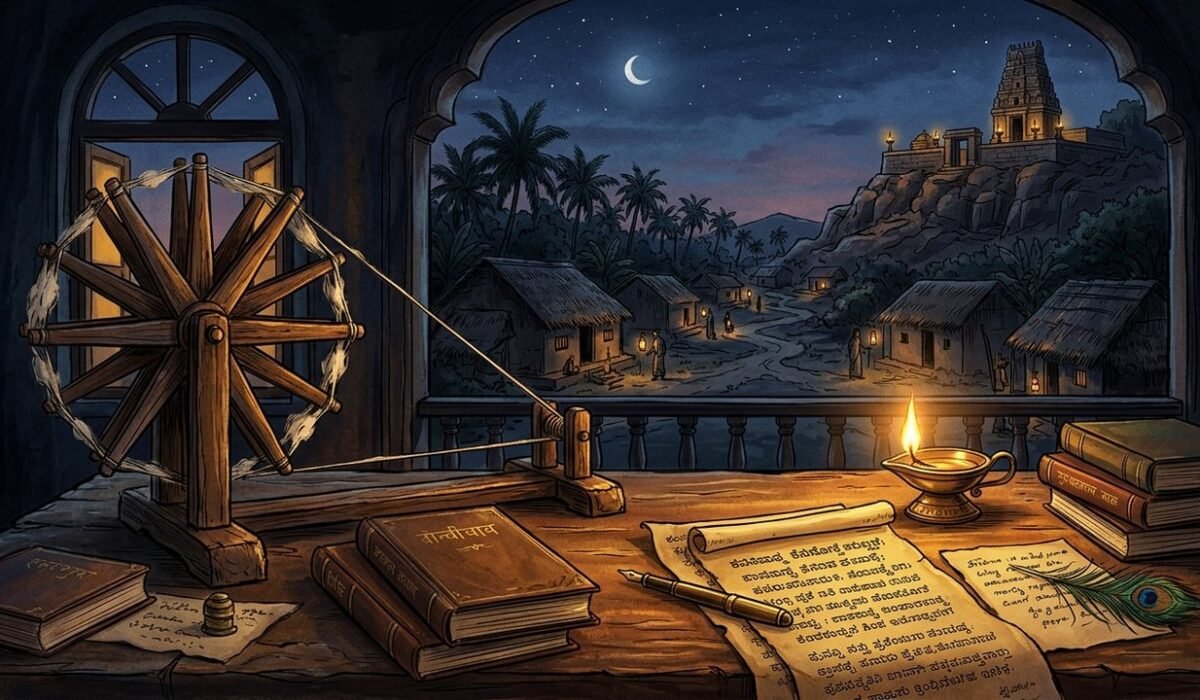
A small village in South India. An elderly woman’s voice. And a revolution that rewrites an entire community from the inside out.
That is the deceptively simple premise of Kanthapura and the reason Raja Rao’s 1938 novel remains one of the most frequently examined texts in UGC NET English, MA entrance exams, and Indian university syllabi. Students who search for Kanthapura summary often find themselves lost between generic plot recaps that skip everything examiners actually ask. This guide is different.
Below you will find a phase-wise narrative breakdown, a character discrimination table, an analysis of Raja Rao’s distinct Sthala-Purana narrative style, a theme-by-theme exploration, and 10 solved MCQs calibrated to NTA UGC NET question patterns. Read end to end or jump straight to the section you need.
Table of Contents
Key Takeaways
• Kanthapura (1938) is narrated by Achakka in the style of a traditional Sthala-Purana. This narrative technique is the most examined aspect of the novel.
• The central arc follows Moorthy as he mobilises a village across caste and gender lines against British colonial rule.
• Raja Rao’s Foreword discusses capturing Indian sensibility through English and appears directly in UGC NET questions.
• Key themes: Gandhian philosophy, caste reform, feminism, resistance, myth as political tool.
• The village is destroyed but its spirit is what the novel honours.
Background: Raja Rao and the Writing of Kanthapura
Raja Rao (see his literary profile on Encyclopaedia Britannica) wrote Kanthapura between 1929 and 1933, while living in France, drawing on Gandhi’s Civil Disobedience Movement. The novel was published in London in 1938.
In his celebrated Foreword, Rao articulates the central problem his novel grapples with:
We cannot write like the English. We should not. We cannot write only as Indians. We have grown to look at the large world as part of us. Our method of expression therefore has to be a dialect which will some day prove to be as distinctive and colourful as the Irish or the American.
Raja Rao, Foreword to Kanthapura (1938)
The Foreword is not mere autobiography. It is Rao’s literary manifesto and his claim that a distinctively Indian variety of English is a creative achievement, not a compromise. For UGC NET, know this quote cold.
Narrative Technique: The Sthala-Purana Style
Before diving into the plot, you need to understand how the story is told because examiners ask about form as often as content.
A Sthala-Purana is a traditional South Indian literary form: the legendary history of a sacred place, told orally by a community elder and interwoven with local deities, myths, and folk memory. Raja Rao consciously borrows this form for his novel.
| Feature | Western Novel Convention | Rao’s Sthala-Purana Style |
|---|---|---|
| Narrator | Third-person omniscient or detached first-person | Achakka, village elder; intimate, gossipy, collective |
| Sentence Rhythm | Standard English grammar | Long breathless sentences mimicking spoken Kannada-inflected speech |
| Mythology | Simile or metaphor | Gandhi literalised as Rama; British as Ravana; temple as political centre |
| Time | Linear chronology | Fluid, blending ritual, historical, and mythic time |
| Individual vs Community | Individual protagonist | The village itself is the collective protagonist |
This form has a practical consequence: the novel reads as though an elder is pulling you into community gossip, local legends, and political outrage simultaneously. That texture is not incidental. It is the argument. Rao shows that rural India had its own intellectual frameworks long before the English novel arrived.
Phase-Wise Summary of Kanthapura
Phase 1: The Village Before the Storm
Kanthapura is introduced as a caste-stratified South Indian village watched over by the goddess Kenchamma. We meet its inhabitants through Achakka’s wry narration: the powerful Brahmin Bhatta, the village patriarch Range Gowda, the progressive widow Rangamma, and her idealist nephew Moorthy, who returns from Mysore transformed by Gandhian ideas.
Moorthy’s first act: he visits the Pariah (Dalit) quarter, a transgression so shocking that the novel frames it in near-sacred language as though the gods themselves protest. This single act sets up the novel’s central conflict: Gandhian modernity vs. caste orthodoxy.
Phase 2: The Awakening
Moorthy introduces Harikatha, traditional devotional storytelling, but uses it to deliver nationalist messages. He organises charkha sessions, forms the village’s Congress committee, and breaks caste barriers. Sudra and Brahmin women join bhajans together; the Pariah colony enters public life.
Moorthy is excommunicated from his Brahmin caste. Rather than breaking him, it liberates him. He publicly burns his foreign clothes, a direct Gandhian gesture, and deepens his commitment. The women form the Sevika Sangha, named symbolically after Durga-Shakti.
Phase 3: Resistance, Repression, and Imprisonment
The movement escalates toward the Skeffington Coffee Estate, a site of British-backed plantation labour exploitation (studied comprehensively in UGC e-PG Pathshala’s module on Nationalism and Resistance in Kanthapura). Villagers stage a Satyagraha at the estate gates. The colonial police respond with lathi charges. Moorthy and several men are arrested and imprisoned.
This is the novel’s structural pivot. With the men imprisoned, women take over the movement entirely. Ratna and Rangamma coordinate resistance, distribute pamphlets, and maintain the network. The novel makes an explicit feminist argument: women are not merely supporters but the movement’s most reliable sustaining force.
Phase 4: The Destruction and Dispersal of Kanthapura
British forces, with help from Bade Khan (police inspector) and the turncoat Bhatta, systematically crush the village. Homes are burned. Families are scattered. Moorthy, released from prison, faces a village in ruins.
The novel ends not with defeat but with displacement. Achakka narrates from a different village, looking back. Kanthapura no longer exists as a place but as memory, a moral fact, a story told by an elder woman. That is precisely what a Sthala-Purana preserves. Rao’s ending is formally and thematically perfect.
Character Discrimination Table: Who’s Who and How They Differ
Exam questions frequently ask you to distinguish between characters whose roles seem similar. Here is the definitive comparison:
| Character | Allegiance | Role in Movement | Symbolic Significance | Fate |
|---|---|---|---|---|
| Moorthy | Gandhian nationalist | Primary organiser; moral centre | Gandhi’s principles transplanted into village soil | Imprisoned; released to a destroyed village |
| Achakka | Witness; narrator | Community memory; voice of Kanthapura | The Sthala-Purana itself | Survives; narrates from exile |
| Rangamma | Gandhian nationalist | Women’s leadership; Sevika Sangha organiser | Political widow; feminism within nationalism | Continues resistance after dispersal |
| Ratna | Gandhian nationalist | Frontline agitator and protester | Defiant widow who refuses social submission | Continues agitation |
| Bhatta | Pro-British; self-serving | Informer; opposes Moorthy | Collaborator who exploits religion for power | Becomes a British instrument |
| Range Gowda | Neutral to nationalist | Village elder who transitions to supporter | Traditional authority that Gandhism wins over | Supports movement; loses property |
| Bade Khan | Colonial state | Police inspector enforcing British rule | Face of colonial violence in the village | Antagonist throughout |
Major Themes in Kanthapura
1. Gandhian Philosophy as Village Religion
Rao does not present Gandhism as an ideology imported from outside. He shows it absorbed into the village’s existing religious language. Gandhi becomes Rama. The British become Ravana. The spinning wheel becomes a devotional object. Rao argues that the independence movement succeeded because it spoke in a language the village already knew: myth, ritual, devotion.
2. Caste as the Internal Enemy
The British are an external antagonist. But the novel is equally concerned with the internal one: the caste system dividing Brahmins, Sudras, and Pariahs into sealed worlds. Moorthy’s transgression into the Pariah quarter is a double act of resistance against British colonialism and against Brahminic social order simultaneously. Rao suggests national liberation cannot happen without social liberation.
3. Women’s Agency Within and Beyond the Movement
The most consequential characters in Phase 3 are women. When Moorthy is imprisoned, the resistance reorganises under female leadership. Rangamma and Ratna exercise specifically female forms of political authority: community organisation, oral communication, and collective action through daily ritual spaces. The novel anticipates feminist readings of the independence movement by decades.
4. Language as the Medium of Resistance
Rao’s long, associative sentences full of Kannada idioms, local proverbs, and run-on oral rhythms are themselves a political act. They refuse the clean declarative prose of the English novel in favour of a voice that sounds like it is being told, not written. The novel’s style enacts the very argument it makes about Indian resistance to colonial forms.
Kanthapura and the Indian English Novel Tradition
Kanthapura belongs to the first wave of Indian English fiction alongside Mulk Raj Anand’s Untouchable (1935) and R.K. Narayan’s Swami and Friends (1935). What distinguishes Rao’s contribution is his insistence on form as the primary vehicle of cultural identity. Scholars (including commentators on Encyclopaedia Britannica’s entry on Kanthapura) frequently call it the first genuinely postcolonial Indian English text. For deeper study of the Raja Rao canon, also see our guides on The Serpent and the Rope and The Chessmaster and His Moves.
10 Solved MCQs on Kanthapura (UGC NET and University Exam Pattern)
These questions are modelled on NTA UGC NET Paper 2 (English) patterns. Attempt them before reading the answers.
Q1. Raja Rao describes Kanthapura as belonging to which ancient Indian narrative tradition?
(A) Panchatantra (B) Sthala-Purana (C) Upanishad (D) Mahabharata
Answer: (B) Sthala-Purana. Rao explicitly names the novel a sthala-purana in his Foreword, one of the most directly examined facts about the novel.
Q2. Who narrates Kanthapura?
(A) An omniscient narrator (B) Moorthy (C) Achakka (D) Rangamma
Answer: (C) Achakka. An elderly Brahmin woman whose oral narration style gives the novel its distinctive rhythm and community voice.
Q3. Which character is most directly associated with the Sevika Sangha?
(A) Ratna (B) Achakka (C) Rangamma (D) Moorthy’s mother
Answer: (C) Rangamma. She organises and leads the Sevika Sangha and represents the feminist dimension of the novel’s politics.
Q4. The Skeffington Coffee Estate in Kanthapura represents:
(A) A site of rural leisure (B) Colonial economic exploitation (C) A Congress party office (D) A government school
Answer: (B) Colonial economic exploitation. The Estate is where the key Satyagraha takes place and where colonial repression becomes most violent.
Q5. In Kanthapura, Gandhi is mythologised as:
(A) Shiva (B) Krishna (C) Rama (D) Hanuman
Answer: (C) Rama. The British are Ravana; Gandhi is Rama. Rao uses this mythic framework to show nationalism absorbed into village religious consciousness.
Q6. Raja Rao’s Foreword to Kanthapura primarily discusses:
(A) The political context of independence (B) The challenge of expressing Indian sensibility through English (C) The biography of the village (D) A dedication to Gandhi
Answer: (B) The challenge of expressing Indian sensibility through English. The Foreword is Rao’s manifesto for a distinctively Indian variety of English.
Q7. Which character functions as a traitor and informer for the British?
(A) Range Gowda (B) Bade Khan (C) Bhatta (D) Narsamma
Answer: (C) Bhatta. The Brahmin priest opposes the Gandhian movement out of self-interest and becomes a British collaborator, directly contrasted with Range Gowda who eventually supports the movement.
Q8. Kanthapura was first published in:
(A) 1930 (B) 1935 (C) 1938 (D) 1943
Answer: (C) 1938. Written between 1929 and 1933, published in London in 1938.
Q9. What does Moorthy burn publicly as a Gandhian gesture?
(A) British government orders (B) His foreign clothes and books (C) Skeffington Estate records (D) Letters from the District Collector
Answer: (B) His foreign clothes and books. This mirrors Gandhi’s Swadeshi movement, rejecting British-manufactured goods as economic and symbolic resistance.
Q10. How does Kanthapura end?
(A) Moorthy becomes village head after independence (B) The village is destroyed and the community scattered (C) The British leave Kanthapura (D) Achakka’s family is restored to their property
Answer: (B) The village is destroyed and the community scattered. Achakka narrates from a different village. Kanthapura no longer exists as a physical place, only as memory and story. The sthala-purana survives even when the sthala (place) does not.
Frequently Asked Questions
What is the central theme of Kanthapura?
The novel’s central theme is the transformative power of Gandhian philosophy on traditional Indian village life. Rao shows how Gandhi’s principles are absorbed by a rural South Indian community through its own religious and cultural frameworks, demanding both national liberation from British rule and social liberation from caste hierarchy.
What is the significance of the Sthala-Purana narrative style in Kanthapura?
The Sthala-Purana is a traditional oral form, the legendary chronicle of a sacred place told by a community elder. Raja Rao adopts this form to argue that Indian fiction in English need not imitate the Western novel. By telling the story through Achakka’s oral, gossip-inflected voice full of local myths and Kannada-inflected rhythms, Rao creates a novel that is formally Indian, not just thematically so.
How does Kanthapura portray women’s roles in the freedom struggle?
Kanthapura gives women a central role. When Moorthy is imprisoned, women led by Rangamma and Ratna sustain the resistance. The Sevika Sangha, symbolically named after Durga-Shakti, becomes the movement’s most organised unit. Rao presents female activism as the spine of rural nationalism.
What is Raja Rao’s Foreword to Kanthapura about?
The Foreword is Rao’s statement on the challenge and possibility of Indian English writing. He argues that Indian writers cannot and should not write like the British, but need not be limited to a narrowly Indian perspective either. He proposes a new dialect of English that carries Indian rhythms, idioms, and sensibilities. This Foreword is frequently cited in UGC NET questions.
Is Kanthapura considered a postcolonial novel?
Yes. Scholars frequently call it one of the first genuinely postcolonial Indian English texts, predating even the term postcolonial. Rao’s use of a pre-modern Indian narrative form to resist the cultural authority of the Western novel is a foundational postcolonial gesture. His formal choices, not just his politics, constitute the novel’s postcolonial argument.
3 responses