The language of paradox is the primary medium of poetry, according to Cleanth Brooks, because it allows writers to express complex emotional truths that logic and science cannot reach. In his influential 1947 work The Well Wrought Urn, Brooks argued that paradox is not just a clever rhetorical trick but the very fabric of poetic communication. By using contradictions, poets can unify opposing ideas into a single, cohesive experience.
Table of Contents
Key Takeaways
- Paradox is Essential: Brooks claims that paradox is the “language appropriate and inevitable to poetry.”
- Scientific vs. Poetic Language: Science seeks one-to-one literal meanings; poetry relies on the tension between multiple meanings.
- Unity in Contradiction: The language of paradox allows a poem to hold two conflicting ideas as true simultaneously.
- The New Criticism Context: Brooks was a leader in New Criticism, which emphasizes the text itself over the author’s life or historical background.
- Functional Irony: Paradox works alongside irony to create a “well-wrought” structure where every part depends on the whole.
- Beyond Logic: Poetic truth is “organic,” meaning it grows from the relationship between words rather than literal dictionary definitions.
What is the language of paradox in literary theory?
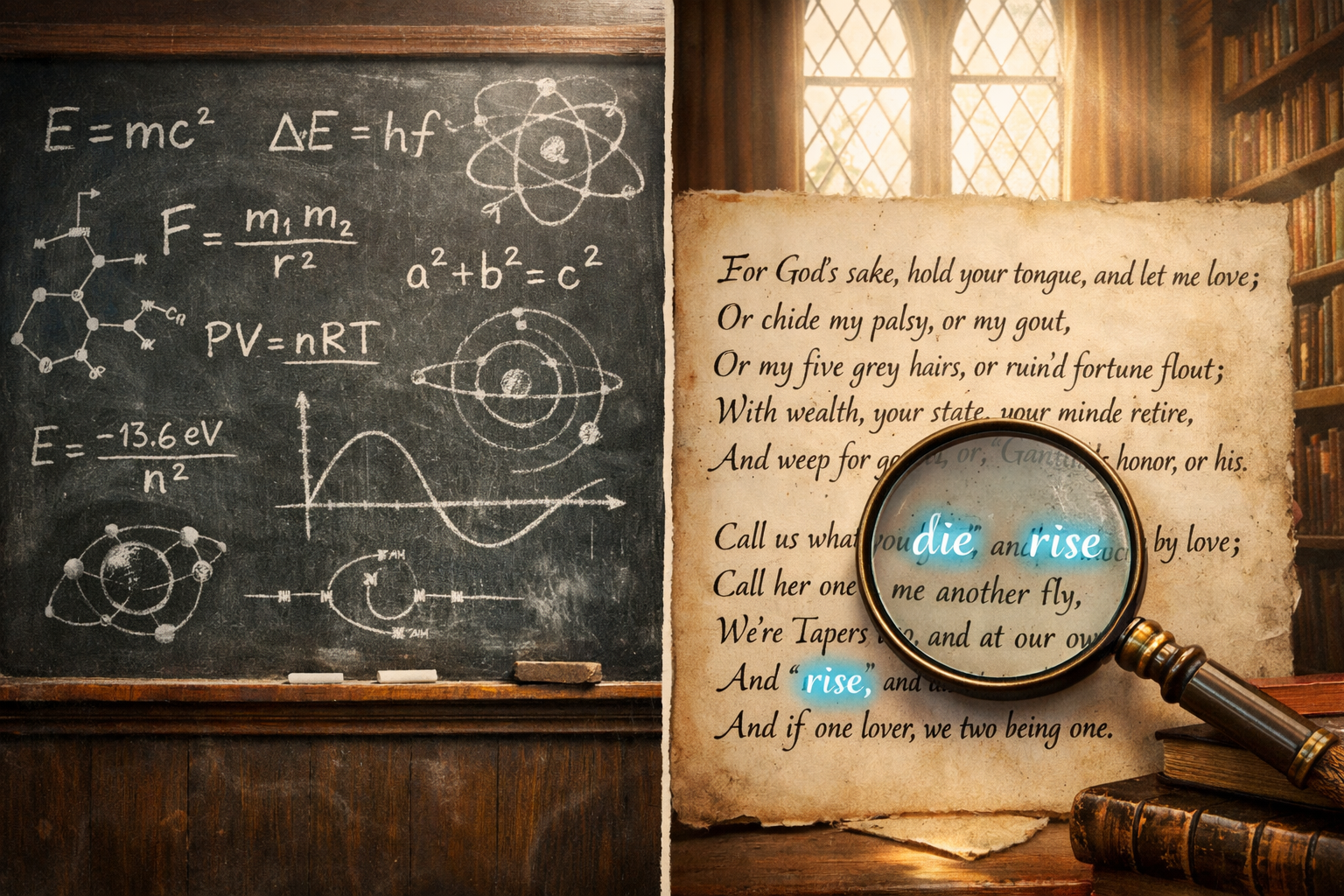
In literary theory, the language of paradox refers to the use of contradictory statements or concepts that, when analyzed, reveal a deeper, unified truth. Cleanth Brooks argued that while science tries to purge language of ambiguity to be precise, poetry embraces ambiguity to be accurate to human experience. A poem uses paradox to resolve the tensions of life into a single artistic moment.
Brooks famously used John Donne’s poem “The Canonization” to show how the language of paradox works. In the poem, lovers are compared to both “flies” and “tapers” (candles) that burn themselves out. While logically a person cannot be both a predator and a victim of their own heat, the paradox captures the intense, self-consuming nature of passion.
- Choose Paradox if: You want to describe a complex feeling (like bittersweet joy) that a single literal word cannot capture.
- Avoid Paradox if: You are writing a technical manual or a scientific report where clarity and singular meaning are the goals.
Why did Cleanth Brooks believe paradox was inevitable in poetry?
Brooks believed the language of paradox was inevitable because the “truth” a poet seeks to convey is rarely a straight line. Life is full of contradictions—people love and hate simultaneously, or find strength in weakness. Because poetry deals with these human complexities, it cannot use the “stabilized” language of a laboratory.
He argued that if a poet tries to be purely literal, the poem becomes flat and loses its power. To get at the “inner heart” of a subject, the poet must approach it indirectly. Brooks suggested that even poems that seem simple on the surface, like those by William Wordsworth, rely on a hidden language of paradox to create their emotional impact.
The “Irony” Connection: Brooks often paired paradox with irony. He viewed irony as the “pressure of the context” on a word. For example, the word “praise” might mean the opposite if said in a mocking tone. Paradox is the structural version of this pressure, where the whole poem forces words to mean more than their literal definitions.
How does the language of paradox differ from scientific language?
The primary difference lies in the goal of the communication: science aims for “purity” of meaning, while poetry aims for “density.” In a scientific paper, every term should have a fixed, universal definition. In the language of paradox, terms are fluid and depend entirely on the context of the poem.
| Feature | Scientific Language | Language of Paradox (Poetry) |
|---|---|---|
| Goal | Clarity and singularity | Complexity and unity |
| Method | Literal definition | Contextual tension |
| Structure | Linear logic | Organic synthesis |
| Success Metric | Verifiable data | Aesthetic “truth” |
Common Mistake: Many students assume paradox is just a mistake or a “confusion” in the text. In the Brooksian view, the paradox is the “solution,” not the problem. It is the only way to hold a complex idea together without thinning it out.
What are the famous examples of paradox in Brooks’ analysis?
Cleanth Brooks focused heavily on the Metaphysical poets, particularly John Donne, to prove his point. However, he also applied the language of paradox to Romantic poets to show that his theory was universal.
- John Donne’s “The Canonization”: The lovers become “saints” through their secular, physical love. This is a paradox because sainthood usually requires the rejection of the physical.
- William Wordsworth’s “Composed upon Westminster Bridge”: The city, usually seen as a place of noise and grime, is described as having a “calm so deep” that it rivals nature. The paradox is that the most artificial place (the city) provides the most natural peace.
- T.S. Eliot’s “The Waste Land”: Modern life is depicted as a “death-in-life,” where people are physically moving but spiritually empty.
Edge Case: Can a poem exist without paradox? Brooks would argue that even if it doesn’t have an obvious “A is B and not B” statement, the way metaphors work is inherently paradoxical. A metaphor says one thing is another (which is literally false) to reveal a higher truth (which is poetically true).
How does the language of paradox relate to “The Well Wrought Urn”?
The title of Brooks’ 1947 book, The Well Wrought Urn, is itself a reference to the language of paradox. It comes from Donne’s “The Canonization,” where the poet says that even if the lovers don’t have a grand tomb, their love will be preserved in a “well-wrought urn” (a poem).
Brooks uses this image to argue that a poem is a self-contained object. You cannot take a “message” out of a poem any more than you can take the shape out of an urn. The language of paradox is what gives the urn its shape. If you try to paraphrase the poem (The Heresy of Paraphrase), you break the urn and lose the paradox that made it special.
- Key Concept: The Heresy of Paraphrase.
- The Idea: You cannot summarize a poem’s “meaning” in plain prose because the meaning is tied to the paradoxical structure.
- The Result: To understand the poem, you must look at how the language of paradox functions within the text, not just look for a moral or a summary.
What is the role of the reader in identifying poetic paradox?
For a reader in 2026, engaging with the language of paradox requires a shift from “reading for information” to “reading for experience.” Brooks’ method, known as Close Reading, asks the reader to look for tensions, shifts in tone, and conflicting images.
To identify paradox, look for:
- Oxymorons: Phrases like “living death” or “darkness visible.”
- Situational Contradictions: A character who gains everything but feels they have lost everything.
- Metaphorical Clashes: Comparing something soft to something hard to describe a specific texture of feeling.
Decision Rule: If you encounter a line in a poem that makes no logical sense, don’t assume the poet is being vague. Ask yourself: “How does this contradiction describe an emotion that logic can’t handle?” That is usually where the language of paradox is doing its heaviest lifting.
FAQ
What is Cleanth Brooks’ definition of paradox?
Brooks defines paradox as the fundamental language of poetry, where contradictory or opposing ideas are fused together to express a complex truth that literal language cannot convey.
Is paradox the same as an oxymoron?
No. An oxymoron is a figure of speech (two words, like “bittersweet”), while the language of paradox is a broader structural concept where the entire theme or situation of a poem involves conflicting truths.
Why did Brooks hate paraphrasing poems?
He called it the “Heresy of Paraphrase.” He believed that a poem’s meaning is inseparable from its form and its language of paradox. If you summarize it, you strip away the tension that makes it poetry.
Who are the “New Critics”?
The New Critics were a group of 20th-century scholars, including Brooks, who argued that literary analysis should focus strictly on the text itself, ignoring the author’s biography or the historical era.
Can paradox be found in modern songs?
Absolutely. Many songwriters use the language of paradox to describe heartbreak or social issues, such as lyrics describing a “crowded room where I feel all alone.”
Did Brooks only care about old poetry?
While he loved the Metaphysical poets, he argued that the language of paradox is a universal “poetic principle” found in all great literature, from Shakespeare to modernists like T.S. Eliot.
Conclusion
The language of paradox is more than just a literary device; it is a way of seeing the world in all its messy, beautiful complexity. Cleanth Brooks taught us that poetry doesn’t succeed by being simple or “correct” in a scientific sense. Instead, it succeeds by embracing the contradictions of the human heart and forging them into a “well-wrought urn.”
To apply this in your own studies or writing, stop trying to “solve” poems as if they were math problems. Instead, look for the points where the language seems to break or contradict itself. It is in those cracks—those paradoxes—where the most profound truths usually hide. If you can master the art of identifying and appreciating the language of paradox, you will find that literature becomes not just a subject to study, but a mirror reflecting the intricate realities of life.
Sources
- Brooks, C. (1947). The Well Wrought Urn: Studies in the Structure of Poetry. Harcourt, Brace & World.
- Wellek, R. (1986). A History of Modern Criticism: 1750-1950. Yale University Press.
- Donne, J. (1633). Songs and Sonnets. (Reference for “The Canonization”).