A tiny mark moves across a white page. At first, a writer is ready to stop it with his pen. Then he notices that it moves in ways that seem purposeful. That small pause changes the scene in Robert Frost’s poem “A Considerable Speck”: the speaker begins to ask what he owes a creature he had barely noticed.
The poem follows that change from first impression to careful attention. The speaker reads the mite’s movements as signs of fear and choice, decides it has a mind, and lets it live. The poem does not prove what the mite feels. Its interest lies in how the speaker observes, interprets and finally restrains his own power.
Key Takeaways
- The speaker first sees a speck, then recognises it as a living mite.
- Its pauses and movements lead him to infer a wish to survive; this is an interpretation, not scientific proof.
- He spares the creature because he knows no harm of it and values a display of mind.
- The title plays on the mite’s tiny size and its worth as an object of thought.
The poem appears in Robert Frost’s 1942 collection A Witness Tree under the title “A Considerable Speck (Microscopic).” It is also included in the ICSE 2027 Class X Treasure Chest prescribed list. Both references are linked in Sources.
A Considerable Speck Summary
While writing on a white sheet, the speaker notices a tiny speck moving across the page. He first considers stopping it with a dot of ink. Its movement makes him reconsider: this is not dust blown by his breath but a living mite with inclinations of its own.
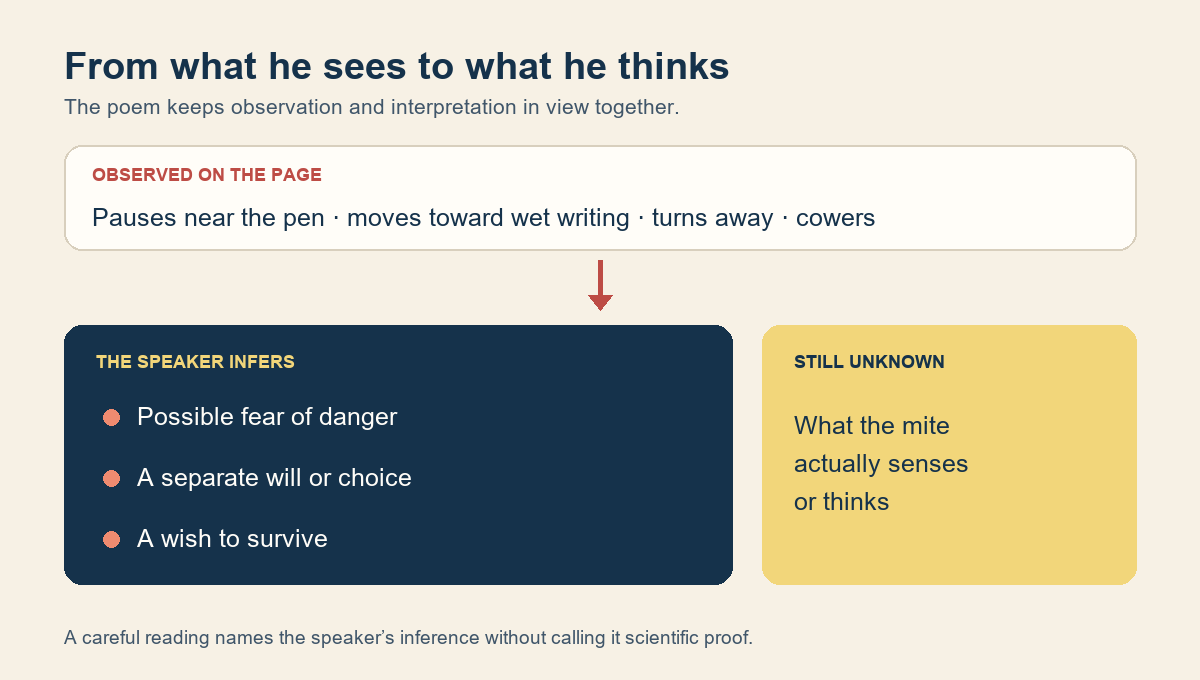
The mite pauses near the pen, races toward the still-wet writing, pauses again and turns away. The speaker cannot tell whether it drinks or smells the ink, but he reads its behaviour as suspicion, dislike and fear. As it falters and crouches in the middle of the sheet, he recognises how completely its fate rests in his hands. He rejects the kind of collective love he describes as regimented, yet chooses to spare this particular creature because he knows no evil of it. The poem ends with his pleasure at finding a sign of mind, however small.
The speaker is the voice in the poem. Although he resembles a writer at work, a student should not treat every statement as a verified fact about Frost’s life. For another Frost poem that begins with an ordinary encounter and opens into a larger question, compare “Mending Wall”, while keeping the two poems’ speakers distinct.
Line-by-Line Explanation of A Considerable Speck
These five reading groups follow the 33 lines in the 1942 collection. They are study divisions, not separate stanzas. Check the line breaks and punctuation in your own Treasure Chest edition before citing line numbers in an answer.
Lines 1–9: From a speck to a living mite
The opening explains why the tiny speck catches the speaker’s attention: it is moving across a white sheet. The contrast between the pale paper and the small mark makes the movement visible. The speaker has paused with his pen in the air and thinks of stopping the speck with a period of ink. The word period means a full stop, but here it also suggests the end of the mite’s life. That double meaning gives the moment a dry, unsettling humour.
The speaker then notices something strange about the speck. He concludes that it is not dust carried by his breath. It is a living mite, with inclinations—tendencies or preferences—of its own. The change matters: he no longer sees an object moving on the page; he sees a small creature acting independently.
Lines 10–18: The speaker interprets the mite’s movements
The mite pauses near the pen, then races toward the part of the manuscript that is still wet. It pauses again and either drank or smelt the ink. This uncertainty matters. The speaker cannot say exactly what the mite is doing; he offers alternatives. When it turns away, he describes the response as loathing, or strong dislike.
From this sequence, the speaker says he is dealing with intelligence. He imagines that the mite’s tiny feet express how much it does not want to die. The observation is the mite’s movement; fear and intention are the speaker’s interpretation of it. This distinction keeps a close reading careful: the poem shows what the speaker sees and what he concludes from it.
Lines 19–23: Terror, cunning and surrender
The pace changes as the mite runs, creeps and falters. Falter means to hesitate or lose steadiness. The speaker describes the creature’s movement as terror and cunning: it seems frightened, yet it also seems to choose where to go. These words make the mite’s struggle vivid, but they remain the speaker’s account of behaviour rather than proof of the creature’s thoughts.
At the centre of the open sheet, the mite cowers and appears to accept whatever fate the speaker accords it. Accord here means to grant or assign. The power difference is stark: the speaker can kill the mite with one movement, while it cannot control what he will do.
Lines 24–29: A particular act of mercy
The speaker now comments on the kind of love he rejects. He uses the phrase “collectivistic regimenting love” for a public or group sentiment that he considers controlling. The poem does not identify a specific political movement, so readers should avoid presenting one as the definite target.
He then turns from that general idea to the mite before him. He says he knows no evil of it and lets it remain. This is a decision about one creature, not a broad declaration that he loves all living things. His response follows his attention to its behaviour and his own ability to harm it.
Lines 30–33: Mind recognises mind
In the final lines, the speaker says he has a mind and recognises mind in any guise, meaning any form or appearance. He is glad to find even the least display of mind on a sheet. The ending brings the poem back to the page where it began: the sheet is both the place where the mite moves and the surface on which the speaker writes.
The closing thought can be read as the speaker’s delight at encountering a mind in a small creature. Because the creature appears on a manuscript, the ending also leaves room for a quieter joke about what a writer hopes to find on a page. That second reading is suggestive, not certain.
Themes, Title and the Meaning of the Ending
The poem asks readers to consider how attention changes the value they assign to a small life. A movement on paper interrupts the speaker’s writing, becomes a sequence of clues, and leads him to withhold an action that would destroy the creature.
Why the title matters
Considerable can describe something large or significant, but it can also mean worthy of consideration. A speck is tiny. The title brings those meanings together: the mite is very small, yet the encounter makes it worth thinking about. Some classroom explanations call this an oxymoron because the words seem to pull in opposite directions. It is more precise to explain both senses of considerable rather than stop at the label.
Attention, individuality and power
The speaker’s decision grows out of sustained attention to one creature. He notices it pause, move toward the wet manuscript, recoil and falter. He interprets those actions as signs of a separate will. The poem’s ethical question follows from that interpretation: if the speaker sees a life rather than a mark, what should he do with the power he has over it?
The poem does not present the mite as equal in physical strength. The speaker holds the pen, and the creature’s fate depends on his choice. His decision to leave it alone shows restraint. The scene does not require a claim that the mite is biologically intelligent in a human sense; it shows the speaker recognising what he takes to be a display of mind.
Individual mercy and collective sentiment
The speaker sets his response to this mite against his criticism of regimented collective love. Readers may debate what social ideas the phrase points toward, but the poem alone does not name a movement or provide enough evidence to settle that question. A sound answer stays with the contrast the poem gives us: the speaker rejects a general, organised sentiment, then responds to the individual creature in front of him.
The ending’s dry wit
The last lines can be read sincerely: the speaker is pleased to recognise mind in a form he might otherwise overlook. They also carry a hint of self-awareness. The event happens on a sheet of writing, and the speaker is delighted to find mind there. The poem lets both ideas coexist without explaining the joke for the reader.
For another concise Frost poem where an image carries a broader idea, see “Fire and Ice”. Its opposing images help readers compare how a poem can compress an argument, though the poems make different arguments.
Poetic Devices and Their Effects
Frost’s techniques help the reader follow the speaker’s changing judgment. A useful answer names a device only when it can explain what that device contributes.
| Device | Evidence in the poem | Effect |
|---|---|---|
| Visual imagery | A tiny mark on white paper; the pen and wet manuscript | Makes the small encounter visible and gives the speaker a reason to notice it. |
| Rhyme | The opening pairs sight/white, there/air and ink/think | Gives the speaking voice a measured pattern while the mite’s movements interrupt the scene. The rhyme varies across the poem; do not force a simple scheme onto all 33 lines. |
| Sound patterning | The repeated initial sound in cunning crept | Draws attention to the phrase’s movement; explain the effect modestly rather than claiming the sound proves an intention. |
| Personification | The speaker describes suspicion, loathing, terror and cunning | Presents the mite as a character in a struggle while reminding us that these motives are attributed by the speaker. |
| Wordplay | A period of ink can be punctuation and a threat to the mite | Connects the speaker’s writing to the creature’s vulnerability and adds dark humour. |
| Enjambment and syntax | Sentences continue across several line breaks | Lets observations gather over time instead of ending at each line. Use the exact breaks in your prescribed edition when discussing a specific example. |
Avoid calling the poem blank verse or free verse without evidence. It uses rhyme, but the pattern is not a simple repeated couplet scheme. Compare its variable rhyme with the more regular pattern discussed in LitGram’s guide to “The Road Not Taken”.
How to Build an Evidence-Based Answer
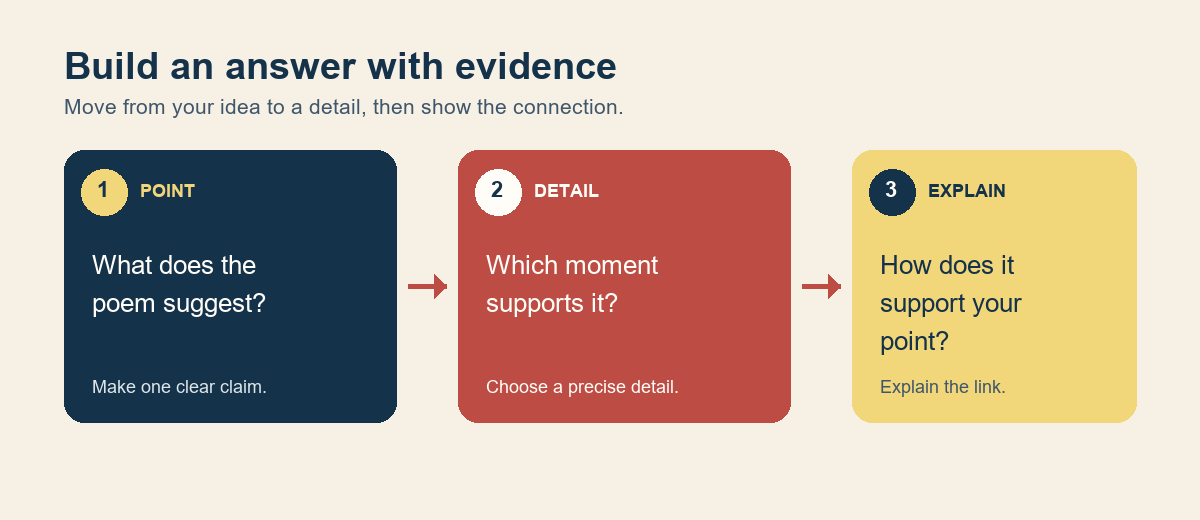
Use three steps: point, textual detail, explanation. State what you think the poem shows, identify a moment that supports your point, and explain the connection. Avoid turning an inference into a fact about the mite.
Question: Why does the speaker spare the mite?
Point: The speaker spares the mite after interpreting its movements as signs of a separate mind.
Textual detail: It pauses near the pen, moves across the wet manuscript, turns away and later cowers on the open sheet.
Explanation: The speaker reads these actions as signs of fear and a wish to survive. Since he has the power to kill it and knows no evil of it, he chooses to leave it alone.
| What the speaker observes | What he infers | Careful wording for an answer |
|---|---|---|
| The mite pauses near the pen. | It may sense a threat. | The speaker reads its pause as suspicion. |
| It turns away from the wet ink. | It dislikes the ink. | He interprets the turn as loathing, though he cannot know exactly what the mite senses. |
| It cowers on the sheet. | It accepts its fate. | The speaker presents its stillness as surrender. |
Original Questions and Answers
These are original revision questions, not official or previous-year examination questions.
1. Why does the speck become important to the speaker?
Its movement makes the speaker question his first impression. He recognises it as a living mite and interprets its pauses and changes of direction as signs of intention. It becomes important because he sees it as a mind with a life of its own.
2. What is the significance of the title?
The title joins the speck’s tiny size to the idea that it is worth considering. As the speaker observes the mite, he gives it increasing significance. A strong answer explains both meanings of considerable rather than calling the phrase an oxymoron without comment.
3. What does the speaker’s uncertainty about the ink show?
He cannot tell whether the mite drank or smelled the ink. This admission shows that he distinguishes what he observes from what he guesses. The poem lets the speaker infer motive without pretending that he knows every detail of the creature’s experience.
4. What does the speaker’s use of guise add to the ending?
Guise means form or appearance. The speaker says he recognises mind in any guise, so the idea is not limited to a human form. The mite matters because the speaker sees a display of mind in something very small.
Paraphrased context practice
A student is writing on a white page when a tiny insect crosses the paper. She first raises her hand to brush it away. It pauses as the hand moves, changes direction and reaches the edge of the page. She lowers her hand and watches it leave.
(a) How does the student’s response change?
She moves from reacting without thought to watching the insect’s behaviour. After noticing its movement, she decides not to brush it away.
(b) Which detail invites the student to infer awareness, and what should she avoid claiming?
The insect pauses and changes direction as her hand moves, which invites her to infer that it responds to a threat. She should describe this as an inference from behaviour, not proof of what the insect thinks.
10 Practice MCQs with Explained Answers
These original questions are for revision. They are not predictions or official board questions.
1. Why does the speaker notice the speck?
A. It makes a sound.
B. It moves across the white paper.
C. It marks his pen.
D. It falls from the window.
Answer: B. The movement across a white surface catches his attention. The poem does not say the speck makes a sound or comes from the window.
2. What does the speaker first intend to do?
A. Lift the paper.
B. Blow the speck away.
C. Stop it with ink from his pen.
D. Measure it.
Answer: C. He has poised his pen to make a period of ink. He does not describe a plan to measure the mite.
3. In the poem, inclinations most nearly means:
A. Preferences or tendencies.
B. Marks made by a pen.
C. Lines on a page.
D. The direction of the light.
Answer: A. The word describes tendencies the speaker believes the mite can call its own.
4. Which detail most clearly preserves uncertainty?
A. The speaker says the creature is a mite.
B. He cannot tell whether it drank or smelled the ink.
C. He sees the sheet of paper.
D. He holds his pen above the page.
Answer: B. The speaker offers two possibilities instead of claiming to know what the mite did.
5. What happens after the mite pauses near the pen?
A. It moves toward the wet manuscript.
B. It jumps off the desk.
C. It hides under the paper.
D. It stops the speaker from writing.
Answer: A. The poem describes it moving on to the part of the manuscript that is not yet dry.
6. What does the speaker infer from the mite’s movements?
A. It has a human voice.
B. It is part of the ink.
C. It shows signs of intelligence and a wish to live.
D. It knows the poem’s subject.
Answer: C. The speaker interprets the pauses and flight as purposeful behaviour. The poem does not claim the mite understands the writing.
7. What does accorded mean in the context of the mite’s fate?
A. Granted or assigned.
B. Hidden from view.
C. Written on the page.
D. Taken away by the wind.
Answer: A. The mite appears to accept whatever fate the speaker grants it.
8. Why does the speaker mention collective love?
A. To explain the mite’s species.
B. To contrast a general, regimented sentiment with his response to one creature.
C. To ask the reader to organise a group.
D. To prove a political movement caused the event.
Answer: B. The speaker contrasts his rejection of regimented collective affection with his choice to spare this particular mite. The poem does not name a specific movement.
9. Why is the title appropriate?
A. The mite is physically large.
B. The speaker measures the page.
C. The speck is tiny but becomes worthy of thought.
D. The paper is difficult to see.
Answer: C. Considerable can mean worthy of consideration, even though the speck is minute.
10. What does the final thought emphasise?
A. The speaker values signs of mind in any form.
B. The speaker wants to stop writing.
C. The mite has fallen asleep for certain.
D. The page is no longer useful.
Answer: A. The speaker ends by expressing pleasure at finding a display of mind. His earlier wording makes sleep a hope, not a certainty.
Common Mistakes and Quick Revision
- Say the speaker infers fear or intention from behaviour; do not call it scientific proof.
- The poem identifies a living mite, but it does not give a species name.
- Explain both senses of considerable when discussing the title.
- Keep the speaker distinct from Robert Frost.
- The speaker hopes the mite sleeps; he does not claim to witness it sleeping.
- Do not assign the political phrase to a named ideology unless a reliable critical source supports that reading.
Quick recap: a speck catches the speaker’s eye; movement makes him reconsider; he interprets it as mind; he chooses restraint.
Frequently Asked Questions
What is the central idea of A Considerable Speck?
The poem shows how the speaker’s attention to a tiny moving creature leads him to recognise what he interprets as a separate mind and to spare it.
Why is the poem called A Considerable Speck?
The title plays on the speck’s small size and the sense of considerable as worth thinking about. The creature becomes significant to the speaker as he watches it.
Why does the speaker spare the mite?
He sees signs of a mind in its behaviour, knows no evil of it and has the power to kill it. He chooses to leave it alone.
Does the poem prove that the mite is intelligent?
No. It shows the speaker interpreting the mite’s movements as signs of intelligence. A careful explanation distinguishes the observed actions from the motive he assigns to them.
For revision, choose one movement in the poem and write three sentences: make a point, identify a textual detail, and explain how the detail supports your reading.
Sources
- Robert Frost, A Witness Tree (1942), including “A Considerable Speck (Microscopic),” p. 57. Read the collection transcription. Faded Page notes that its public-domain status applies in Canada and may differ elsewhere; this article quotes only brief phrases.
- The Morgan Library & Museum, catalogue record for the poem’s 1939 separate printing. View catalogue record PML 188017.
- Council for the Indian School Certificate Examinations, ICSE Examination Year 2027: List of Prescribed Textbooks, Class X. View Appendix I.
About the author
Mukesh Rishit is the founder of LitGram, which publishes English-literature study guides for students in India. This guide is grounded in Frost’s poem and the official CISCE prescribed-text list; it distinguishes the speaker’s observations from his interpretations. For questions or corrections, see Contact LitGram.