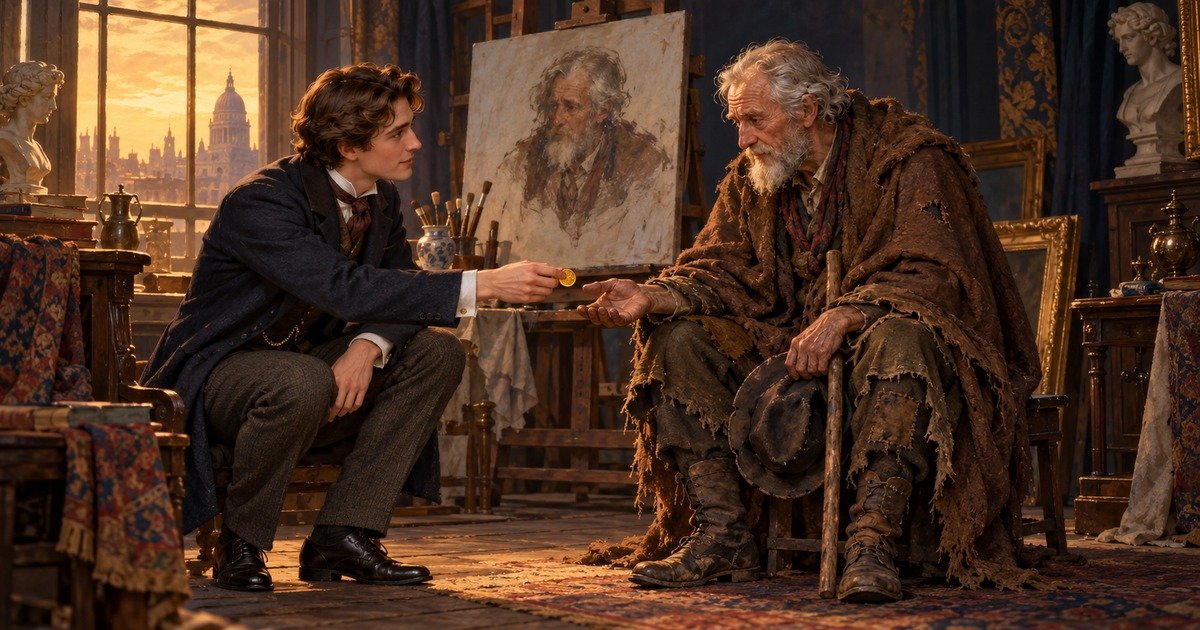
The Model Millionaire is a short story by Oscar Wilde, first printed in 1887. Hughie Erskine, a poor young man, gives a sovereign to an old beggar who is posing for his painter friend. The beggar is really Baron Hausberg, one of the richest men in Europe. It is a Class 9 text in the ICSE 2027 Treasure Chest list.
The Model Millionaire at a glance
| Detail | What to remember |
|---|---|
| Author | Oscar Wilde (1854-1900), an Irish writer |
| First printed | The World, June 1887. Collected in Lord Arthur Savile’s Crime and Other Stories (1891) |
| Full title | The Model Millionaire: A Note of Admiration |
| Kind of story | A short comic story with a surprise ending |
| Main characters | Hughie Erskine, Alan Trevor, Baron Hausberg, Laura Merton |
| Board and class | ICSE 2027, English Paper 2 (Literature), Class IX. It is in Treasure Chest, listed in the board’s list of prescribed books |
| Setting | London: a painter’s studio, the Palette Club and Hughie’s rooms |
Read this guide with your textbook open. The quotations below come from the story, and the full text is free on Project Gutenberg. Your exam may use the Treasure Chest version, so check any line you copy against your book.
The Model Millionaire summary in five steps
1. A charming young man with no money. Hughie Erskine is handsome and well liked, but he cannot earn. He lives on “two hundred a year that an old aunt allowed him” and has failed at the Stock Exchange, tea-selling and selling sherry. He loves Laura Merton. Her father, a retired Colonel, will not allow an engagement until Hughie has ten thousand pounds of his own.
2. The beggar in the studio. One morning Hughie visits his friend Alan Trevor, a painter. Trevor is finishing a life-size picture of a beggar. The model is a “wizened old man” with a “most piteous expression”, in torn clothes. Trevor leaves the room for a moment.
3. The sovereign. Hughie feels sorry for the old man. He has only a sovereign and some coppers. He thinks, “it means no hansoms for a fortnight”, and still slips the coin into the beggar’s hand. The old man smiles and thanks him.
4. The shock. That night at the Palette Club, Trevor says the old man is Baron Hausberg, “one of the richest men in Europe”. The Baron had asked Trevor to paint him as a beggar. Hughie is embarrassed and angry at himself. Trevor laughs, and says the Baron was in “the highest spirits” after Hughie left.
5. The reward. Next morning an old gentleman, Monsieur Gustave Naudin, brings Hughie a letter from the Baron. It is marked “A wedding present to Hugh Erskine and Laura Merton, from an old beggar” and holds a cheque for £10,000. That is exactly the sum the Colonel asked for. Hughie and Laura marry. Trevor is best man, and he ends with a joke on the title.
Characters in The Model Millionaire
| Character | Who they are | Evidence from the story |
|---|---|---|
| Hughie Erskine | A handsome, kind, careless young man with no profession | “a delightful, ineffectual young man with a perfect profile and no profession” |
| Alan Trevor | A painter and Hughie’s friend. He does not tell Hughie who the model is | “An artist’s heart is his head” |
| Baron Hausberg | A very rich man who enjoys posing as a beggar | “He could buy all London to-morrow without overdrawing his account” |
| Laura Merton | Hughie’s sweetheart. She loves him although he is poor | “Laura adored him” |
| Colonel Merton | Laura’s father. He likes Hughie but wants money first | “Come to me, my boy, when you have got ten thousand pounds of your own” |
| Gustave Naudin | The Baron’s messenger, an old gentleman with a slight French accent | He brings the sealed letter and the cheque |
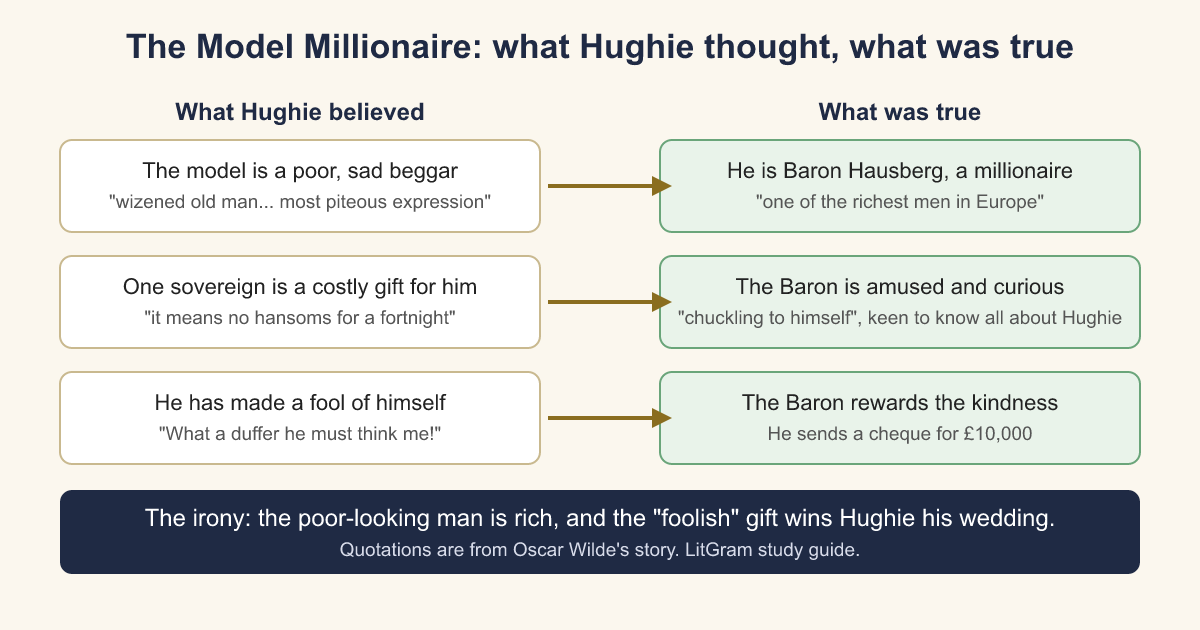
What Hughie believed and what was true
The whole story turns on a gap between how things look and how they are. The diagram below shows the three steps in that gap. Use it to plan a quick answer on irony.
Themes with lines from the story
| Theme | What it means here | Line to quote |
|---|---|---|
| Kindness without a reward in mind | Hughie gives because he pities the man, and not because he expects anything back | “he wants it more than I do” |
| Appearance and reality | The beggar looks poor but is a millionaire. The painter says rags are “romance” | “What you call rags I call romance.” |
| Money and love | A young couple cannot marry without money. The Colonel names a sum | “the handsomest couple in London, and had not a penny-piece between them” |
| Art and real life | Trevor cares about how the beggar looks in a picture, and not about his misery | “our business is to realise the world as we see it, not to reform it” |
Literary devices in the story
| Device | Where it appears | Why Wilde uses it |
|---|---|---|
| Irony | The “beggar” is one of the richest men in Europe | It gives the story its surprise and shows how easily we judge by looks |
| Satire and epigram | “Romance is the privilege of the rich, not the profession of the unemployed.” | Wilde mocks the idea that only money matters, using a witty, quotable line |
| Wordplay (a play on words) | “what was a butterfly to do among bulls and bears?” | A butterfly stands for light-hearted Hughie. Bulls and bears are Stock Exchange terms |
| Foreshadowing | The old man “kept chuckling to himself and rubbing his old wrinkled hands together” | It hints that the Baron has a plan before the reader knows it |
| Reversal of words (antimetabole) | “Millionaire models are rare enough; but … model millionaires are rarer still!” | The two words swap places in the second half. It ends the story with a joke on the title |
Why the title is clever
“Model millionaire” has two meanings. A model is a person who poses for a painter, and Baron Hausberg is a millionaire who poses as a beggar. A model can also mean an example to follow, and Hughie’s kindness is a good example. Trevor plays with both meanings in the last line. The subtitle, “A Note of Admiration”, suggests a warm tone towards Hughie’s kindness. The story never explains it, so treat that as a reading and not as a fact.
Word meanings from the story
| Word or phrase | Meaning in the story |
|---|---|
| wizened | dried up and full of wrinkles because of old age |
| piteous | deserving pity; very sad to look at |
| alms | money given to a poor person |
| sovereign | a gold coin worth one pound |
| guinea | an old unit of money, worth one pound and one shilling |
| hansom | a light horse-drawn cab for two passengers |
| trouvaille | a French word for a lucky find |
| philanthropic | kind to others, especially by giving money |
| glum | sad and quiet |
| prosaic | plain and ordinary, without imagination |
Questions and model answers for The Model Millionaire
The word counts below are a guide, so match the length to the marks in your own paper. In every answer, state the point, quote a short line, and explain what the line shows.
Why does Hughie give money to the beggar? (about 30 words)
Hughie pities the old man because he looks “forlorn and wretched”. He has only a sovereign, and giving it means “no hansoms for a fortnight”, yet he gives it. This shows his kind and generous nature.
How does Hughie’s attitude differ from Alan Trevor’s? (about 60 words)
Hughie sees a suffering man and wants to help. He says, “I think it is dreadful that any one should be so miserable.” Trevor sees a good subject for a painting. He says, “What you call rags I call romance.” Hughie feels with the beggar, while Trevor looks at him as an artist. Trevor is not cruel, but he cares about art more than about relief.
Why is the story called The Model Millionaire? (about 120 words)
The title plays on two meanings of the word model. First, the beggar in Trevor’s studio is a model, meaning a person who poses for a painting, and he turns out to be a millionaire, Baron Hausberg. Second, a model can be an example to follow, and Hughie’s unselfish kindness is a good example. Trevor’s last remark plays on both meanings: “Millionaire models are rare enough; but, by Jove, model millionaires are rarer still!” The sentence turns the two words around. One way to read it is this: a millionaire who poses as a model is rare, but a rich man who is also a good example is rarer. The title therefore points to the irony of the story and to the reward for Hughie’s kindness.
Is the ending fair to Hughie? (about 60 words)
Yes. Hughie did not know the beggar was rich, so he gave from kindness and not for gain. The Baron rewards him with exactly the sum the Colonel asked for. The story suggests that real kindness, given freely, can bring luck. Wilde keeps the tone light, so we smile at the fortunate ending.
Common mistakes and how to avoid them
- Confusing Alan Trevor with Baron Hausberg. Trevor is the painter and Hughie’s friend. Hausberg is the millionaire who poses as the beggar.
- Saying Hughie gave money to get the cheque. He thinks the man is poor and feels sorry for him. The cheque is a surprise to him.
- Forgetting what the gift cost him. The line “it means no hansoms for a fortnight” shows his sacrifice, and it wins marks when you quote it.
- Writing only that he gave a sovereign and became rich. Name the Baron, the letter from Monsieur Naudin, and the £10,000 cheque.
- Calling the story a tragedy or a love story only. It is a light comedy about kindness. Love matters because it explains why Hughie needs money.
Memory trick: remember the numbers. Hughie gives one pound, and the Colonel asks for ten thousand, and the cheque is for exactly ten thousand. One small coin leads to one large cheque. To keep the names straight, remember that Trevor is the Truth-teller who reveals the secret at the club, and Hausberg is the Hidden millionaire.
Practice MCQs on The Model Millionaire
- Who wrote The Model Millionaire? Answer: Oscar Wilde.
- How much did Hughie live on each year? Answer: Two hundred pounds, from an old aunt.
- What did Hughie give the beggar? Answer: A sovereign.
- Who was the old beggar really? Answer: Baron Hausberg.
- How much money did the Colonel say Hughie must have before the engagement? Answer: Ten thousand pounds.
- Who brought Hughie the Baron’s letter? Answer: Monsieur Gustave Naudin.
- Who was the best man at the wedding? Answer: Alan Trevor.
- Which device gives the story its surprise ending? Answer: Irony.
Related guides from the same Class IX list
The same board list for Class IX includes more poems and a play. Try these next:
- A Doctor’s Journal Entry for August 6, 1945: questions and answers
- I Remember, I Remember by Thomas Hood: questions and answers
- The Night Mail by W.H. Auden: questions and answers
- Julius Caesar Act 1 Scene 2: questions and answers
For another ICSE short story with a twist of humour, see With the Photographer by Stephen Leacock (ICSE Class 10).