Julius Caesar Act 3 Scene 1 is the scene in which the conspirators stab Caesar at the Capitol on the Ides of March. Antony then makes peace with them, wins the right to speak at Caesar’s funeral, and, left alone, swears revenge. It is on the ICSE Class 10 syllabus. This guide gives the summary, characters, main speeches, extract questions with answers and a free PDF.
Where Act 3 Scene 1 fits in the play
Shakespeare’s Julius Caesar is a tragedy first staged in 1599. In Acts 1 and 2, Cassius draws Brutus into a plot to kill Caesar, who the conspirators fear will become king. Caesar has been warned more than once: the Soothsayer told him to “beware the Ides of March”, and his wife Calpurnia dreamt of his death. Decius Brutus still talked him into going to the Senate.
Act 3 Scene 1 is the turning point. Everything before it leads up to the murder. Everything after it shows the price of the murder, which begins in this very scene when Brutus lets Antony speak.
ICSE Class 10 students read Acts 3, 4 and 5 for the board exam. If you are revising Act 2 first, see our Julius Caesar Act 2 Scene 1 questions and answers. You can read the full scene in the Folger Shakespeare text of Act 3 Scene 1.
Julius Caesar Act 3 Scene 1 summary
1. Before the Capitol. Caesar meets the Soothsayer and says, “The ides of March are come.” The Soothsayer replies, “Ay, Caesar; but not gone.” Artemidorus begs Caesar to read his paper, which warns him of the plot. Caesar puts it aside: what concerns himself “shall be last served”.
2. A moment of fear. Popilius Lena wishes Cassius well in his “enterprise” and then speaks to Caesar. Cassius panics, thinking the plot has been found out, and says he will kill himself if it fails. Brutus calms him: Popilius is smiling and Caesar’s face does not change. Trebonius leads Antony out of the way.
3. The petition. Metellus Cimber kneels and asks Caesar to recall his banished brother, Publius Cimber. Brutus, Cassius and the others kneel too. Caesar refuses and calls himself “constant as the northern star”, the one star that never moves.
4. The murder. Casca cries “Speak, hands for me!” and strikes first. The others stab Caesar, Brutus last. Caesar says “Et tu, Brute! Then fall, Caesar” and dies. The conspirators shout “Liberty! Freedom!” and Brutus asks them to bathe their hands in Caesar’s blood.
5. Antony’s peace. Antony sends a servant to ask whether he may come safely. He arrives, grieves over the body, and offers to die by their swords. Brutus says they acted out of pity for Rome. Antony shakes each bloody hand and asks to speak at the funeral. Cassius objects, but Brutus agrees, on conditions.
6. Antony alone. Antony begs the corpse to pardon him for being gentle with “these butchers”. He prophesies civil war in Italy. Learning that Octavius is near Rome, he tells the servant to wait until he has tested the people’s mood in his funeral speech.
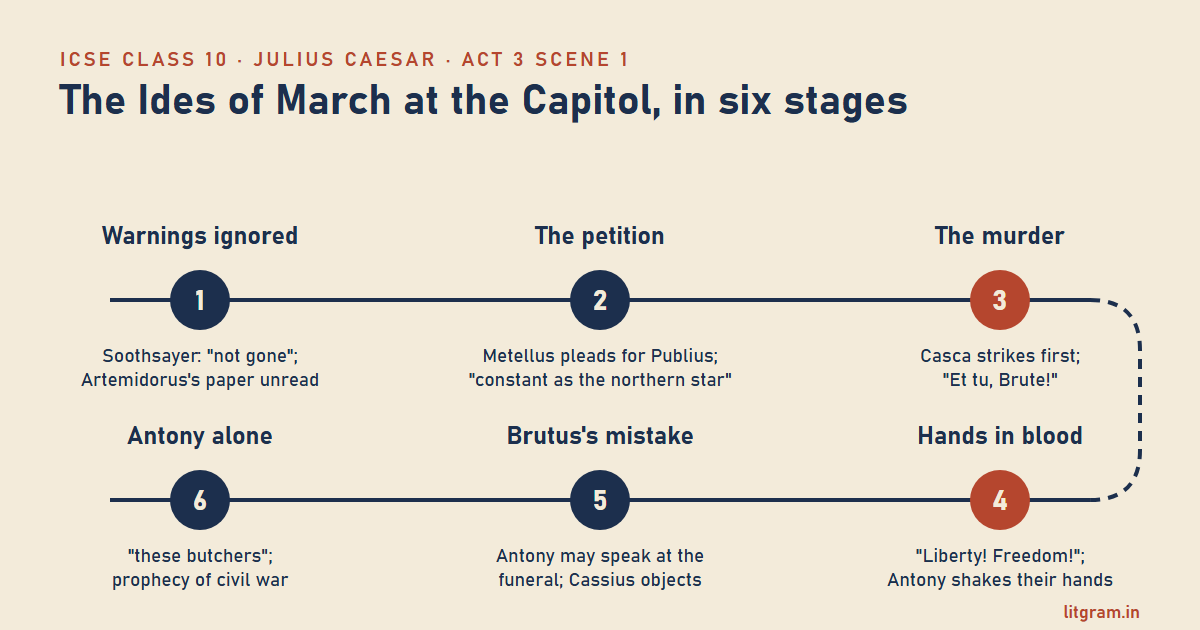
Download the Act 3 Scene 1 summary PDF
For revision before the exam, download the two-page Julius Caesar Act 3 Scene 1 summary PDF. It has the six stages, the characters, Brutus’s conditions, quotations to learn, word meanings, common mistakes and extract practice with answers.
Characters in Act 3 Scene 1
| Character | What he does in this scene | What it shows |
|---|---|---|
| Julius Caesar | Ignores Artemidorus, refuses the petition, is stabbed and dies | Pride and over-confidence: “constant as the northern star” |
| Brutus | Stabs last; calls the killing a deed of pity; lets Antony speak | Honest and idealistic, but a poor judge of men |
| Cassius | Panics at Popilius; warns Brutus against Antony | Nervous but shrewd; he reads Antony correctly |
| Mark Antony | Shakes the conspirators’ hands; asks to speak; swears revenge alone | Loyal to Caesar, clever and careful; a skilled actor |
| Casca | Strikes the first blow | The blunt man of the group |
| Metellus Cimber | Pleads for his banished brother Publius | His petition is the excuse to crowd round Caesar |
| Trebonius | Draws Antony away before the murder | Part of the plan to keep Antony safe and out of the way |
| Artemidorus | Tries to hand Caesar a warning paper | The last chance Caesar ignores |
| Popilius Lena | Wishes the “enterprise” success, then talks to Caesar | Creates a moment of suspense |
| Antony’s and Octavius’s servants | Carry messages | Show Antony planning ahead; Octavius is near Rome |
The four speeches to know
Caesar: “constant as the northern star”
When everyone kneels, Caesar compares himself to the northern star. The sky is full of stars that move, he says, but only one “doth hold his place”. Among men, too, he alone cannot be moved. This is his last long speech, and it shows the pride that makes the conspirators fear him. It is also dramatic irony: the man who says nothing can move him is about to fall.
Caesar: “Et tu, Brute! Then fall, Caesar.”
“Et tu, Brute” is Latin for “You too, Brutus?” Caesar can face the other daggers, but not his friend’s. The line shows that Brutus’s betrayal hurts him more than the wounds. In Act 3 Scene 2 Antony will call Brutus’s stab “the most unkindest cut of all”.
Brutus: “ambition’s debt is paid”
Brutus tells the frightened senators not to run, because “ambition’s debt is paid”. He sees the murder as a payment Caesar owed for his ambition. He then asks the conspirators to wash their hands in Caesar’s blood and walk to the market-place crying “Peace, freedom and liberty!” He wants the killing to look like a sacrifice, not a crime.
Antony’s speech over the body
Alone, Antony drops his mask: “O, pardon me, thou bleeding piece of earth, / That I am meek and gentle with these butchers!” He prophesies a curse on men, civil war (“Domestic fury and fierce civil strife”) across Italy, and bloodshed so common that mothers will only smile at it. Caesar’s spirit will “Cry ‘Havoc,’ and let slip the dogs of war”. This speech tells us that his friendship with the conspirators was an act.
Brutus’s mistake: the conditions for Antony’s speech
Cassius warns Brutus, “You know not what you do”, because the people may be moved by Antony’s words. Brutus thinks he can control the risk. He will speak first, and he lays down these conditions:
- Antony must not blame the conspirators in his speech.
- He may speak all the good he can think of about Caesar.
- He must say he speaks by the conspirators’ permission.
- He must speak from the same pulpit, after Brutus has finished.
Antony replies, “I do desire no more.” This is the mistake that ruins the conspirators. In Act 3 Scene 2 Antony keeps every condition and still turns the crowd against them.
Themes in Act 3 Scene 1
| Theme | Where it shows |
|---|---|
| Pride and its fall | “constant as the northern star”, just before the stabbing |
| Betrayal and friendship | “Et tu, Brute!”; Antony shaking the hands of Caesar’s killers |
| Idealism against cunning | Brutus trusts Antony; Cassius and Antony both think like politicians |
| Freedom or murder? | “Liberty! Freedom! Tyranny is dead!” against “these butchers” |
| Fate and warnings | The Soothsayer and Artemidorus; Caesar ignores both |
| The power of words | Brutus’s mistake in letting Antony speak sets up the next scene |
Dramatic devices
Dramatic irony. The audience knows the plot; Caesar does not. So when he says he is as fixed as the northern star, we know he is minutes from death.
Suspense. Popilius Lena’s words to Cassius make the conspirators, and the audience, fear the plot is discovered.
Imagery of blood and hunting. Antony calls Caesar a “brave hart” (a deer) brought to bay, with “thy hunters” standing round him. The blood the conspirators wash in becomes a sign of guilt, not of sacrifice.
Soliloquy. A soliloquy is a speech made alone on stage, so the audience hears the character’s true thoughts. Antony’s speech over the body is one. It shows his real plan after his public show of friendship.
Word meanings
| Word or phrase | Meaning |
|---|---|
| schedule | a written paper (Artemidorus’s warning) |
| suit | a request, petition |
| puissant | powerful |
| couchings, lowly courtesies | bowing and kneeling |
| spaniel-fawning | flattering like a fawning dog |
| enfranchisement | freedom, restoring a man’s rights |
| firmament | the sky |
| bootless | in vain, uselessly |
| Pompey’s basis | the base of Pompey’s statue, where Caesar falls |
| misgiving | doubt, fear |
| bay’d | cornered, like a hunted deer |
| Ate | the Greek goddess of revenge and ruin |
| Havoc | the order to kill without mercy |
| seven leagues | about twenty miles |
Julius Caesar Act 3 Scene 1 questions and answers
In the ICSE paper each drama question is an extract with five parts. In the 2025 paper they carried 3, 3, 3, 3 and 4 marks. Answer each part in three or four sentences and use the words of the question.
Extract 1
“I could be well moved, if I were as you: / If I could pray to move, prayers would move me”
(i) Who speaks these words, to whom, and on what occasion?
Caesar speaks to the conspirators at the Capitol. Metellus Cimber has asked him to recall his banished brother, and Brutus and Cassius have knelt to support the request.
(ii) What does the speaker mean by “constant as the northern star”?
The northern star is the only star that never changes its place. Caesar means that he, too, never changes his mind. He banished Publius Cimber and will keep him banished.
(iii) What happens immediately after this speech?
Cinna and Decius Brutus plead again and Caesar brushes them off. Casca cries “Speak, hands for me!” and stabs him first; the others follow, and Brutus strikes last.
(iv) What do Caesar’s last words show?
“Et tu, Brute! Then fall, Caesar.” He gives up when he sees Brutus among his killers. The betrayal of a friend hurts him more than the wounds.
(v) How is this speech an example of dramatic irony? (4 marks)
Caesar boasts that nothing can move him and that he alone holds his place among men. The audience knows the daggers are ready and that he is about to fall. His pride is at its height at the very moment before his death, which makes the boast hollow and the fall more striking.
Extract 2
“Here is a mourning Rome, a dangerous Rome, / No Rome of safety for Octavius yet”
(i) Whom is Antony speaking to, and what instructions does he give?
He speaks to Octavius’s servant. The servant must ride back and tell Octavius what has happened and warn him that Rome is not yet safe. But first he must stay and help carry Caesar’s body to the market-place.
(ii) Why is Rome “dangerous”? Why is it not safe for Octavius?
Caesar has just been murdered and the city is in panic. Octavius is Caesar’s nephew and heir, so the conspirators may see him as a threat.
(iii) Mention three predictions Antony makes when he is alone with Caesar’s body.
A curse will fall on men; civil war (“Domestic fury and fierce civil strife”) will spread through Italy; and bloodshed will become so common that mothers will only smile to see their children killed.
(iv) What did Brutus and Cassius think of Antony? Whose view was right?
Brutus trusted Antony and let him speak at the funeral. Cassius feared him and warned that the people would be moved by his words. Cassius was right: Antony’s speech turned Rome against the conspirators.
(v) What does this part of the scene reveal about Antony? (4 marks)
In public he is gentle and friendly, shaking every conspirator’s hand. In private he calls them “butchers” and plans revenge. He is loyal to Caesar, patient and shrewd: he will test the people’s mood with his speech before he sends word to Octavius. He is a clever politician who hides his feelings until the time is right.
Short answers
1. Why does Cassius panic when Popilius Lena talks to Caesar?
Popilius has just wished him success in his “enterprise”, so Cassius fears the plot has been discovered and that Popilius is telling Caesar.
2. Why do the conspirators bathe their hands in Caesar’s blood?
Brutus wants the killing to look like a solemn sacrifice for Rome’s freedom. They will walk to the market-place waving their red weapons and crying “Peace, freedom and liberty!”
3. Why does Brutus agree to let Antony speak?
He thinks it will help them. If he speaks first and says Antony speaks with their permission, the people will see the conspirators as fair and respectful to Caesar.
What examiners look for, and common mistakes
The CISCE examiners’ report on the 2025 ICSE Literature paper noted that students lost marks by missing key words. In one Julius Caesar question, many ignored the words “immediately after” and wrote about events from much later in the scene. Few students used the words “sarcasm” and “irony” where they were needed. Read every part of the question twice and underline words such as “immediately”, “NOT” and “earlier”.
- Casca strikes first, not Brutus. Brutus strikes last.
- The petition is for Publius Cimber, Metellus Cimber’s banished brother.
- Artemidorus’s paper is a warning about the plot, not a petition. Caesar does not read it.
- Antony is not present at the murder; Trebonius has drawn him away.
- Brutus speaks first and Antony speaks after him. Do not reverse the order of the funeral speeches.
- “Et tu, Brute” means “You too, Brutus?”, not “Goodbye, Brutus”.
- Brutus’s conditions for Antony’s speech are laid down in this scene, though students are often asked about them in Act 3 Scene 2 extracts.
Memory trick for the order of events: “S-P-K-H-F-A”, Soothsayer, Petition, Killing, Hands (washing and shaking), Funeral permission, Antony alone.
Act 3 Scene 1 MCQs
- What does the Soothsayer reply when Caesar says “The ides of March are come”?
Answer: “Ay, Caesar; but not gone.” - Who tries to give Caesar a paper warning him of the plot?
Answer: Artemidorus. - Who draws Antony away before the murder?
Answer: Trebonius. - For whom does Metellus Cimber plead?
Answer: His banished brother, Publius Cimber. - To what does Caesar compare himself?
Answer: The northern star. - Who stabs Caesar first?
Answer: Casca. - Where does Caesar’s body fall?
Answer: At the base of Pompey’s statue (“Pompey’s basis”). - What does Antony ask of the conspirators?
Answer: To take Caesar’s body to the market-place and speak at his funeral. - Who warns Brutus not to let Antony speak?
Answer: Cassius. - How far from Rome is Octavius that night?
Answer: Within seven leagues.
Score guide: 9-10 correct, you know the scene; below 9, read the six-stage summary again.
Related ICSE guides
All our Julius Caesar and Treasure Chest guides are listed in syllabus order on the ICSE English Class 9 and 10 study guides page. For the earlier acts, read Julius Caesar Act 1 Scene 2 questions and answers and Act 2 Scene 1 questions and answers. From Treasure Chest, see With the Photographer.