Indigo by Louis Fischer is Chapter 5 of Flamingo, the NCERT English book for Class 12 (CBSE and RBSE). It tells how Gandhi went to Champaran in Bihar in 1917 to help poor indigo sharecroppers, defied a British order to leave, and won them a refund and freedom from fear. This guide gives the summary in English and Hindi, answers and a free PDF.
About Indigo by Louis Fischer
Louis Fischer (1896-1970) was an American journalist, born in Philadelphia. He wrote for The New York Times and taught at Princeton University. Indigo is an extract from his book The Life of Mahatma Gandhi.
The chapter is not a story. It is a true account, and Fischer heard much of it from Gandhi himself, when he visited Gandhi at his Sevagram ashram in 1942. NCERT gives the theme of the unit as Gandhi’s leadership in winning justice for poor people through argument and negotiation, and the sub-theme as the part played by unknown Indians in the freedom movement.
Read the full English text in the official NCERT Flamingo Chapter 5 PDF. Each Hindi part below starts with the first words of a passage, so you can follow it in your book.
Indigo summary in six stages
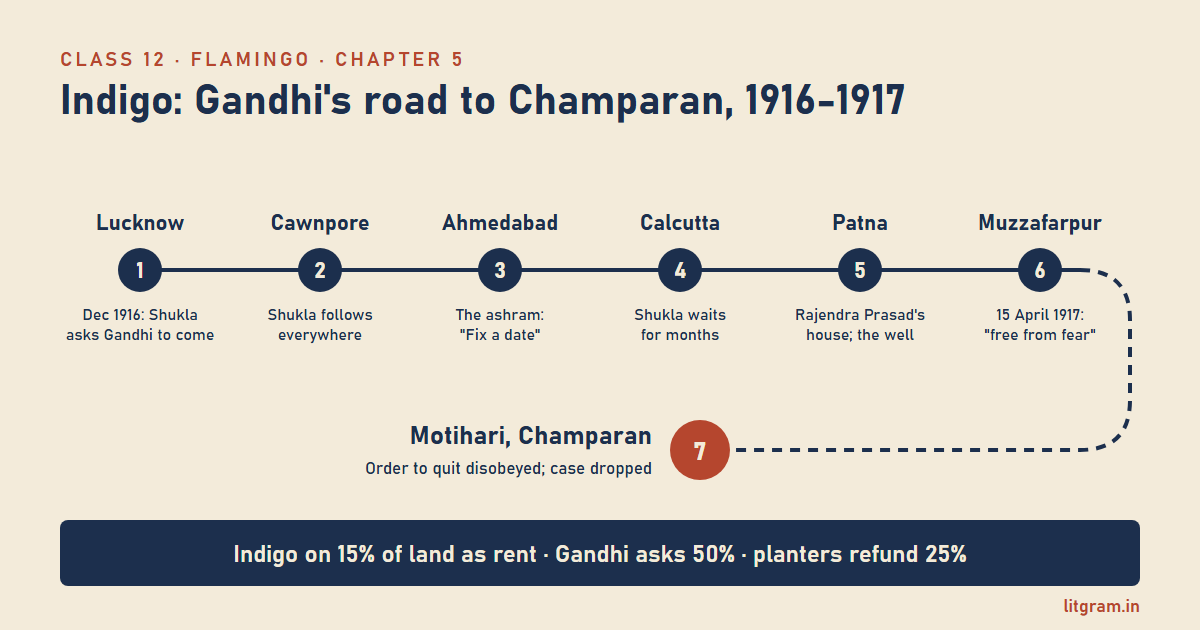
1. Rajkumar Shukla’s request. At the Lucknow session of the Congress in December 1916, a poor peasant named Rajkumar Shukla asks Gandhi to come to Champaran. Gandhi has never heard of the place. Shukla follows him for months, from Cawnpore to the ashram near Ahmedabad, and finally meets him in Calcutta.
2. On the way: Patna and Muzzafarpur. Shukla takes Gandhi to Patna, to the house of the lawyer Rajendra Prasad. The servants think Gandhi is another peasant and do not let him draw water from the well. In Muzzafarpur, Professor J.B. Kripalani meets him with students, and he stays with Professor Malkani. He tells the lawyers that court cases do little good; the peasants must first be free from fear.
3. The indigo problem. English landlords made their tenants grow indigo on 15 per cent of their land and hand over the whole crop as rent. When Germany made synthetic indigo, the landlords took money from the peasants to free them from this deal. The peasants who learnt the truth wanted their money back.
4. The order to leave. At Motihari, the police serve Gandhi a notice to quit Champaran. He writes on the receipt that he will disobey it and is summoned to court. Thousands of peasants gather round the court. Gandhi pleads guilty, but the case is first postponed and then dropped. This is the first win for civil disobedience in modern India.
5. The inquiry and the 25 per cent refund. Gandhi and the lawyers record the statements of about ten thousand peasants. The Lieutenant-Governor sets up a commission with Gandhi as the only member for the peasants. Gandhi asks for a 50 per cent refund and then accepts the planters’ offer of 25 per cent. The amount matters less than the lesson: the landlords had to give back money and prestige.
6. Schools, health and self-reliance. Gandhi opens primary schools in six villages, brings a doctor, and asks Kasturbai to teach cleanliness. He refuses the help of C.F. Andrews because the Indians must not lean on an Englishman. Champaran becomes a turning point in Gandhi’s life.
Download the Indigo summary PDF
For quick revision before the exam, download the two-page Indigo Class 12 summary PDF (English and Hindi). It has the six stages, a Hindi summary, the people in the chapter, themes, word meanings, common mistakes and practice questions with answers.
Indigo summary in Hindi (सारांश हिंदी में)
दिसंबर 1916 में लखनऊ में कांग्रेस का अधिवेशन हुआ। वहाँ चंपारण (बिहार) का एक गरीब किसान, राजकुमार शुक्ला, गांधीजी से मिला और उन्हें अपने ज़िले में आने को कहा। वह अनपढ़ था, पर बहुत दृढ़ निश्चयी था। वह महीनों तक गांधीजी के पीछे-पीछे घूमता रहा, और आखिर गांधीजी ने उसे कलकत्ता में मिलने को कहा।
कलकत्ता से दोनों पटना गए, जहाँ वकील राजेंद्र प्रसाद के नौकरों ने गांधीजी को भी एक किसान समझा और उन्हें कुएँ से पानी नहीं भरने दिया। फिर गांधीजी मुज़फ़्फ़रपुर गए। वहाँ उन्होंने वकीलों से कहा कि अदालतों से किसानों का भला नहीं होगा; असली राहत डर से मुक्ति है।
चंपारण की ज़्यादातर ज़मीन अंग्रेज़ ज़मींदारों की थी। किसानों को अपनी ज़मीन के 15 प्रतिशत हिस्से में नील (indigo) उगाकर पूरी फसल लगान के रूप में देनी पड़ती थी। जब जर्मनी ने कृत्रिम नील बना लिया, तो ज़मींदारों ने किसानों से मुआवज़ा लेकर उन्हें इस करार से छोड़ दिया। सच पता चलने पर किसान अपना पैसा वापस चाहते थे।
मोतिहारी में गांधीजी को चंपारण छोड़ने का सरकारी नोटिस मिला। उन्होंने साफ लिखा कि वे यह आदेश नहीं मानेंगे। अगले दिन अदालत के बाहर हज़ारों किसान जमा हो गए। सरकार घबरा गई और मुकदमा वापस ले लिया गया। यह आधुनिक भारत में सविनय अवज्ञा (civil disobedience) की पहली जीत थी।
जाँच आयोग बना, जिसमें किसानों की ओर से अकेले गांधीजी थे। गांधीजी ने 50 प्रतिशत रकम लौटाने की माँग की, पर 25 प्रतिशत पर मान गए, क्योंकि असली जीत यह थी कि ज़मींदारों को पैसा और अपनी शान दोनों छोड़ने पड़े। कुछ ही वर्षों में अंग्रेज़ बागान-मालिक ज़मीन छोड़कर चले गए। गांधीजी ने गाँवों में स्कूल खोले, इलाज और सफाई का काम शुरू किया, और लोगों को आत्मनिर्भर बनना सिखाया।
People in Indigo
| Person | Who they are | What they do in the chapter |
|---|---|---|
| Gandhi | The leader at the centre of the account | Goes to Champaran, defies the order to leave, wins the refund, opens schools |
| Rajkumar Shukla | An illiterate but determined sharecropper from Champaran | Follows Gandhi for months until he agrees to come |
| Rajendra Prasad | A lawyer in Patna, later President of India | Joins Gandhi in Motihari; records how the lawyers decided to stay |
| J.B. Kripalani | A professor at the Arts College, Muzzafarpur | Meets Gandhi at the station at midnight with a large group of students |
| Professor Malkani | A teacher in a government school, Muzzafarpur | Lets Gandhi stay in his home for two days |
| Sir Edward Gait | Lieutenant-Governor of the province | Has the case dropped; appoints the commission of inquiry after four long interviews |
| Rev. J.Z. Hodge | A British missionary in Champaran | Describes how Gandhi accepted the 25 per cent offer |
| Kasturbai, Mahadev Desai, Narhari Parikh, Devadas | Gandhi’s wife, disciples and youngest son | Teach in the village schools and work on cleanliness |
| Charles Freer Andrews | An English pacifist and follower of Gandhi | Offers to stay; Gandhi refuses so that the Indians rely on themselves |
Indigo in Hindi: part-by-part explanation
हर भाग की शुरुआत पाठ की पहली पंक्ति से होती है। अपनी किताब में वही पंक्ति ढूँढिए और फिर यह व्याख्या पढ़िए।
भाग 1: लखनऊ में राजकुमार शुक्ला (When I first visited Gandhi…)
लुई फिशर 1942 में सेवाग्राम आश्रम में गांधीजी से मिले। गांधीजी ने बताया कि अंग्रेज़ों को भारत छोड़ने के लिए कहने का निर्णय 1917 की एक घटना से जुड़ा है। दिसंबर 1916 के लखनऊ कांग्रेस अधिवेशन में 2,301 प्रतिनिधि आए थे। वहीं एक दुबला-पतला गरीब किसान गांधीजी से मिला: “I am Rajkumar Shukla. I am from Champaran, and I want you to come to my district”. गांधीजी ने चंपारण का नाम भी नहीं सुना था; यह हिमालय की तलहटी में, नेपाल के पास था।
शब्द: emaciated = बहुत दुबला; sharecropper = बटाईदार किसान; resolute = दृढ़ निश्चयी।
भाग 2: “Fix a date” (Gandhi told Shukla he had an appointment…)
गांधीजी ने कहा कि उन्हें कानपुर और देश के दूसरे हिस्सों में जाना है। शुक्ला हर जगह उनके साथ गया, यहाँ तक कि अहमदाबाद के आश्रम तक। हफ्तों वह गांधीजी के पास से नहीं हटा और बार-बार कहता रहा: “Fix a date”. उसकी लगन (tenacity) देखकर गांधीजी ने उसे कलकत्ता में मिलने को कहा। महीनों बाद, जब गांधीजी कलकत्ता पहुँचे, शुक्ला तय जगह पर उकड़ूँ बैठा इंतज़ार कर रहा था।
भाग 3: पटना और कुएँ का पानी (in Calcutta when Gandhi arrived…)
दोनों ट्रेन से पटना गए। शुक्ला गांधीजी को वकील राजेंद्र प्रसाद के घर ले गया। राजेंद्र प्रसाद शहर से बाहर थे। नौकर शुक्ला को जानते थे, इसलिए उन्होंने गांधीजी को भी एक गरीब किसान समझा। गांधीजी को कुएँ से पानी नहीं भरने दिया गया, ताकि उनकी बाल्टी से पूरा कुआँ “अपवित्र” न हो जाए। यह उस समय के छुआछूत को दिखाता है।
भाग 4: मुज़फ़्फ़रपुर (Gandhi decided to go first…)
पूरी जानकारी लेने के लिए गांधीजी पहले मुज़फ़्फ़रपुर गए। 15 अप्रैल 1917 की आधी रात को प्रोफेसर जे.बी. कृपलानी छात्रों के साथ स्टेशन पर मिले। गांधीजी दो दिन प्रोफेसर मलकानी के घर रुके, जो एक सरकारी स्कूल में शिक्षक थे। उस समय किसी सरकारी शिक्षक का गांधीजी जैसे व्यक्ति को घर में ठहराना (harbour a man like me) बहुत बड़ी बात थी, क्योंकि छोटे शहरों में लोग होम-रूल के समर्थकों से हमदर्दी दिखाने से भी डरते थे।
वकीलों ने बताया कि वे किसानों के मुकदमे लड़ते हैं और इसकी फीस भी बताई। गांधीजी ने उन्हें भारी फीस लेने पर डाँटा और कहा: “The real relief for them is to be free from fear.” यानी डरे हुए किसानों के लिए अदालतें बेकार हैं; असली राहत डर से छुटकारा है।
भाग 5: नील की खेती का करार (Most of the arable land…)
चंपारण की खेती लायक ज़्यादातर ज़मीन अंग्रेज़ों की बड़ी जागीरों में बँटी थी, जिन पर भारतीय काश्तकार काम करते थे। मुख्य व्यापारिक फसल नील थी। ज़मींदार किसानों से उनकी ज़मीन के तीन-बीसवें हिस्से, यानी 15 प्रतिशत, पर नील उगवाते थे और पूरी नील की फसल लगान के रूप में ले लेते थे। फिर जर्मनी ने कृत्रिम (synthetic) नील बना लिया, जिससे असली नील का दाम गिरना तय था। ज़मींदारों ने चालाकी से किसानों से मुआवज़ा लेकर उन्हें 15 प्रतिशत वाले करार से छोड़ दिया। जो किसान मान गए, उन्हें बाद में कृत्रिम नील का पता चला और वे अपना पैसा वापस चाहते थे।
भाग 6: नोटिस और अदालत (At this point Gandhi arrived in Champaran…)
गांधीजी पहले ज़मींदारों के संगठन के सचिव से मिले, जिसने कहा कि वह “बाहरी व्यक्ति” को कुछ नहीं बताएगा। गांधीजी ने कहा कि वे बाहरी नहीं हैं। तिरहुत डिवीज़न के कमिश्नर ने उन्हें धमकाया और तिरहुत छोड़ने की सलाह दी। गांधीजी मोतिहारी गए। एक गाँव में किसान पर अत्याचार की खबर सुनकर वे हाथी पर निकले, पर पुलिस सुपरिंटेंडेंट के दूत ने उन्हें लौटा दिया और चंपारण तुरंत छोड़ने का नोटिस दिया। गांधीजी ने रसीद पर लिखा कि वे यह आदेश नहीं मानेंगे। अगले दिन के लिए उन्हें अदालत का समन मिला।
भाग 7: मोतिहारी में भीड़ (All night Gandhi remained awake…)
गांधीजी रात भर जागे। उन्होंने राजेंद्र प्रसाद को तार भेजा, आश्रम को निर्देश भेजे और वायसराय को पूरी रिपोर्ट भेजी। सुबह मोतिहारी किसानों से भर गया। वे गांधीजी के बारे में ज़्यादा नहीं जानते थे; बस इतना सुना था कि उनकी मदद करने आया एक महात्मा मुसीबत में है। अदालत के चारों ओर हज़ारों किसानों का यह अपने-आप हुआ प्रदर्शन अंग्रेज़ों के डर से उनकी मुक्ति की शुरुआत था। अफसर गांधीजी की मदद के बिना भीड़ भी नहीं संभाल पाए।
अदालत में गांधीजी ने अपराध स्वीकार किया। उन्होंने कहा कि वे “conflict of duties” (कर्तव्यों के टकराव) में हैं: एक ओर कानून तोड़ने का बुरा उदाहरण न देना, दूसरी ओर उस सेवा को करना जिसके लिए वे आए थे। उन्होंने आदेश इसलिए नहीं माना क्योंकि अंतरात्मा की आवाज़ ऊँचा कानून है। मजिस्ट्रेट ने बिना ज़मानत उन्हें छोड़ दिया और फैसला कई दिन टाल दिया।
भाग 8: वकीलों का फैसला (Rajendra Prasad, Brij Kishor Babu…)
राजेंद्र प्रसाद, ब्रजकिशोर बाबू, मौलाना मज़हरुल हक़ और दूसरे वकील आए। गांधीजी ने पूछा कि अगर उन्हें जेल हो गई तो वे क्या करेंगे। वकीलों ने कहा कि वे घर लौट जाएँगे। फिर उन्होंने आपस में सोचा: एक अजनबी किसानों के लिए जेल जाने को तैयार है, और वे पास के ज़िलों के होकर लौट जाएँ, तो यह “shameful desertion” (शर्मनाक तरीके से साथ छोड़ना) होगा। वे गांधीजी के साथ जेल जाने को तैयार हो गए। गांधीजी ने कहा कि चंपारण की लड़ाई जीत ली गई है। कुछ दिन बाद लेफ्टिनेंट-गवर्नर ने मुकदमा ही वापस ले लिया।
भाग 9: जाँच और 25 प्रतिशत (Gandhi and the lawyers now…)
लगभग दस हज़ार किसानों के बयान लिखे गए। जून में गांधीजी लेफ्टिनेंट-गवर्नर सर एडवर्ड गेट से चार बार लंबी बातचीत करने गए। एक सरकारी जाँच आयोग बना, जिसमें ज़मींदार, सरकारी अफसर और किसानों की ओर से अकेले गांधीजी थे। गांधीजी लगातार सात महीने चंपारण में रहे। सबूतों के सामने बागान-मालिक पैसा लौटाने को तैयार हुए। गांधीजी ने 50 प्रतिशत माँगा, बागान-मालिकों ने 25 प्रतिशत की पेशकश की, और गांधीजी ने तुरंत मान लिया। उनका कहना था कि रकम से ज़्यादा ज़रूरी यह है कि ज़मींदारों को पैसा और अपनी प्रतिष्ठा का हिस्सा छोड़ना पड़ा। किसान ने सीखा कि उसके भी अधिकार हैं। कुछ वर्षों में अंग्रेज़ बागान-मालिक जागीरें छोड़कर चले गए और नील की बटाई खेती खत्म हो गई।
भाग 10: स्कूल, इलाज और सफाई (Gandhi never contented himself…)
गांधीजी सिर्फ राजनीतिक हल से संतुष्ट नहीं हुए। उन्होंने छह गाँवों में प्राथमिक स्कूल खोले। महादेव देसाई, नरहरि पारिख, उनकी पत्नियाँ, गांधीजी का सबसे छोटा बेटा देवदास और कस्तूरबा पढ़ाने आए। कस्तूरबा ने निजी और सामुदायिक सफाई के नियम सिखाए। एक डॉक्टर छह महीने के लिए आया; दवाएँ सिर्फ तीन थीं: अरंडी का तेल, कुनैन और गंधक का मरहम। एक औरत ने कस्तूरबा को बताया कि उसके पास पहनी हुई साड़ी के अलावा दूसरी साड़ी नहीं है। यह गरीबी की हद दिखाता है।
भाग 11: एन्ड्रूज़ और आत्मनिर्भरता (Early in the Champaran action…)
गांधीजी चंपारण से भी आश्रम का ध्यान रखते थे और डाक से निर्देश भेजते थे। उनके लिए चंपारण जीवन का मोड़ बना: “I declared that the British could not order me about in my own country.” सी.एफ. एन्ड्रूज़, एक अंग्रेज़ शांतिवादी, फ़िजी जाने से पहले विदा लेने आए। वकील चाहते थे कि वे रुक जाएँ, पर गांधीजी ने मना कर दिया: “You should not seek a prop in Mr. Andrews because he happens to be an Englishman”. राजेंद्र प्रसाद ने लिखा कि इस तरह गांधीजी ने उन्हें आत्मनिर्भरता का पाठ पढ़ाया। आत्मनिर्भरता, आज़ादी और किसानों की मदद, तीनों एक साथ जुड़े थे।
Themes in Indigo
| Theme | Where it shows |
|---|---|
| Freedom from fear | “The real relief for them is to be free from fear.” The crowd at Motihari is the start of the peasants’ “liberation from fear of the British” |
| Civil disobedience and non-violence | Gandhi disobeys the order openly, pleads guilty, refuses bail and helps the police control the crowd |
| Power of ordinary people | Rajkumar Shukla starts it all; thousands of peasants surround the court; ten thousand give statements |
| Self-reliance | Gandhi refuses the help of Andrews: the Indians must win their own battle |
| Politics joined to daily life | Schools, a doctor, cleanliness: “a loyalty to living, human beings” |
| Leadership by example | A stranger ready to go to jail shames the lawyers into staying |
The last line of the chapter joins the themes together: self-reliance, Indian independence and help to sharecroppers “were all bound together”. In an answer on the theme, quote that line and show one example of each.
Gandhi’s method in Champaran
NCERT asks you to link events to satyagraha and non-violence. Use these steps; each one has proof in the text.
- He gets the facts first: he goes to Muzzafarpur for information and later records ten thousand statements.
- He talks to the other side, the landlords’ secretary and the commissioner, before he acts.
- He disobeys openly and without violence. He writes on the receipt that he will disobey, and pleads guilty in court.
- He accepts the penalty. He asks for “the penalty due” and refuses to pay bail.
- He cooperates where it helps, for example by helping the officials control the crowd.
- He gives way on money, not on principle, and accepts 25 per cent because the landlords’ prestige is broken.
Students often write only “he used non-violence”. Name two of these steps with the event that proves each, and you show the examiner that you understand the method.
Language and style
Direct speech. Fischer quotes Gandhi, Rajendra Prasad and J.Z. Hodge. NCERT asks why. The quotations make the account believable, since we hear the people who were there, and they make the scenes lively, as in Shukla’s “Fix a date”.
Irony. The landlords’ secretary calls Gandhi an outsider, but Gandhi says he is no outsider in his own country. The servants of Rajendra Prasad think the future Mahatma might be an untouchable and keep him away from the well.
The comma rule. When a “when” clause comes first, a comma separates it from the main clause: “When the court reconvened, the judge said…” When the main clause comes first, there is no comma: “He had not proceeded far when the police superintendent’s messenger overtook him.”
Word meanings
| Word or phrase | Meaning | हिंदी |
|---|---|---|
| urge the departure | strongly ask someone to leave | जाने का आग्रह करना |
| emaciated | very thin and weak | बहुत दुबला |
| sharecropper | a farmer who pays part of the crop as rent | बटाईदार |
| resolute | determined, firm | दृढ़ निश्चयी |
| tenacity | not giving up | लगन |
| yeoman | a farmer who works his own land | छोटा किसान |
| harbour a man like me | give shelter to someone the rulers dislike | शरण देना |
| chided | scolded | डाँटा |
| arable | fit for growing crops | खेती योग्य |
| irksome | annoying, troublesome | परेशान करने वाला |
| conflict of duties | two duties pulling in opposite directions | कर्तव्यों का टकराव |
| deposition | a statement given on oath | बयान |
| protracted | long, drawn out | लंबा खिंचा हुआ |
| seek a prop | look for support | सहारा ढूँढना |
Words related to legal procedures (NCERT)
From the text: deposition, summons, notice, receipt, court, trial, prosecutor, judge, magistrate, bail, recess, reconvened, sentence, judgment, pleading guilty, penalty, case dropped, commission of inquiry, lawyers, contract, compensation. Other words you may add: affidavit, verdict, acquittal, appeal, warrant, hearing, witness.
Indigo question answers
Think as you read (NCERT)
1. Strike out what is not true. (a) Rajkumar Shukla was a sharecropper. Strike out “a politician”, “delegate” and “a landlord”. (b) He was poor and illiterate. Strike out “physically strong”, since Gandhi calls him “emaciated”.
2. Why is Rajkumar Shukla described as being “resolute”?
He would not give up. He followed Gandhi from Lucknow to Cawnpore and Ahmedabad, stayed by his side for weeks, and waited in Calcutta for months until Gandhi came with him to Champaran.
3. Why do you think the servants thought Gandhi to be another peasant?
Gandhi came with Shukla, whom they knew as a poor yeoman, and he dressed and lived simply, like a peasant. So they took him for one more poor villager.
4. List the places that Gandhi visited between his first meeting with Shukla and his arrival at Champaran.
Lucknow, Cawnpore, his ashram near Ahmedabad, Calcutta, Patna and Muzzafarpur. Then he reached Motihari, the capital of Champaran.
5. What did the peasants pay the British landlords as rent? What did the British now want instead and why? What would be the impact of synthetic indigo on the prices of natural indigo?
They grew indigo on 15 per cent of their land and gave the whole indigo crop as rent. When Germany developed synthetic indigo, the landlords wanted money as compensation for releasing the peasants from the deal, because they knew indigo would soon earn little. Synthetic indigo would bring down the price of natural indigo.
6. The events in this part of the text illustrate Gandhi’s method of working. Can you identify some instances and link them to satyagraha and non-violence?
Gandhi disobeyed the order to leave openly and peacefully, and pleaded guilty. He asked for the penalty instead of escaping it, refused bail, and helped the police control the crowd. This is satyagraha: firmness in truth, with no violence and no hatred.
7. Why did Gandhi agree to a settlement of 25 per cent refund to the farmers?
For Gandhi the amount mattered less than the principle. By paying back any money, the landlords gave up part of their prestige and admitted they were not above the law. That taught the peasants they had rights.
8. How did the episode change the plight of the peasants?
They lost their fear and learnt courage. Within a few years the British planters left their estates, the land went back to the peasants, and indigo sharecropping disappeared.
Understanding the text (NCERT)
1. Why do you think Gandhi considered the Champaran episode to be a turning point in his life?
In Champaran, Gandhi first used civil disobedience in India, and it worked. He said he had only declared “that the British could not order me about in my own country.” The episode showed him that ordinary Indians, once free from fear, could stand up to British power. So it shaped his later struggle.
2. How was Gandhi able to influence lawyers? Give instances.
He chided the Muzzafarpur lawyers for taking big fees from poor peasants. In Motihari, he asked the senior lawyers what they would do if he went to jail. When they saw that a stranger was ready to go to prison for the peasants, they felt that going home would be “shameful desertion” and agreed to follow him into jail.
3. What was the attitude of the average Indian in smaller localities towards advocates of “home rule”?
They were afraid to show any sympathy for them. That is why Gandhi called it extraordinary that Professor Malkani, a government teacher, gave him shelter.
4. How do we know that ordinary people too contributed to the freedom movement?
An illiterate peasant, Rajkumar Shukla, brought Gandhi to Champaran. Thousands of peasants gathered round the court at Motihari, and about ten thousand gave statements. Teachers and volunteers came to run schools. Without them, the Champaran movement would not have happened.
Long answers (120-150 words)
1. “Freedom from fear is more important than legal justice for the poor.” Explain with reference to Indigo.
When the Muzzafarpur lawyers told Gandhi about their court cases for the peasants, he scolded them for their big fees. He said that where the peasants are so crushed and fear-stricken, law courts are useless. A frightened person cannot use the law even when it is on his side; he will not speak, give evidence or hold out against a powerful landlord. So Gandhi worked first on fear. At Motihari, thousands of peasants surrounded the court, and Fischer calls this the beginning of their liberation from fear of the British. Later, ten thousand of them gave statements. After the refund, the peasant “learned courage” and saw he had rights. Within a few years the planters left. Free from fear, the peasants won more than any court could give them. (About 145 words.)
2. Describe the role of Rajkumar Shukla in bringing Gandhi to Champaran.
Rajkumar Shukla was a poor, illiterate sharecropper from Champaran. He came to the Lucknow Congress session in December 1916 to complain about the landlord system and asked Gandhi to visit his district. Gandhi had other appointments, so Shukla followed him to Cawnpore and to the ashram near Ahmedabad, never leaving his side for weeks and begging him to fix a date. Moved by his tenacity, Gandhi told him to meet him in Calcutta. Months later, Shukla was waiting at the appointed spot. He then took Gandhi to Patna and on towards Champaran. Without this one resolute peasant, the Champaran movement, and the first victory of civil disobedience in modern India, might never have happened. Shukla shows how much ordinary people gave to the freedom struggle. (About 135 words.)
3. Why did Gandhi refuse the help of C.F. Andrews? What does this show?
C.F. Andrews, an English pacifist and devoted follower of Gandhi, came to say goodbye before leaving for Fiji. The lawyers thought it would help to keep an Englishman on their side in this unequal fight. Andrews was willing, but Gandhi strongly opposed it. He said that the wish for Andrews’s help showed the weakness of their hearts. The cause was just, and they must rely on themselves to win. They should not lean on Andrews only because he was English. Rajendra Prasad admitted that Gandhi had read their minds and taught them self-reliance. This shows that Gandhi wanted Indians to stand on their own feet. For him, self-reliance, independence and help to the sharecroppers were bound together. (About 130 words.)
4. How did Gandhi’s stay in Champaran go beyond politics?
Gandhi never contented himself with large political or economic solutions. He saw the cultural and social backwardness of the Champaran villages and acted at once. He appealed for teachers, and Mahadev Desai, Narhari Parikh, their wives, his son Devadas and Kasturbai came; primary schools opened in six villages. Kasturbai taught the ashram rules of personal cleanliness and community sanitation. Gandhi got a doctor to volunteer for six months, though only castor oil, quinine and sulphur ointment were available. He also saw women’s poverty: one woman owned only the sari she wore. Fischer says Gandhi’s politics were intertwined with the practical, day-to-day problems of the millions. He was loyal to living people, not to abstract ideas, and tried to build a self-reliant Indian. (About 135 words.)
Extract-based practice
Read: “The real relief for them is to be free from fear.”
(a) Who says this, and to whom? Gandhi, to the Muzzafarpur lawyers.
(b) Why does he say it? He thinks court cases do little good for peasants who are crushed and afraid.
(c) Find a word in the passage that means “scolded”. Chided.
What examiners look for, and common mistakes
Answer pattern. The CBSE 2025-26 sample paper asks 40-50 word short answers and 120-150 word long answers, and its marking scheme rewards reasons and inference over retelling. Match the length to your paper. In “why” questions, give the reason in your first sentence, then one detail from the chapter as proof.
- Indigo is an extract from a biography, The Life of Mahatma Gandhi. Do not call it a short story.
- The peasants grew indigo on 15 per cent (three twentieths) of their land, not 50 per cent.
- Gandhi asked for 50 per cent and accepted 25 per cent. The 25 per cent was the planters’ offer.
- Synthetic indigo came from Germany, not from England.
- Rajkumar Shukla was a sharecropper, not a landlord or a delegate.
- The commissioner was of the Tirhut division, in which Champaran lay. Motihari was the capital of Champaran.
- Gandhi did not escape trial. He pleaded guilty and asked for the penalty; the Lieutenant-Governor dropped the case.
- Andrews was going to Fiji. Gandhi sent him away to teach self-reliance, not because he disliked him.
Memory trick for the route. “Lucky Cows Always Climb Past Muddy Meadows”: Lucknow, Cawnpore, Ahmedabad, Calcutta, Patna, Muzzafarpur, Motihari. And for the numbers, remember “15 grown, 50 asked, 25 taken”.
Indigo MCQs
- Indigo is an extract from which book?
Answer: The Life of Mahatma Gandhi by Louis Fischer. - Where did Rajkumar Shukla first meet Gandhi?
Answer: At the Lucknow session of the Indian National Congress, December 1916. - Why was Gandhi not allowed to draw water from the well in Patna?
Answer: The servants feared he might be an untouchable and pollute the well. - Who received Gandhi at Muzzafarpur station at midnight?
Answer: Professor J.B. Kripalani, with a large body of students. - What share of their land did the tenants have to plant with indigo?
Answer: Three twentieths, or 15 per cent. - Which country developed synthetic indigo?
Answer: Germany. - What did Gandhi write on the receipt for the notice to quit Champaran?
Answer: That he would disobey the order. - Who ordered the case against Gandhi to be dropped?
Answer: The Lieutenant-Governor of the province. - What refund did the planters finally agree to?
Answer: 25 per cent. Gandhi had asked for 50 per cent. - Which three medicines did the volunteer doctor have?
Answer: Castor oil, quinine and sulphur ointment.
Score guide: 9-10 correct, you know the chapter; below 9, reread the summary and the Hindi parts.
Related Class 12 guides
This chapter is part of our Class 12 English Flamingo and Vistas guide. The chapter before it in Flamingo is The Rattrap in Hindi, and the next is Poets and Pancakes. Earlier chapters: The Last Lesson summary in Hindi, Lost Spring by Anees Jung and Deep Water by William Douglas.