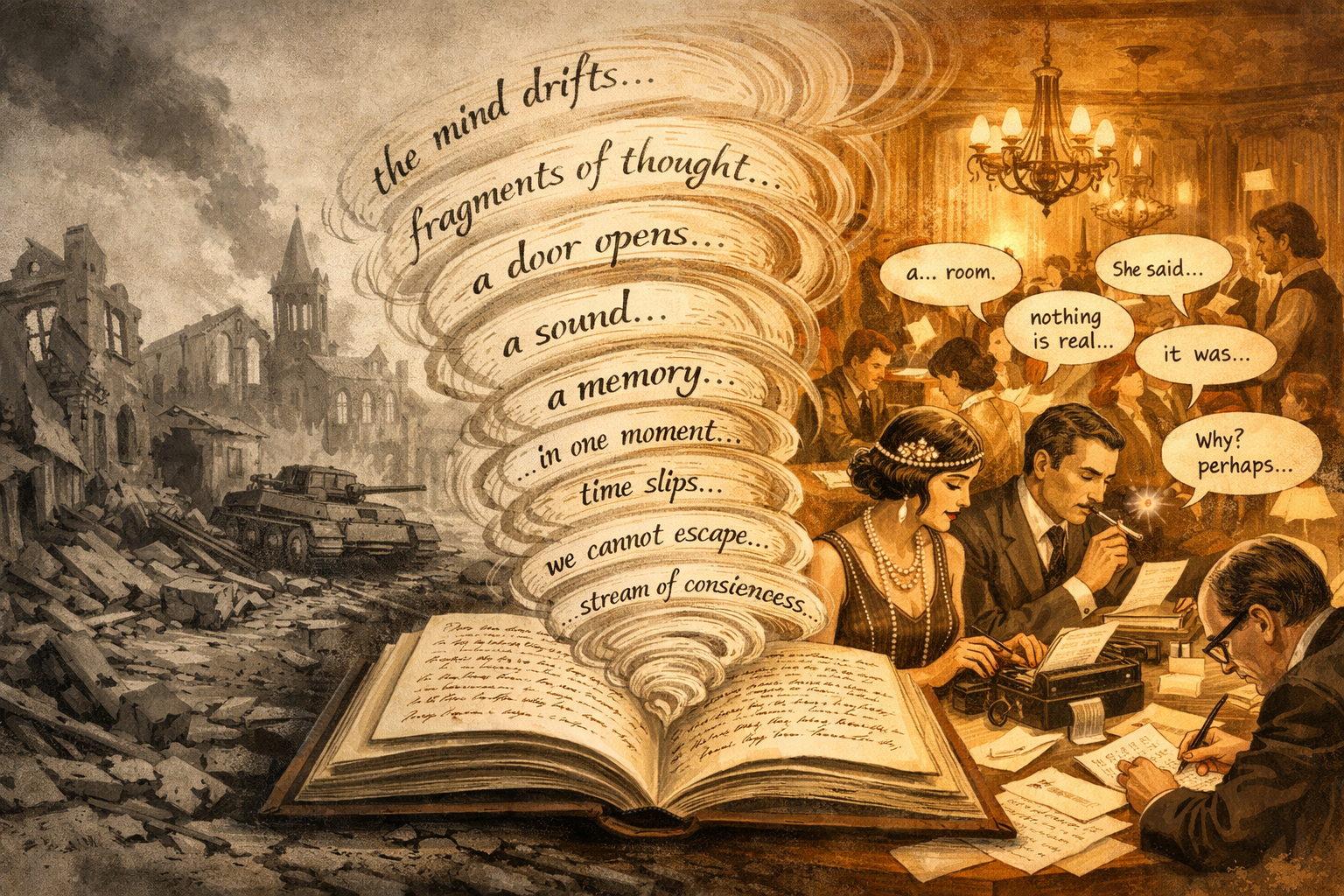
Modernism literature between the wars (roughly 1918–1939) was a radical break from traditional storytelling. Writers rejected Victorian conventions and experimented with stream of consciousness, fragmented narratives, and unreliable narrators to capture a world shattered by World War I and anxious about what came next.
Table of Contents
Key Takeaways
- Modernism emerged as a direct response to the trauma of World War I and the rapid social changes of the early 20th century.
- Key techniques include stream of consciousness, interior monologue, non-linear timelines, and multiple perspectives.
- Major figures include Virginia Woolf, T.S. Eliot, James Joyce, Ernest Hemingway, William Faulkner, and F. Scott Fitzgerald.
- The movement flourished in literary hubs like Paris, London, and New York between roughly 1918 and 1939.
- Modernist writers questioned the reliability of language itself to capture human experience.
- The interwar period produced some of the most studied texts in the English literary canon.
- Modernism gave way to postmodernism after World War II, though its influence continues in contemporary fiction.
What Exactly Is Modernism in Literature?
Modernism in literature is a broad cultural and artistic movement that rejected 19th-century realism in favor of experimentation, subjectivity, and a deep skepticism about traditional values. For literature enthusiasts, it’s the moment when novels stopped pretending to be windows onto the world and started admitting they were constructions.
The movement didn’t arrive with a single manifesto. Instead, it grew from a shared sense among writers that old forms couldn’t carry the weight of modern experience. The Victorian novel, with its omniscient narrator and tidy moral resolutions, felt dishonest after the trenches of the Somme.
For a broader foundation, the Modernism in Literature: A Complete Guide at LitGram covers the full arc of the movement across multiple periods.
Why Did World War I Trigger the Modernist Movement?
World War I didn’t just kill soldiers — it killed certainty. The war (1914–1918) demolished the idea that Western civilization was progressing rationally toward a better future. Writers who lived through it, or who came of age in its aftermath, couldn’t return to the confident narrative voice of earlier fiction.
Key reasons the war accelerated modernism:
- Loss of faith in institutions: Church, government, and empire all failed to prevent mass slaughter.
- Psychological trauma: Shell shock (now recognized as PTSD) introduced the idea that the mind itself was fractured and unreliable.
- Technological horror: Poison gas, machine guns, and aerial bombing made “progress” look monstrous.
- Collapse of meaning: Traditional language felt inadequate to describe what soldiers experienced.
“April is the cruellest month” — T.S. Eliot, The Waste Land (1922). That opening line wasn’t just poetry. It was a generation’s verdict on optimism.
T.S. Eliot’s poem The Waste Land became the defining text of this disillusionment. You can explore The Hollow Men by T.S. Eliot for another key example of how Eliot channeled postwar despair into verse.
What Were the Core Techniques of Modernist Literature?
Modernist writers developed a toolkit of techniques specifically designed to represent consciousness, doubt, and fractured reality. These weren’t stylistic quirks — each technique served a philosophical purpose.
| Technique | What It Does | Key Example |
|---|---|---|
| Stream of consciousness | Mimics the unfiltered flow of thought | Woolf’s Mrs Dalloway |
| Interior monologue | Direct access to a character’s inner voice | Joyce’s Ulysses |
| Non-linear narrative | Disrupts chronological storytelling | Faulkner’s The Sound and the Fury |
| Unreliable narrator | Questions the authority of any single perspective | Ford Madox Ford’s The Good Soldier |
| Fragmented structure | Reflects a broken world | Eliot’s The Waste Land |
| Allusion and intertextuality | Layers meaning through references | Joyce’s use of Homer in Ulysses |
Common mistake: Many readers assume modernist difficulty is pretension. In fact, the complexity usually mirrors a specific argument — that reality is not simple, and that any narrative claiming otherwise is lying.
Eliot’s critical framework for how writers should relate to tradition is worth understanding too. His essay Tradition and the Individual Talent remains essential reading for anyone studying modernism seriously.
Who Were the Major Modernist Writers Between the Wars?
The interwar modernist canon is large, but a core group of writers defined the movement’s ambitions and set the standard for literary experimentation.
Virginia Woolf (1882–1941)
Woolf’s novels Mrs Dalloway (1925) and To the Lighthouse (1927) perfected stream-of-consciousness technique. She argued in her essay “Modern Fiction” that novelists should capture “the myriad impressions” of the mind rather than following plot conventions.
James Joyce (1882–1941)
Joyce’s Ulysses (1922) is arguably the most ambitious novel in English. Set over a single day in Dublin, it layers mythological allusion, interior monologue, and stylistic parody into a work that still rewards rereading decades later.
T.S. Eliot (1888–1965)
As both poet and critic, Eliot shaped how modernism understood itself. The Waste Land synthesized European culture, Eastern philosophy, and wartime despair into 434 lines.
Ernest Hemingway (1899–1961)
Hemingway’s “iceberg theory” — saying less to imply more — was its own form of modernist restraint. The Sun Also Rises (1926) captured the Lost Generation’s aimlessness with devastating economy.
William Faulkner (1897–1962)
Faulkner pushed stream of consciousness to its limit in The Sound and the Fury (1929). For a deeper look at his techniques, the guide to William Faulkner for UGC NET is an excellent resource.
F. Scott Fitzgerald (1896–1940)
The Great Gatsby (1925) used a semi-reliable narrator and lyrical prose to dissect the American Dream’s hollow promise.
How Did Modernism Change Poetry Between the Wars?
Modernist poetry broke decisively with the musical regularity of Victorian verse. Free verse replaced rhyme schemes. Imagery replaced explicit statement. The poem became a site of ambiguity rather than resolution.
Key shifts in interwar poetry:
- Free verse became the dominant form, freeing poets from metrical constraints.
- The image (as championed by Imagism) replaced ornate description.
- Allusion replaced explanation — readers were expected to do interpretive work.
- Irony became a primary mode, undercutting sentiment wherever it appeared.
W.H. Auden bridged the gap between high modernism and more politically engaged poetry in the 1930s. His work Night Mail shows how modernist technique could serve documentary and social purposes.
What Role Did Paris Play in Interwar Modernism?
Paris between the wars was the closest thing modernism had to a headquarters. The city attracted expatriate writers from Britain, Ireland, and America who found its bohemian culture, cheap living, and relative freedom from censorship ideal for experimental work.
Key figures in the Paris scene:
- Gertrude Stein ran a salon at 27 rue de Fleurus that functioned as an unofficial modernist academy.
- Sylvia Beach published Ulysses through her Shakespeare and Company bookshop after no mainstream publisher would touch it.
- Ernest Hemingway and F. Scott Fitzgerald both did significant work there.
- Samuel Beckett arrived later in the decade and absorbed modernist influence before developing his own distinctive voice.
For a look at how Beckett extended modernist ideas into theatre, Samuel Beckett and the Theatre of the Absurd traces that lineage clearly.
How Does Modernism Differ from Postmodernism?
This is one of the most common follow-up questions, and it’s worth answering directly. Modernism and postmodernism share a distrust of traditional forms, but they respond to that distrust differently.
| Feature | Modernism | Postmodernism |
|---|---|---|
| Attitude to meaning | Searches for deeper truth | Questions whether truth exists |
| Narrative | Fragmented but purposeful | Playfully self-contradictory |
| Tone | Often earnest, even anguished | Ironic, sometimes parodic |
| Key concern | How to represent reality | Whether representation is possible |
| Period | Roughly 1890–1945 | Roughly 1945–present |
Choose modernism as your focus if you’re interested in how writers tried to salvage meaning from catastrophe. Choose postmodernism if you’re more interested in texts that question the act of meaning-making itself. For a full breakdown, the Postmodernist Literature and Culture guide covers the transition in detail.
What Are the Best Entry Points for Reading Modernist Literature?
Not every modernist text is equally accessible. Here’s a practical reading path based on difficulty and reward:
Start here (more accessible):
- The Great Gatsby — F. Scott Fitzgerald (1925)
- A Room with a View — E.M. Forster (1908)
- The Sun Also Rises — Ernest Hemingway (1926)
Move to these next:
- Mrs Dalloway — Virginia Woolf (1925)
- To the Lighthouse — Virginia Woolf (1927)
- The Waste Land — T.S. Eliot (1922)
Challenge yourself with:
- The Sound and the Fury — William Faulkner (1929)
- Ulysses — James Joyce (1922)
Edge case: Many readers bounce off Joyce’s Ulysses on a first attempt. Reading a companion guide alongside it, or tackling Dubliners first, makes the experience far more rewarding.
FAQ: Modernism Literature Between the Wars
What years does interwar modernism cover?
Interwar modernism spans roughly 1918 to 1939 — from the end of World War I to the start of World War II. The broader modernist movement began around 1890 and extended into the 1940s.
Why is modernist literature so difficult to read?
Modernist writers deliberately broke with conventions that made Victorian fiction easy to follow. The difficulty is intentional: it reflects a belief that reality is complex, consciousness is non-linear, and simple narratives falsify experience.
What is stream of consciousness?
Stream of consciousness is a narrative technique that represents a character’s thoughts as they actually occur — associative, fragmented, and unfiltered by a narrator’s shaping hand. Virginia Woolf and James Joyce are its most celebrated practitioners.
Is modernism only a British and American movement?
No. Modernism was international. French, German, Italian, and Latin American writers all participated. However, English-language modernism is especially well-documented and influential in the academic canon.
What ended the modernist period?
World War II effectively closed the interwar modernist period. The Holocaust and atomic bomb created a new set of cultural traumas that pushed literature toward postmodernism, existentialism, and new forms of realism.
How does modernism relate to New Criticism?
New Criticism, which dominated literary studies from the 1930s to 1960s, developed partly as a way to read modernist texts. Its focus on close reading and the autonomous literary work suited the complexity of modernist poetry and prose. See the New Criticism Explained guide for more.
Who coined the term “Lost Generation”?
Gertrude Stein is credited with the phrase, which she reportedly used in conversation with Ernest Hemingway. He used it as an epigraph to The Sun Also Rises, cementing it in literary history.
Did modernist writers have political views?
Yes, and they varied widely. Eliot was conservative and Anglo-Catholic. Woolf was a feminist and pacifist. Hemingway covered the Spanish Civil War. Faulkner engaged deeply with American racial history. Modernism was never a single political position.
Conclusion: Why Modernism Still Matters in 2026
Modernism between the wars wasn’t just a literary fashion. It was a serious attempt to answer a serious question: how do you write honestly about a world that has stopped making sense?
The techniques modernist writers developed — stream of consciousness, unreliable narration, fragmented structure — are now standard tools in contemporary fiction. Any reader who wants to understand how the novel works today needs to understand how it was rebuilt between 1918 and 1939.
Actionable next steps for literature enthusiasts:
- Start with Fitzgerald or Hemingway if you’re new to the period — both are readable and rewarding.
- Read Woolf’s essay “Modern Fiction” (1925) to hear a modernist explain the movement’s goals in her own words.
- Pair difficult texts with secondary reading — a good guide to Ulysses or The Waste Land transforms the experience.
- Explore the critical frameworks that grew alongside modernism, including New Criticism and Structuralism.
- Follow the lineage forward into postmodernism to see how the movement’s ideas were challenged and extended.
The writers of the interwar period didn’t just describe a broken world. They built new literary forms capable of holding that brokenness honestly. That’s why their work still reads as urgent, not merely historical.
Modernist Writer Explorer
Interwar Period (1918–1939) — Filter by form or technique
References
- Bradbury, Malcolm, and James McFarlane, eds. Modernism: A Guide to European Literature 1890–1930. Penguin, 1976.
- Woolf, Virginia. “Modern Fiction.” The Common Reader. Hogarth Press, 1925.
- Eliot, T.S. “Tradition and the Individual Talent.” The Egoist, 1919.
- Levenson, Michael, ed. The Cambridge Companion to Modernism. Cambridge University Press, 1999.
- Nicholls, Peter. Modernisms: A Literary Guide. University of California Press, 1995.
- Kenner, Hugh. A Homemade World: The American Modernist Writers. Knopf, 1975.