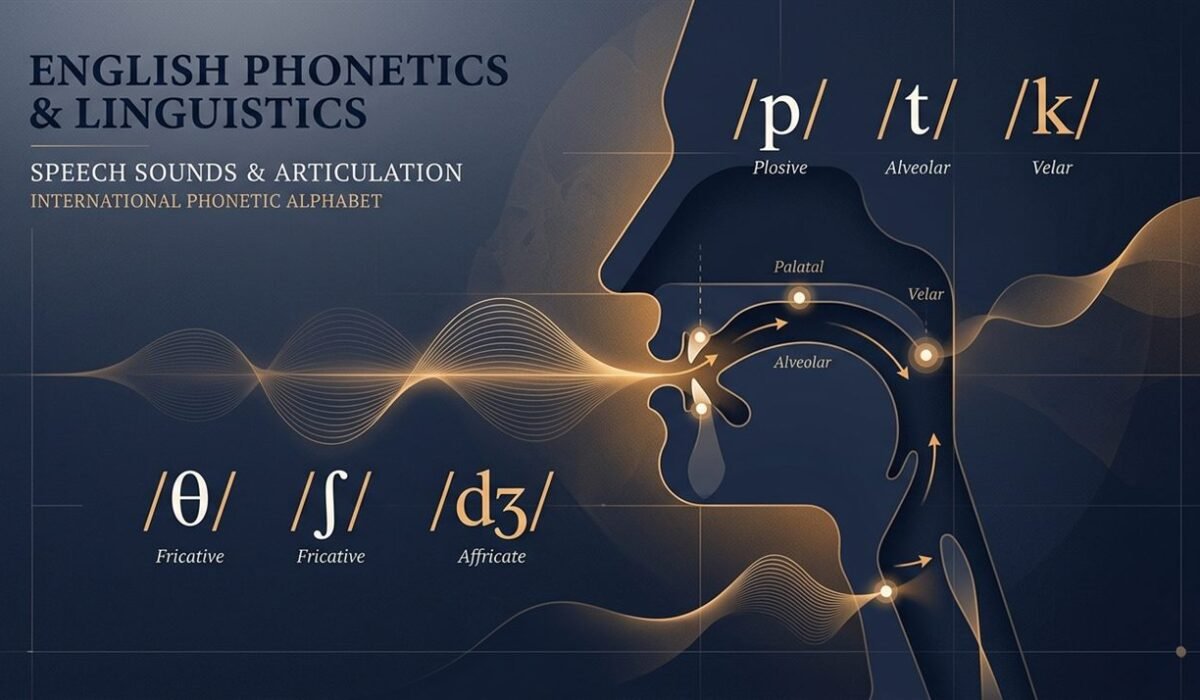
English spelling is notorious for confusing learners because 26 alphabet letters produce 44 distinct speech sounds (phonemes) in Received Pronunciation (RP) and Standard English. Of these 44 sounds, exactly 24 are consonant sounds, while 20 are vowel sounds (12 pure vowels/monophthongs and 8 diphthongs). For competitive exams like RPSC RPSC First Grade English, Second Grade English, and UGC NET Paper 2, mastering these 24 consonant symbols, their place of articulation, and their voicing is essential for scoring full marks in the phonetics section.
What is a Consonant Sound in Phonetics?
In articulatory phonetics, a consonant sound is produced when the outgoing airstream from the lungs is obstructed, constricted, or diverted by speech organs (articulators) such as the lips, teeth, tongue, alveolar ridge, hard palate, soft palate (velum), or glottis. Unlike vowels, which are produced with an unobstructed vocal tract and free airflow, all 24 English consonants involve some form of audible friction, complete closure, or partial narrowing. These repeating consonant patterns also form the foundation for key sound devices in poetry (such as alliteration and consonance); see our study guide on 15 Literary Terms Every Exam Student Must Know.
Every consonant sound is scientifically classified using three distinct criteria:
- State of the Glottis (Voicing): Whether the vocal cords vibrate (Voiced) or do not vibrate (Voiceless).
- Place of Articulation: Where in the vocal tract the obstruction occurs (e.g., lips, teeth, alveolar ridge).
- Manner of Articulation: How the airstream escapes or is blocked (e.g., plosive, fricative, nasal).
The Master Chart: 24 English Consonant Sounds with IPA & Examples
Here is the complete reference table of all 24 consonant phonemes with their standard IPA (International Phonetic Association) symbols, articulatory description, and example words in initial, medial, and final positions.
| IPA Symbol | Name & Articulation Description | Voicing | Examples (Initial, Medial, Final) |
|---|---|---|---|
| /p/ | Voiceless Bilabial Plosive | Voiceless | pen, spoon, cap |
| /b/ | Voiced Bilabial Plosive | Voiced | bat, rubber, rob |
| /t/ | Voiceless Alveolar Plosive | Voiceless | tea, button, cat |
| /d/ | Voiced Alveolar Plosive | Voiced | dog, ladder, red |
| /k/ | Voiceless Velar Plosive | Voiceless | cat, sky, back, king |
| /g/ | Voiced Velar Plosive | Voiced | gun, bigger, bag |
| /f/ | Voiceless Labiodental Fricative | Voiceless | fish, coffee, leaf, phone |
| /v/ | Voiced Labiodental Fricative | Voiced | van, river, have |
| /θ/ (Theta) | Voiceless Dental Fricative | Voiceless | think, author, bath, thin |
| /ð/ (Eth) | Voiced Dental Fricative | Voiced | this, father, breathe, they |
| /s/ | Voiceless Alveolar Fricative | Voiceless | sun, city, pass, bus |
| /z/ | Voiced Alveolar Fricative | Voiced | zoo, rose, buzz, lazy |
| /ʃ/ (Esh) | Voiceless Post-alveolar / Palato-alveolar Fricative | Voiceless | shoe, nation, fish, chef |
| /ʒ/ (Ezh) | Voiced Post-alveolar / Palato-alveolar Fricative | Voiced | measure, vision, rouge, beige |
| /h/ | Voiceless Glottal Fricative | Voiceless | hat, ahead, who |
| /tʃ/ | Voiceless Post-alveolar / Palato-alveolar Affricate | Voiceless | chair, teacher, match |
| /dʒ/ | Voiced Post-alveolar / Palato-alveolar Affricate | Voiced | jug, bridge, age, gem |
| /m/ | Voiced Bilabial Nasal | Voiced | man, summer, arm |
| /n/ | Voiced Alveolar Nasal | Voiced | no, sunny, pen |
| /ŋ/ (Engma) | Voiced Velar Nasal | Voiced | sing, finger, drink (never occurs initially in English) |
| /l/ | Voiced Alveolar Lateral Approximant | Voiced | leg, yellow, bell |
| /r/ | Voiced Post-alveolar Approximant | Voiced | red, sorry, carry (silent in RP final position) |
| /w/ | Voiced Labial-velar Approximant / Semi-vowel | Voiced | wet, away, when |
| /j/ | Voiced Palatal Approximant / Semi-vowel | Voiced | yes, yellow, unit, new |
Classification by Manner of Articulation
Manner of articulation describes how the air passes through the vocal tract. The 24 English consonants fall into six distinct families:
1. Plosives (Stops) — 6 Sounds
Plosives are formed when the articulators create a complete closure in the vocal tract, stopping the airflow completely, followed by a sudden explosive release. There are 3 pairs of plosives (one voiceless, one voiced):
- /p/ & /b/: Bilabial closure (lips pressed together)
- /t/ & /d/: Alveolar closure (tongue tip against tooth ridge)
- /k/ & /g/: Velar closure (back of tongue against soft palate)
2. Fricatives — 9 Sounds
Fricatives are produced by bringing two articulators close enough together to narrow the airflow, creating audible friction or a hissing sound. Fricatives make up the largest family in English consonants:
- /f/ & /v/: Labiodental (upper teeth on lower lip)
- /θ/ & /ð/: Dental (tongue tip against upper teeth)
- /s/ & /z/: Alveolar (tongue blade near alveolar ridge)
- /ʃ/ & /ʒ/: Palato-alveolar (tongue blade near hard palate and alveolar ridge)
- /h/: Glottal (friction produced in the glottis / vocal cords)
3. Affricates — 2 Sounds
An affricate begins as a complete stop (plosive) and releases slowly into a fricative in the same place of articulation:
- /tʃ/: Voiceless palato-alveolar affricate (combination of /t/ + /ʃ/, as in chair)
- /dʒ/: Voiced palato-alveolar affricate (combination of /d/ + /ʒ/, as in judge)
4. Nasals — 3 Sounds
In nasal consonants, the oral cavity is blocked completely, but the soft palate (velum) is lowered, allowing the airstream to escape through the nasal cavity. All nasals in English are voiced:
- /m/: Bilabial nasal (lips closed, air escapes nose) — man, hum
- /n/: Alveolar nasal (tongue on ridge, air escapes nose) — net, tin
- /ŋ/: Velar nasal (back of tongue on soft palate) — sing, ring, long
5. Lateral Approximant — 1 Sound
The sound /l/ is the only lateral consonant in English. The tongue tip makes contact with the center of the alveolar ridge, while the sides of the tongue drop, allowing air to escape freely along the sides. In English, /l/ has two phonetic variants (allophones): clear [l] before vowels (e.g., light) and dark [ɫ] before consonants or at word endings (e.g., milk, ball).
6. Approximants (Frictionless Continuants / Semi-vowels) — 3 Sounds
Approximants involve articulators coming close together without touching or creating turbulent friction. They are phonetically vowel-like but function phonologically as consonants:
- /w/: Labio-velar semi-vowel (lips rounded, tongue raised toward velum) — win, water
- /r/: Post-alveolar approximant (tongue curled slightly back toward hard palate) — run, right
- /j/: Palatal semi-vowel (tongue raised toward hard palate) — yes, young, tune (/tjuːn/)
Classification by Place of Articulation
Place of articulation tells us exactly where the sound is formed in the vocal tract. The 24 consonants are grouped into eight anatomical zones:
| Place of Articulation | Articulators Involved | Consonant Phonemes | Total |
|---|---|---|---|
| Bilabial | Upper lip + Lower lip | /p/, /b/, /m/, /w/ | 4 |
| Labiodental | Lower lip + Upper front teeth | /f/, /v/ | 2 |
| Dental | Tongue tip + Upper front teeth | /θ/, /ð/ | 2 |
| Alveolar | Tongue tip/blade + Alveolar tooth ridge | /t/, /d/, /s/, /z/, /n/, /l/ | 6 |
| Post-alveolar / Palato-alveolar | Tongue blade + Back of tooth ridge / Front of hard palate | /ʃ/, /ʒ/, /tʃ/, /dʒ/, /r/ | 5 |
| Palatal | Front of tongue + Hard palate | /j/ | 1 |
| Velar | Back of tongue + Soft palate (velum) | /k/, /g/, /ŋ/ | 3 |
| Glottal | Vocal folds (glottis) | /h/ | 1 |
Voiced vs. Voiceless Consonants: The Vocal Cord Test
A frequent question in RPSC First Grade and UGC NET asks students to identify whether a given consonant is voiced or voiceless.
The Touch Test: Place your fingers gently on your throat (Adam’s apple) and pronounce /s/ continuously: sssss. You will feel no vibration. Now switch to /z/: zzzzz. You will immediately feel a distinct buzzing vibration. That vibration is the vocal cords vibrating, confirming that /z/ is voiced and /s/ is voiceless.
The 9 Voiceless Consonants: /p/, /t/, /k/, /f/, /θ/, /s/, /ʃ/, /tʃ/, /h/
The 15 Voiced Consonants: /b/, /d/, /g/, /v/, /ð/, /z/, /ʒ/, /dʒ/, /m/, /n/, /ŋ/, /l/, /r/, /w/, /j/
High-Yield Exam Traps for RPSC & UGC NET Aspirants
In competitive examinations, examiners specifically construct questions around silent letters, homophones, and phonetic spelling traps:
- The Letter ‘C’ has no IPA symbol: There is no sound /c/ in English IPA. The letter ‘c’ is transcribed as /s/ in city (/ˈsɪti/) or /k/ in cat (/kæt/).
- The Letter ‘X’ represents two sounds: ‘X’ is never a single phonetic symbol. It represents /ks/ in box (/bɒks/) or /gz/ in exam (/ɪɡˈzæm/).
- The /ŋ/ sound never begins an English word: In English phonological structure (a key topic in Structuralism and structural linguistics), the velar nasal /ŋ/ can only occur in medial or final positions (e.g., singing /ˈsɪŋɪŋ/), never initially.
- The ‘TH’ Minimal Pairs: English has two distinct ‘th’ sounds:
- Voiceless /θ/: thin, bath, author, breath (noun)
- Voiced /ð/: this, father, then, breathe (verb)
- Silent Consonant Letters in Exam Words:
- Silent ‘p’: psychology (/saɪˈkɒlədʒi/), receipt (/rɪˈsiːt/), pneumonia (/njuːˈməʊniə/)
- Silent ‘b’: doubt (/daʊt/), debt (/det/), tomb (/tuːm/), comb (/kəʊm/)
- Silent ‘k’: knee (/niː/), knight (/naɪt/), knife (/naɪf/)
- Silent ‘l’: calm (/kɑːm/), walk (/wɔːk/), salmon (/ˈsæmən/)
10 High-Yield Practice MCQs with Explanations
Q1. How many consonant sounds are there in the Received Pronunciation (RP) of English?
A) 21
B) 24
C) 26
D) 20
Answer: B) 24
Explanation: English has 26 alphabet letters, but phonetically there are 44 sounds: 24 consonants and 20 vowels.
Q2. Which of the following is a voiceless palato-alveolar affricate?
A) /dʒ/
B) /tʃ/
C) /ʃ/
D) /ʒ/
Answer: B) /tʃ/
Explanation: /tʃ/ (as in church, chair) is voiceless, while /dʒ/ (as in judge) is its voiced counterpart. /ʃ/ and /ʒ/ are fricatives, not affricates.
Q3. Which of the following sounds is NOT a plosive in English?
A) /p/
B) /t/
C) /f/
D) /k/
Answer: C) /f/
Explanation: /f/ is a voiceless labiodental fricative. The six English plosives are /p/, /b/, /t/, /d/, /k/, /g/.
Q4. The sound /θ/ in ‘think’ is classified as:
A) Voiced dental fricative
B) Voiceless dental fricative
C) Voiceless alveolar plosive
D) Voiced labiodental fricative
Answer: B) Voiceless dental fricative
Explanation: /θ/ is articulated with the tongue tip against the upper teeth without vocal cord vibration.
Q5. How many voiced consonant sounds exist in English?
A) 9
B) 12
C) 15
D) 18
Answer: C) 15
Explanation: Out of 24 consonants, 9 are voiceless and 15 are voiced. All nasals (/m/, /n/, /ŋ/), lateral (/l/), approximants (/w/, /r/, /j/), plus /b/, /d/, /g/, /v/, /ð/, /z/, /ʒ/, /dʒ/ are voiced.
Q6. The phonetic symbol for the underlined sound in the word ‘measure’ is:
A) /z/
B) /ʃ/
C) /ʒ/
D) /dʒ/
Answer: C) /ʒ/
Explanation: ‘Measure’ is transcribed as /ˈmeʒə(r)/. The middle sound is the voiced palato-alveolar fricative /ʒ/.
Q7. Which consonant sound can NEVER occur at the beginning of an English word?
A) /j/
B) /ŋ/
C) /w/
D) /h/
Answer: B) /ŋ/
Explanation: The velar nasal /ŋ/ (engma) only occurs medially (e.g., finger) or finally (e.g., sing) in English phonotactics.
Q8. The consonants /w/ and /j/ are technically called:
A) Affricates
B) Plosives
C) Semi-vowels or Approximants
D) Sibilants
Answer: C) Semi-vowels or Approximants
Explanation: Phonetically they resemble vowels (no oral closure), but phonologically they behave as consonants (functioning as syllable onsets).
Q9. Which consonant sound is a voiced alveolar lateral approximant?
A) /r/
B) /l/
C) /w/
D) /j/
Answer: B) /l/
Explanation: /l/ is articulated with the tongue against the alveolar ridge while air escapes along the sides (lateral).
Q10. What is the correct phonetic transcription of the word ‘church’?
A) /tʃɜːtʃ/
B) /ʃɜːʃ/
C) /kɜːtʃ/
D) /dʒɜːdʒ/
Answer: A) /tʃɜːtʃ/
Explanation: ‘Church’ begins and ends with the voiceless affricate /tʃ/, enclosing the long vowel /ɜː/.
Frequently Asked Questions (Phonetics FAQ)
Q1. What is the difference between consonant letters and consonant sounds?
A: Consonant letters are the 21 written alphabetic symbols (B, C, D, F, etc.) in the English alphabet. Consonant sounds are the 24 acoustic speech phonemes (/p/, /b/, /θ/, etc.) produced by the vocal tract. One letter can produce multiple sounds (e.g., ‘c’ in cat /k/ vs. cent /s/).
Q2. Why are there 44 sounds in English but only 26 letters?
A: English spelling evolved historically from Old English, Norman French, Latin, and Greek borrowings without updating its 26-letter Latin alphabet. As pronunciation changed over centuries (like the Great Vowel Shift), the 26 letters had to double up or combine (digraphs like ‘th’, ‘sh’, ‘ch’, ‘ph’) to represent the 44 spoken phonemes.
Q3. Which consonant sounds are easiest to confuse in exam transcriptions?
A: The most common confusion occurs between /θ/ and /ð/ (both written ‘th’), /s/ and /z/ (plural endings like cats /s/ vs. dogs /z/), and /ʃ/ vs. /tʃ/ (as in sheep /ʃ/ vs. cheap /tʃ/).
Q4. What is Received Pronunciation (RP)?
A: Received Pronunciation (RP), also known as BBC English or Standard Southern British, is the standard accent of English traditionally used as the reference model for teaching and authoritative lexicons such as the Cambridge English Dictionary, and the benchmark tested in RPSC and UGC NET examinations.
1 response