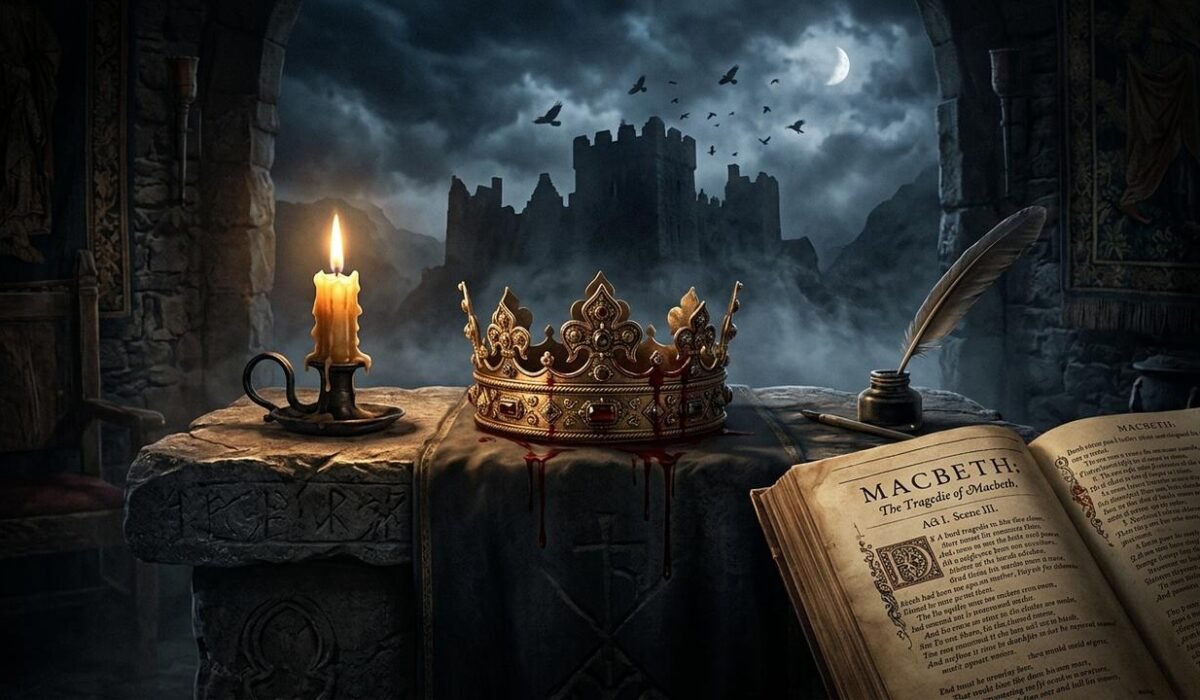
William Shakespeare’s The Tragedy of Macbeth (c. 1606) stands as the shortest, darkest, and most dramatically intense of his four great tragedies. For competitive aspirants preparing for RPSC School Lecturer (First Grade), RPSC Senior Teacher (Second Grade), UGC NET English Paper 2, and state SET examinations, Macbeth is a recurring high-weightage anchor text.
📌 Exam Overview & Key Takeaways
- High-Frequency Syllabus Areas: Historical alterations of Holinshed’s Chronicles, Jacobean politics (Gunpowder Plot & King James I), Act-by-Act chronological turning points, famous soliloquies, imagery of clothing and sleeplessness, and twentieth-century critical essays.
- Exam Level Coverage: 50 authentic, syllabus-aligned multiple-choice questions divided into 5 structured sections with primary textual references and critical traps.
- Essential Prerequisite Guides: For a comprehensive character study and tragic theory, review our companion analysis on Macbeth as Tragic Hero: Complete Character Analysis with Evidence, along with key dramatic lines in our RPSC Drama Important Quotes Guide and foundational exam concepts in RPSC First Grade English Preparation.
- Primary Reference Sources: All textual references and act/scene citations correspond to standard scholarly records available in the Folger Shakespeare Library digital edition and the British Library Discovering Literature archives.
Part 1: Textual Composition, Dates & Historical Sources (Q1–Q10)
Examiners frequently test the precise historical and political milieu of Macbeth. Shakespeare composed the play around 1606 shortly after James VI of Scotland ascended the English throne as James I, weaving historical compliments and contemporary anxieties directly into the dramatic fabric.
Q1. What was William Shakespeare’s primary historical source for the plot of Macbeth?
- (A) Plutarch’s Lives of the Noble Greeks and Romans
- (B) Raphael Holinshed’s Chronicles of England, Scotland, and Ireland (1587)
- (C) Geoffrey of Monmouth’s Historia Regum Britanniae
- (D) William Painter’s Palace of Pleasure
View Correct Answer & Detailed Explanation
Correct Answer: (B) Raphael Holinshed’s Chronicles of England, Scotland, and Ireland (1587)
Textual Analysis & Reference: Shakespeare drew almost the entirety of his historical plot from the second edition of Raphael Holinshed’s Chronicles of England, Scotland, and Ireland (1587). While he consulted Plutarch for his Roman tragedies (such as Julius Caesar and Antony and Cleopatra), Holinshed was the authoritative source for Scottish history.
Q2. In Raphael Holinshed’s historical account, how is Banquo originally depicted, and why did Shakespeare deliberately alter his character?
- (A) Banquo was Duncan’s brother; Shakespeare made him an unrelated general to avoid dynastic incest.
- (B) Banquo was an accomplice in Duncan’s murder; Shakespeare made him innocent and virtuous to flatter King James I, who claimed descent from Banquo.
- (C) Banquo was a mythical sorcerer; Shakespeare humanized him into a Scottish general.
- (D) Banquo never existed in Holinshed; Shakespeare invented him entirely.
View Correct Answer & Detailed Explanation
Correct Answer: (B) Banquo was an accomplice in Duncan’s murder; Shakespeare made him innocent and virtuous to flatter King James I, who claimed descent from Banquo.
Textual Analysis & Reference: In Holinshed’s Chronicles, Banquo is explicitly an accomplice who aids Macbeth in the regicide of King Duncan. Shakespeare radically transformed Banquo into an innocent, morally upright figure who resists the temptation of the Weird Sisters because King James I of England traced his royal lineage directly to Banquo through the Stuart dynasty.
Q3. Which contemporary English historical event of November 1605 is directly reflected in the Porter’s comic monologue in Act II, Scene 3?
- (A) The Essex Rebellion
- (B) The Babington Plot
- (C) The Gunpowder Plot
- (D) The Defeat of the Spanish Armada
View Correct Answer & Detailed Explanation
Correct Answer: (C) The Gunpowder Plot
Textual Analysis & Reference: The Porter’s speech famously refers to ‘an equivocator, that could swear in both the scales against either scale; who committed treason enough for God’s sake, yet could not equivocate to heaven.’ This directly references Father Henry Garnet, a Jesuit superior tried and executed in early 1606 for his involvement in the Gunpowder Plot (5 November 1605), who defended the doctrine of equivocation at his trial.
Q4. Which scholarly treatise written by King James I in 1597 significantly influenced Shakespeare’s portrayal of witchcraft and the supernatural in Macbeth?
- (A) The True Law of Free Monarchies
- (B) Basilikon Doron
- (C) Daemonologie
- (D) A Counterblaste to Tobacco
View Correct Answer & Detailed Explanation
Correct Answer: (C) Daemonologie
Textual Analysis & Reference: King James I published Daemonologie in Edinburgh in 1597, defending the theological belief in witchcraft and detailing witch rituals, storms, and familiars. Shakespeare incorporated specific elements from the North Berwick Witch Trials (which James personally oversaw), including witches sailing in sieves and boiling uncanny ingredients in cauldrons.
Q5. In what year and publication did Shakespeare’s Macbeth first appear in print?
- (A) In a Quarto edition of 1606
- (B) In the First Folio of 1623
- (C) In a Bad Quarto of 1608
- (D) In the Second Folio of 1632
View Correct Answer & Detailed Explanation
Correct Answer: (B) In the First Folio of 1623
Textual Analysis & Reference: Unlike many other Shakespearean plays, no contemporary Quarto edition of Macbeth was ever published during Shakespeare’s lifetime. The play was published for the first time in the First Folio of 1623 (prepared by John Heminges and Henry Condell), where it was entered as The Tragedie of Macbeth.
Q6. Most modern textual scholars agree that the songs and scenes featuring Hecate (Act III, Scene 5 and Act IV, Scene 1) were later interpolated by which Jacobean dramatist?
- (A) Thomas Middleton
- (B) John Fletcher
- (C) John Webster
- (D) Ben Jonson
View Correct Answer & Detailed Explanation
Correct Answer: (A) Thomas Middleton
Textual Analysis & Reference: The Hecate passages in Act III, Scene 5 and Act IV, Scene 1 feature two songs (‘Come away, come away’ and ‘Black spirits’) taken verbatim from Thomas Middleton’s play The Witch (c. 1613-1616). Most textual editors agree that Middleton revised the King’s Men’s promptbook version of Macbeth around 1616 to add musical spectacles.
Q7. How does the historical character of King Duncan in Holinshed differ from Shakespeare’s tragic depiction?
- (A) In Holinshed, Duncan was an elderly, holy, and saintly ruler.
- (B) In Holinshed, Duncan was young, weak, indolent, and an ineffective ruler whose reign provoked rebellions.
- (C) In Holinshed, Duncan was a tyrannical usurper murdered legally by Macbeth.
- (D) In Holinshed, Duncan died peacefully in his sleep of natural causes.
View Correct Answer & Detailed Explanation
Correct Answer: (B) In Holinshed, Duncan was young, weak, indolent, and an ineffective ruler whose reign provoked rebellions.
Textual Analysis & Reference: Historically in Holinshed, Duncan is described as a young and feeble king whose soft nature and negligence fostered lawlessness and insurrection, whereas Macbeth was actually an able administrator who ruled Scotland successfully for ten peaceful years before turning tyrannical. Shakespeare elevated Duncan into an aged, saintly patriarch to magnify the heinous moral sacrilege of regicide.
Q8. Who was the acting monarch when Macbeth was staged, and which acting troupe performed it?
- (A) Queen Elizabeth I; Lord Chamberlain’s Men
- (B) King James I; The King’s Men
- (C) Queen Elizabeth I; Admiral’s Men
- (D) King Charles I; King’s Players
View Correct Answer & Detailed Explanation
Correct Answer: (B) King James I; The King’s Men
Textual Analysis & Reference: When Queen Elizabeth I died in 1603, King James I granted royal patronage to Shakespeare’s company, renaming the Lord Chamberlain’s Men to ‘The King’s Men’. Macbeth was explicitly written and performed under this royal patronage for King James I.
Q9. In Holinshed’s Chronicles, where was the historical Duncan slain by Macbeth?
- (A) In his royal bedchamber at Inverness Castle
- (B) At Bothgofnane (Pitgaveny) near Elgin in open conflict or ambush
- (C) On the battlefield at Dunsinane
- (D) Inside the royal palace at Forres
View Correct Answer & Detailed Explanation
Correct Answer: (B) At Bothgofnane (Pitgaveny) near Elgin in open conflict or ambush
Textual Analysis & Reference: In Holinshed, Macbeth slew Duncan at Bothgofnane near Elgin. The dramatic details of murdering an unsuspecting, sleeping guest in a castle were borrowed by Shakespeare from Holinshed’s earlier account of the murder of King Duffe by his treacherous host Donwald and his ambitious wife.
Q10. What is the unique structural distinction of Macbeth among Shakespeare’s four canonical great tragedies (Hamlet, Othello, King Lear, Macbeth)?
- (A) It has the largest number of lines.
- (B) It contains the fewest female speaking roles.
- (C) It is by far the shortest in word count, running approximately 2,100 lines.
- (D) It is written entirely in rhymed couplets.
View Correct Answer & Detailed Explanation
Correct Answer: (C) It is by far the shortest in word count, running approximately 2,100 lines.
Textual Analysis & Reference: Running barely 2,100 lines (roughly half the length of Hamlet at over 4,000 lines), Macbeth is the shortest of Shakespeare’s four great tragedies. This conciseness produces its relentless, breakneck dramatic tempo where action rapidly cascades without subplots.
Part 2: Act-by-Act Plot Development & Pivotal Turning Points (Q11–Q20)
The narrative architecture of Macbeth moves with surgical economy. The following questions test precise chronological events, prophecies, apparition mechanics, and character motivations.
Q11. In Act I, Scene 2, the wounded Sergeant describes Macbeth’s valorous defeat of which rebel leader?
- (A) Sweno, King of Norway
- (B) Macdonwald, the rebel from the Western Isles
- (C) The treacherous Thane of Cawdor
- (D) The Earl of Northumberland
View Correct Answer & Detailed Explanation
Correct Answer: (B) Macdonwald, the rebel from the Western Isles
Textual Analysis & Reference: The Captain reports to King Duncan that brave Macbeth, ‘disdaining Fortune’, carved through the rebel ranks until he faced the treacherous Macdonwald and ‘unseam’d him from the nave to the chaps, / And fix’d his head upon our battlements’ (Act I, Scene 2).
Q12. What are the three specific titles by which the Weird Sisters hail Macbeth upon the blasted heath in Act I, Scene 3?
- (A) Thane of Glamis, Thane of Ross, King of Scotland
- (B) Thane of Glamis, Thane of Cawdor, King hereafter
- (C) Thane of Fife, Thane of Cawdor, Prince of Cumberland
- (D) General of Scotland, Thane of Glamis, King of Britain
View Correct Answer & Detailed Explanation
Correct Answer: (B) Thane of Glamis, Thane of Cawdor, King hereafter
Textual Analysis & Reference: The Weird Sisters greet him in ascending sequence: ‘All hail, Macbeth! hail to thee, Thane of Glamis!’ (his current title), ‘All hail, Macbeth, hail to thee, Thane of Cawdor!’ (an unannounced honor), and ‘All hail, Macbeth, that shalt be king hereafter!’
Q13. What official announcement made by King Duncan in Act I, Scene 4 acts as an immediate structural stumbling block to Macbeth’s ambitious path to the crown?
- (A) Duncan establishes an elective monarchy by Scottish chieftains.
- (B) Duncan names his eldest son, Malcolm, as the Prince of Cumberland and lawful heir.
- (C) Duncan bequeaths his royal treasury entirely to Donalbain.
- (D) Duncan revokes Macbeth’s newfound title of Cawdor.
View Correct Answer & Detailed Explanation
Correct Answer: (B) Duncan names his eldest son, Malcolm, as the Prince of Cumberland and lawful heir.
Textual Analysis & Reference: Duncan proclaims his eldest son, Malcolm, the Prince of Cumberland, establishing primogeniture. Macbeth immediately recognizes this obstacle in an aside: ‘The Prince of Cumberland! that is a step / On which I must fall down, or else o’erleap, / For in my way it lies.’ (Act I, Scene 4).
Q14. In Act II, Scene 2, what exact word sticks in Macbeth’s throat immediately following the murder of King Duncan, symbolizing his instant spiritual damnation?
- (A) ‘Mercy’
- (B) ‘Heaven’
- (C) ‘Amen’
- (D) ‘Forgive’
View Correct Answer & Detailed Explanation
Correct Answer: (C) ‘Amen’
Textual Analysis & Reference: Macbeth relates to Lady Macbeth: ‘One cried “God bless us!” and “Amen” the other… I could not say “Amen,” when they did say “God bless us!” … I had most need of blessing, and “Amen” / Stuck in my throat.’ (Act II, Scene 2). This signifies total theological alienation.
Q15. Following Duncan’s assassination in Act II, Scene 3, where do the King’s two sons, Malcolm and Donalbain, choose to flee?
- (A) Malcolm flees to France, and Donalbain flees to Rome.
- (B) Malcolm flees to England, and Donalbain flees to Ireland.
- (C) Malcolm flees to Ireland, and Donalbain flees to England.
- (D) Both brothers flee together to the court of Norway.
View Correct Answer & Detailed Explanation
Correct Answer: (B) Malcolm flees to England, and Donalbain flees to Ireland.
Textual Analysis & Reference: Recognizing that ‘There’s daggers in men’s smiles: the near in blood, / The nearer bloody’, the princes separate for safety: Malcolm flees to England (to seek refuge with King Edward the Confessor), while Donalbain flees to Ireland.
Q16. What is the climactic technical turning point (peripeteia) in Act III, Scene 3 that signals the ultimate failure of Macbeth’s desperate campaign to secure his dynasty?
- (A) The murder of Banquo by the hired assassins
- (B) The escape of Banquo’s young son, Fleance, in the darkness
- (C) Macduff’s refusal to attend the royal banquet
- (D) The appearance of the armed apparition
View Correct Answer & Detailed Explanation
Correct Answer: (B) The escape of Banquo’s young son, Fleance, in the darkness
Textual Analysis & Reference: While the murderers succeed in assassinating Banquo, one murderer accidentally strikes out the torch light, allowing Fleance to flee into the night. Fleance’s escape guarantees the fulfillment of the Witches’ prophecy that Banquo’s descendants will inherit the crown, rendering all of Macbeth’s bloodletting futile.
Q17. During the royal banquet in Act III, Scene 4, whose ghost appears and occupies Macbeth’s reserved seat, and who else in the banquet hall can see it?
- (A) Duncan’s ghost; seen by both Macbeth and Lady Macbeth.
- (B) Banquo’s ghost; seen by Macbeth and all the assembled Scottish Thanes.
- (C) Banquo’s ghost; seen exclusively by Macbeth, remaining entirely invisible to Lady Macbeth and the lords.
- (D) Duncan’s ghost; seen exclusively by the two murderers.
View Correct Answer & Detailed Explanation
Correct Answer: (C) Banquo’s ghost; seen exclusively by Macbeth, remaining entirely invisible to Lady Macbeth and the lords.
Textual Analysis & Reference: Banquo’s ghost enters and sits in Macbeth’s place. Crucially, the ghost is an objective hallucinatory projection seen only by Macbeth. Lady Macbeth and the Scottish nobles see an empty chair, forcing Lady Macbeth to dismiss the assembly hurriedly.
Q18. Match the three symbolic apparitions summoned by the Weird Sisters in Act IV, Scene 1 with their corresponding warnings:
- (A) 1-Bloody Child (Beware Macduff); 2-Armed Head (None of woman born); 3-Crowned Child (Birnam Wood)
- (B) 1-Armed Head (Beware Macduff); 2-Bloody Child (None of woman born shall harm Macbeth); 3-Crowned Child with tree (Birnam Wood to Dunsinane)
- (C) 1-Crowned Child (Beware Macduff); 2-Armed Head (Birnam Wood); 3-Bloody Child (None of woman born)
- (D) 1-Armed Head (Birnam Wood); 2-Crowned Child (Beware Thane of Fife); 3-Bloody Child (Procession of Kings)
View Correct Answer & Detailed Explanation
Correct Answer: (B) 1-Armed Head (Beware Macduff); 2-Bloody Child (None of woman born shall harm Macbeth); 3-Crowned Child with tree (Birnam Wood to Dunsinane)
Textual Analysis & Reference: The first apparition is an Armed Head (‘Macbeth! Macbeth! Macbeth! beware Macduff; / Beware the Thane of Fife’). The second is a Bloody Child (‘none of woman born / Shall harm Macbeth’). The third is a Crowned Child with a tree in his hand (‘Macbeth shall never vanquish’d be until / Great Birnam wood to high Dunsinane hill / Shall come against him’).
Q19. In Act IV, Scene 3 (the England scene), how does Prince Malcolm initially test the moral integrity and political loyalty of Macduff?
- (A) By accusing Macduff of being Macbeth’s undercover spy.
- (B) By falsely claiming that he himself possesses boundless lust, avarice, and vices far worse than Macbeth’s tyranny.
- (C) By demanding that Macduff assassinate King Edward the Confessor.
- (D) By offering to surrender the Scottish throne to Macduff.
View Correct Answer & Detailed Explanation
Correct Answer: (B) By falsely claiming that he himself possesses boundless lust, avarice, and vices far worse than Macbeth’s tyranny.
Textual Analysis & Reference: Malcolm suspects Macduff might be an agent sent by Macbeth. To test his sincere love for Scotland, Malcolm slanders his own nature, claiming he is insatiably voluptuous, greedy, and devoid of kingly virtues. When Macduff cries out in despair (‘O Scotland, Scotland!… Fit to govern! / No, not to live’), Malcolm realizes Macduff is truly devoted to his country and retracts his false confessions.
Q20. In Act V, Scene 8, how is the second apparition’s riddle (‘none of woman born shall harm Macbeth’) dramatically resolved in the final combat?
- (A) Macduff was adopted and did not know his biological parents.
- (B) Macduff was born posthumously after his mother had expired.
- (C) Macduff was ‘from his mother’s womb / Untimely ripp’d’ by Caesarean section.
- (D) Macduff fought under the supernatural enchantment of the English King.
View Correct Answer & Detailed Explanation
Correct Answer: (C) Macduff was ‘from his mother’s womb / Untimely ripp’d’ by Caesarean section.
Textual Analysis & Reference: Macduff reveals: ‘Despair thy charm; / And let the angel whom thou still hast served / Tell thee, Macduff was from his mother’s womb / Untimely ripp’d’ (Act V, Scene 8). In Elizabethan/Jacobean linguistic understanding, a child delivered via Caesarean section was technically not ‘born of woman’ through natural parturition.
Part 3: Famous Soliloquies, Dramatic Quotations & Speakers (Q21–Q30)
Shakespeare’s language in Macbeth is dense, compressed, and laden with visceral imagery. Competitive exams frequently present verbatim lines requiring exact speaker identification, context, and philosophical import.
Q21. Who speaks the opening paradox that establishes the moral inversion and corrupted atmosphere of the entire tragedy: ‘Fair is foul, and foul is fair: / Hover through the fog and filthy air’?
- (A) Macbeth in his opening soliloquy
- (B) The Three Witches in unison (Act I, Scene 1)
- (C) Lady Macbeth invoking the spirits of darkness
- (D) Banquo upon surveying the blasted heath
View Correct Answer & Detailed Explanation
Correct Answer: (B) The Three Witches in unison (Act I, Scene 1)
Textual Analysis & Reference: All three Witches chant this foundational chiasmus together at the conclusion of Act I, Scene 1. It establishes the central moral theme: boundaries between good and evil, truth and deception, heroism and damnation will be systematically overturned.
Q22. In Act I, Scene 5, upon reading her husband’s letter, what flaw does Lady Macbeth identify in Macbeth’s character that might prevent him from seizing the crown?
- (A) A lack of physical courage on the battlefield
- (B) He is ‘too full o’ the milk of human kindness / To catch the nearest way’
- (C) His unyielding devotion to King Duncan’s family
- (D) His religious dread of the Scottish clergy
View Correct Answer & Detailed Explanation
Correct Answer: (B) He is ‘too full o’ the milk of human kindness / To catch the nearest way’
Textual Analysis & Reference: Lady Macbeth assesses her husband’s divided psyche: ‘Yet do I fear thy nature; / It is too full o’ the milk of human kindness / To catch the nearest way: thou wouldst be great; / Art not without ambition, but without / The illness should attend it’ (Act I, Scene 5).
Q23. Identify the speaker and context: ‘Come, you spirits / That tend on mortal thoughts, unsex me here, / And fill me from the crown to the toe top-full / Of direst cruelty!’
- (A) The First Witch preparing the charm in the cauldron
- (B) Hecate rebuking the Three Witches
- (C) Lady Macbeth invoking demonic forces to shed feminine remorse (Act I, Scene 5)
- (D) Lady Macduff lamenting her husband’s flight to England
View Correct Answer & Detailed Explanation
Correct Answer: (C) Lady Macbeth invoking demonic forces to shed feminine remorse (Act I, Scene 5)
Textual Analysis & Reference: Lady Macbeth speaks this soliloquy upon hearing that King Duncan is arriving at Inverness. She calls upon dark spirits to strip away her maternal compassion (‘unsex me here’) and replace her breast milk with gall, preparing her psychological resolve for regicide.
Q24. In Macbeth’s great soliloquy in Act I, Scene 7 (‘If it were done when ’tis done, then ’twere well / It were done quickly’), what does he identify as his single driving motive?
- (A) Hatred of Duncan’s lineage
- (B) ‘Vaulting ambition, which o’erleaps itself / And falls on the other’
- (C) Fear of being executed by his peers
- (D) Loyalty to the Weird Sisters’ mandate
View Correct Answer & Detailed Explanation
Correct Answer: (B) ‘Vaulting ambition, which o’erleaps itself / And falls on the other’
Textual Analysis & Reference: Reviewing the reasons against regicide (Duncan is his kinsman, king, and houseguest, and has been blameless in office), Macbeth concludes: ‘I have no spur / To prick the sides of my intent, but only / Vaulting ambition, which o’erleaps itself / And falls on the other’ (Act I, Scene 7).
Q25. In Act II, Scene 1, before murdering Duncan, what hallucination appears before Macbeth, leading him toward the King’s bedchamber?
- (A) A floating bloody crown
- (B) A visionary dagger with ‘gouts of blood’ upon the blade and dudgeon
- (C) A weeping child holding a mirror
- (D) The severed head of Macdonwald
View Correct Answer & Detailed Explanation
Correct Answer: (B) A visionary dagger with ‘gouts of blood’ upon the blade and dudgeon
Textual Analysis & Reference: Macbeth utters the iconic lines: ‘Is this a dagger which I see before me, / The handle toward my hand? Come, let me clutch thee. / I have thee not, and yet I see thee still… And on thy blade and dudgeon gouts of blood, / Which was not so before’ (Act II, Scene 1).
Q26. Who utters the haunting line, ‘Will all great Neptune’s ocean wash this blood / Clean from my hand? No, this my hand will rather / The multitudinous seas incarnadine, / Making the green one red’?
- (A) Lady Macbeth during the sleepwalking scene
- (B) Macbeth immediately after murdering Duncan (Act II, Scene 2)
- (C) Macduff upon discovering Duncan’s slain body
- (D) Malcolm in exile in England
View Correct Answer & Detailed Explanation
Correct Answer: (B) Macbeth immediately after murdering Duncan (Act II, Scene 2)
Textual Analysis & Reference: Macbeth speaks this in utter shock to Lady Macbeth in Act II, Scene 2. The hyperbolic classical allusion to Neptune illustrates the irreversible, cosmic stain of his crime. ‘Incarnadine’ means to dye deep crimson/red.
Q27. Which character delivers the famous philosophical reflection on the fleeting futility of human existence: ‘Life’s but a walking shadow, a poor player / That struts and frets his hour upon the stage / And then is heard no more’?
- (A) Banquo before his assassination
- (B) Macduff upon hearing of his slaughtered family
- (C) Macbeth upon receiving news of Lady Macbeth’s death (Act V, Scene 5)
- (D) The Doctor watching Lady Macbeth’s collapse
View Correct Answer & Detailed Explanation
Correct Answer: (C) Macbeth upon receiving news of Lady Macbeth’s death (Act V, Scene 5)
Textual Analysis & Reference: In Act V, Scene 5, Seyton informs Macbeth that ‘The Queen, my lord, is dead.’ Macbeth delivers the immortal ‘Tomorrow, and tomorrow, and tomorrow’ soliloquy, concluding that life is ‘a tale / Told by an idiot, full of sound and fury, / Signifying nothing.’
Q28. During her sleepwalking torment in Act V, Scene 1, what agonized cry does Lady Macbeth utter that reveals her subconscious guilt over the murder of Duncan and Macduff’s family?
- (A) ‘Amen stuck in my throat!’
- (B) ‘Out, damned spot! out, I say!… The Thane of Fife had a wife: where is she now?’
- (C) ‘O, full of scorpions is my mind!’
- (D) ‘Look like the innocent flower, but be the serpent under’t’
View Correct Answer & Detailed Explanation
Correct Answer: (B) ‘Out, damned spot! out, I say!… The Thane of Fife had a wife: where is she now?’
Textual Analysis & Reference: In Act V, Scene 1, watched by the Doctor and the Gentlewoman, Lady Macbeth obsessively rubs her hands to wash away imaginary blood, crying: ‘Out, damned spot! out, I say!—One: two: why, then, ’tis time to do’t… The Thane of Fife had a wife: where is she now?—What, will these hands ne’er be clean?’
Q29. Complete the chilling quotation spoken by Macbeth to Lady Macbeth in Act III, Scene 2 regarding the persistent torment of his conscience: ‘O, full of ________ is my mind, dear wife!’
- (A) serpents
- (B) scorpions
- (C) vultures
- (D) demons
View Correct Answer & Detailed Explanation
Correct Answer: (B) scorpions
Textual Analysis & Reference: Macbeth exclaims: ‘O, full of scorpions is my mind, dear wife! / Thou know’st that Banquo, and his Fleance, lives’ (Act III, Scene 2). The metaphor of stinging scorpions encapsulates his paranoid agony and psychological disintegration.
Q30. Who says to Malcolm regarding the psychological burden of overwhelming tragedy: ‘Give sorrow words: the grief that does not speak / Whispers the o’er-fraught heart and bids it break’?
- (A) Ross, after breaking the news of Macduff’s family’s slaughter (Act IV, Scene 3)
- (B) Malcolm, counseling Macduff to convert his grief into anger
- (C) Macduff, weeping for his children
- (D) The Doctor in Act V
View Correct Answer & Detailed Explanation
Correct Answer: (B) Malcolm, counseling Macduff to convert his grief into anger
Textual Analysis & Reference: When Ross arrives in England and informs Macduff that his castle was surprised and his wife and babes ‘savagely slaughter’d’, Macduff pulls his hat over his brows in silent shock. Malcolm urges him: ‘Give sorrow words: the grief that does not speak / Whispers the o’er-fraught heart and bids it break’ (Act IV, Scene 3).
Part 4: Literary Devices, Imagery & Tragic Machinery (Q31–Q40)
The aesthetic coherence of Macbeth relies on recurring image patterns—garments, blood, darkness, and disrupted natural order. These questions examine the technical poetics and dramatic devices.
Q31. What recurring symbolic motif is introduced when Angus and Banquo observe Macbeth reacting to his newly granted title: ‘Why do you dress me / In borrow’d robes?’ (Act I, Scene 3)?
- (A) The motif of predatory beasts
- (B) The motif of ill-fitting, borrowed, or dwarfish clothing
- (C) The motif of nautical shipwrecks
- (D) The motif of astronomical eclipses
View Correct Answer & Detailed Explanation
Correct Answer: (B) The motif of ill-fitting, borrowed, or dwarfish clothing
Textual Analysis & Reference: Caroline Spurgeon in Shakespeare’s Imagery and What It Tells Us (1935) proved that the dominant metaphorical motif in Macbeth is ill-fitting clothing. Macbeth is repeatedly likened to a small, petty man wearing garments that are far too large for him, culminating in Act V: ‘Now does he feel his title / Hang loose about him, like a giant’s robe / Upon a dwarfish thief.’
Q32. Which classical Aristotelian term defines Macbeth’s fatal tragic flaw, specifically manifest as overreaching, unrestrained political ambition?
- (A) Anagnorisis
- (B) Hamartia
- (C) Hubris
- (D) Peripeteia
View Correct Answer & Detailed Explanation
Correct Answer: (B) Hamartia
Textual Analysis & Reference: In Aristotle’s Poetics, the tragic flaw or error of judgment that brings about the downfall of an otherwise noble protagonist is called Hamartia. In Macbeth, his hamartia is explicitly self-acknowledged as ‘vaulting ambition’. Hubris denotes excessive pride/arrogance (often against gods), while Hamartia encompasses the broader moral error.
Q33. What dramatic device occurs in Act I, Scene 6 when King Duncan approaches Macbeth’s castle at Inverness and remarks, ‘This castle hath a pleasant seat; the air / Nimbly and sweetly recommends itself / Unto our gentle senses’?
- (A) Pathetic fallacy
- (B) Tragic irony (Dramatic irony)
- (C) Bathos
- (D) Litotes
View Correct Answer & Detailed Explanation
Correct Answer: (B) Tragic irony (Dramatic irony)
Textual Analysis & Reference: This is supreme dramatic irony: King Duncan perceives Inverness Castle as sweet, welcoming, and peaceful, whereas the audience is acutely aware that inside those very walls, Macbeth and Lady Macbeth are plotting his imminent murder that very night.
Q34. Immediately following the murder of Duncan, Macbeth hears a supernatural voice cry: ‘Sleep no more! Macbeth does murder sleep’ (Act II, Scene 2). How does Shakespeare conceptualize ‘sleep’ in this speech?
- (A) As a treacherous trap for soldiers
- (B) As the innocent balm of hurt minds, great nature’s second course, and chief nourisher in life’s feast
- (C) As the brother of death and oblivion
- (D) As an illusion fabricated by the Weird Sisters
View Correct Answer & Detailed Explanation
Correct Answer: (B) As the innocent balm of hurt minds, great nature’s second course, and chief nourisher in life’s feast
Textual Analysis & Reference: Macbeth recites: ‘Sleep that knits up the ravell’d sleave of care, / The death of each day’s life, sore labour’s bath, / Balm of hurt minds, great nature’s second course, / Chief nourisher in life’s feast.’ By murdering Duncan in his sleep, Macbeth has murdered his own capacity for peace, condemning both himself and his wife to perpetual insomnia and sleepwalking.
Q35. In Act II, Scene 4, what unnatural omens and portents reflecting the disruption of cosmic order (Pathetic Fallacy / Great Chain of Being) are reported by Ross and an Old Man following Duncan’s murder?
- (A) The ocean turned to solid ice and rivers flowed backward.
- (B) An owl hawked at and killed a towering falcon, and Duncan’s beautiful horses turned wild and ate each other.
- (C) The sun exploded into two moons and lions roamed the streets of Edinburgh.
- (D) Trees spontaneously caught fire throughout Birnam wood.
View Correct Answer & Detailed Explanation
Correct Answer: (B) An owl hawked at and killed a towering falcon, and Duncan’s beautiful horses turned wild and ate each other.
Textual Analysis & Reference: The murder of God’s anointed monarch violates the divine order (the Great Chain of Being). Ross and the Old Man note that daylight is strangled by darkness, an ordinary mousing owl killed a noble falcon (inversion of status), and Duncan’s well-bred horses broke their stalls and cannibalized one another (‘Tis said they eat each other’).
Q36. What rhetorical and theatrical function does the Porter Scene (Act II, Scene 3) serve immediately following the horrific regicide?
- (A) It provides romantic relief for younger audience members.
- (B) It provides comic relief while reinforcing moral themes by metaphorically framing Inverness as the gate of hell.
- (C) It is an unscripted clown improvisation that breaks the play’s tragic tone.
- (D) It serves exclusively to allow actors time to clean theatrical blood offstage.
View Correct Answer & Detailed Explanation
Correct Answer: (B) It provides comic relief while reinforcing moral themes by metaphorically framing Inverness as the gate of hell.
Textual Analysis & Reference: Thomas De Quincey in his celebrated 1823 essay On the Knocking at the Gate in Macbeth pointed out that the Porter scene provides brief comic relief, but far more crucially, the heavy knocking signals the re-establishment of normal human reality following the nightmare of murder. Furthermore, the Porter pretends to be the porter of hell-gate (‘If a man were porter of hell-gate, he should have old turning the key’), showing that Inverness has indeed become hell.
Q37. What is the term for the deliberate use of ambiguous, double-edged language that deceives without telling an explicit lie, as practiced by the Weird Sisters?
- (A) Equivocation
- (B) Zeugma
- (C) Chiasmus
- (D) Anaphora
View Correct Answer & Detailed Explanation
Correct Answer: (A) Equivocation
Textual Analysis & Reference: Equivocation is the central linguistic mode of the Witches. Their prophecies (such as ‘none of woman born shall harm Macbeth’ and ‘until Great Birnam wood to high Dunsinane hill shall come against him’) are technically true in a literal sense but fundamentally misleading in their intent and interpretation.
Q38. In Lady Macbeth’s line, ‘Look like the innocent flower, / But be the serpent under’t’ (Act I, Scene 5), which literary device is employed?
- (A) Metaphor and Simile combined with Biblical allusion to the Genesis Fall
- (B) Oxymoron and Synecdoche
- (C) Hyperbole and Litotes
- (D) Personification and Apostrophe
View Correct Answer & Detailed Explanation
Correct Answer: (A) Metaphor and Simile combined with Biblical allusion to the Genesis Fall
Textual Analysis & Reference: The line utilizes simile (‘look like the innocent flower’) and metaphor (‘be the serpent under’t’). It also carries a direct allusion to the Gunpowder Plot commemorative medal struck by King James I in 1605, which featured a serpent concealed beneath flowers and strawberries.
Q39. Which character acts as the moral choral figure in Act III, Scene 6, speaking with bitter sarcasm about Macbeth’s convenient elimination of his rivals?
- (A) Lennox
- (B) Angus
- (C) Menteith
- (D) Caithness
View Correct Answer & Detailed Explanation
Correct Answer: (A) Lennox
Textual Analysis & Reference: In Act III, Scene 6, Lennox speaks to an unnamed Lord with devastating dramatic irony: ‘Men must not walk too late. Who cannot want the thought how monstrous / It was for Malcolm and for Donalbain / To kill their gracious father? damned fact! How it did grieve Macbeth!… Did he not straight / In pious rage the two delinquents tear / That were the slaves of drink and thralls of sleep?’
Q40. In Act V, Scene 4, how does Malcolm’s invading army fulfill the third apparition’s prophecy regarding Birnam Wood?
- (A) A supernatural forest fire spreads from Birnam to Dunsinane.
- (B) Malcolm orders every soldier to hew down a bough from Birnam Wood and carry it before him to conceal their numbers.
- (C) The Scottish witches physically transplant the trees of Birnam overnight.
- (D) The battle takes place halfway between Birnam and Dunsinane.
View Correct Answer & Detailed Explanation
Correct Answer: (B) Malcolm orders every soldier to hew down a bough from Birnam Wood and carry it before him to conceal their numbers.
Textual Analysis & Reference: Malcolm instructs: ‘Let every soldier hew him down a bough / And bear’t before him: thereby shall we shadow / The numbers of our host and make discovery / Err in report of us’ (Act V, Scene 4). When the messenger informs Macbeth that ‘the wood began to move’, the supernatural prophecy dissolves into military stratagem.
Part 5: Critical Perspectives, Scholarly Essays & UGC NET Traps (Q41–Q50)
Modern competitive examinations test not only the text of Macbeth, but the seminal critical tradition surrounding it—from A.C. Bradley and G. Wilson Knight to New Criticism and Feminist/Historicist theory.
Q41. Which famous 20th-century New Critic wrote the provocative 1933 essay ‘How Many Children Had Lady Macbeth?’, satirizing character-based criticism?
- (A) F.R. Leavis
- (B) L.C. Knights
- (C) Cleanth Brooks
- (D) William Empson
View Correct Answer & Detailed Explanation
Correct Answer: (B) L.C. Knights
Textual Analysis & Reference: L.C. Knights wrote How Many Children Had Lady Macbeth? An Essay in the Theory and Practice of Shakespeare Criticism (1933). Knights launched a famous attack against A.C. Bradley’s nineteenth-century approach of treating Shakespeare’s characters as real human beings with independent biographies outside the dramatic text, arguing that Shakespeare’s plays should be read primarily as dramatic poems.
Q42. In his landmark work Shakespearean Tragedy (1904), how does A.C. Bradley characterize the distinctive atmosphere of Macbeth?
- (A) An atmosphere of bright sunlight obscured by sudden sea fog
- (B) An atmosphere dominated by darkness, black night, blood, and the uncanny presence of supernatural evil
- (C) An intellectual courtroom dominated by legalistic debate
- (D) A domestic drawing room tragedy transposed to a military camp
View Correct Answer & Detailed Explanation
Correct Answer: (B) An atmosphere dominated by darkness, black night, blood, and the uncanny presence of supernatural evil
Textual Analysis & Reference: A.C. Bradley observes that almost all pivotal scenes in Macbeth take place in pitch darkness or murky gloom (the midnight murder of Duncan, the evening assassination of Banquo, the sleepwalking scene by candlelight). Bradley emphasized that Shakespeare drenches the Scottish landscape in blood and supernatural horror to externalize Macbeth’s moral damnation.
Q43. In The Well Wrought Urn (1947), which New Critic analyzed the paradoxical symbolism of the ‘Babe’ in Macbeth in the famous chapter ‘The Naked Babe and the Cloak of Manliness’?
- (A) Cleanth Brooks
- (B) Allen Tate
- (C) John Crowe Ransom
- (D) I.A. Richards
View Correct Answer & Detailed Explanation
Correct Answer: (A) Cleanth Brooks
Textual Analysis & Reference: Cleanth Brooks devotes an entire chapter of The Well Wrought Urn to Macbeth, analyzing Macbeth’s lines: ‘And pity, like a naked new-born babe, / Striding the blast, or heaven’s cherubim, horsed / Upon the sightless couriers of the air’ (Act I, Scene 7). Brooks argues that the paradox of the fragile, naked infant represents the unyielding power of the natural human bonds and moral law that Macbeth violates.
Q44. In his influential study The Wheel of Fire (1930), which thematic critic interpreted Macbeth as an exploration of ‘the psychology of evil and nightmare’?
- (A) G. Wilson Knight
- (B) Jan Kott
- (C) E.M.W. Tillyard
- (D) Harold Bloom
View Correct Answer & Detailed Explanation
Correct Answer: (A) G. Wilson Knight
Textual Analysis & Reference: G. Wilson Knight, in The Wheel of Fire: Interpretations of Shakespearean Tragedy, pioneered spatial and spatial-symbolic interpretation. He analyzed Macbeth as a visionary poetic universe depicting a man descending into nightmare, isolation, and spiritual death as a consequence of choosing absolute evil.
Q45. In Shakespeare Our Contemporary (1964), Polish critic Jan Kott compared the political mechanism of Shakespeare’s tragedies and histories, including Macbeth, to what concept?
- (A) The Great Chain of Being
- (B) The Grand Mechanism (a relentless staircase of power, murder, and inevitable downfall)
- (C) The Wheel of Fortune (Rota Fortunae)
- (D) The Carnivalesque
View Correct Answer & Detailed Explanation
Correct Answer: (B) The Grand Mechanism (a relentless staircase of power, murder, and inevitable downfall)
Textual Analysis & Reference: Jan Kott famously formulated the concept of the ‘Grand Mechanism’—a terrifying, impersonal, mechanized staircase of power where every step to the throne must be bought with blood, and whoever reaches the summit must be pushed down by the next murderer climbing from below. Kott’s bleak, mid-20th-century interpretation influenced Peter Brook’s productions.
Q46. According to Sigmund Freud in his 1916 psychoanalytic paper ‘Some Character-Types Met with in Psycho-Analytic Work’, how are Macbeth and Lady Macbeth psychologically linked?
- (A) They represent the Id and the Super-ego locked in irreconcilable conflict.
- (B) They are two parts of a single undivided personality, where Lady Macbeth enacts the guilt and mental collapse that Macbeth represses.
- (C) They represent the Oedipus complex directed against King Duncan as primal father.
- (D) They suffer from shared manic narcissism.
View Correct Answer & Detailed Explanation
Correct Answer: (B) They are two parts of a single undivided personality, where Lady Macbeth enacts the guilt and mental collapse that Macbeth represses.
Textual Analysis & Reference: Freud suggested that Macbeth and Lady Macbeth can be interpreted as two halves of a single psychological entity. As Macbeth grows progressively hardened, remorseless, and incapable of feeling remorse, Lady Macbeth internalizes all the conscience, guilt, and psychic collapse that her husband sheds, culminating in her somnambulism and suicide.
Q47. In Feminist criticism of Macbeth (notably explored by Janet Adelman in Suffocating Mothers), what anxiety primarily drives Macbeth’s violence?
- (A) Anxiety over religious excommunication by the Catholic Church
- (B) A patriarchal anxiety over female power, maternal contamination, and reproductive lineage
- (C) Economic class conflict between feudal lords and agrarian serfs
- (D) Colonial subjugation by English armies
View Correct Answer & Detailed Explanation
Correct Answer: (B) A patriarchal anxiety over female power, maternal contamination, and reproductive lineage
Textual Analysis & Reference: Feminist critics such as Janet Adelman argue that Macbeth dramatizes intense male anxieties regarding female generation and maternal power. The Weird Sisters are barren, bearded females; Lady Macbeth demands to be ‘unsexed’ and fantasies about dashing her baby’s brains out; and Macbeth is ultimately vanquished only by a man who was ‘untimely ripp’d’ without normal birth through a woman’s body.
Q48. In Act IV, Scene 1, when the witches display the ‘show of eight kings’, the eighth king holds a mirror (‘glass’) that reflects many more future kings. What did this mirror symbolize during its royal performance before King James I?
- (A) The boundless vanity of Scottish monarchs
- (B) The perpetual Stuart royal succession stretching into eternity, flattering King James I in the audience
- (C) The illusory nature of political power
- (D) The coming conquest of Scotland by Spain
View Correct Answer & Detailed Explanation
Correct Answer: (B) The perpetual Stuart royal succession stretching into eternity, flattering King James I in the audience
Textual Analysis & Reference: The procession displays the descendants of Banquo who will rule Scotland and England. The eighth king holds a two-fold ball and treble scepter (symbolizing the union of the crowns of Scotland, England, and Ireland under James I in 1603). The mirror held by the king famously reflected King James I himself sitting in the royal gallery, symbolically validating his perpetual royal dynasty.
Q49. In the closing speech of the tragedy (Act V, Scene 8), how does the newly crowned King Malcolm designate Macbeth and Lady Macbeth, summarizing their legacy for the Scottish nation?
- (A) ‘This fallen warrior and his sorrowful bride’
- (B) ‘This dead butcher and his fiend-like queen’
- (C) ‘The usurping tyrant and the sleeping shadow’
- (D) ‘The bloody captain and the barren lady’
View Correct Answer & Detailed Explanation
Correct Answer: (B) ‘This dead butcher and his fiend-like queen’
Textual Analysis & Reference: Malcolm delivers the final judgment: ‘Producing forth the cruel ministers / Of this dead butcher and his fiend-like queen, / Who, as ’tis thought, by self and violent hands / Took off her life’ (Act V, Scene 8).
Q50. What major royal reform does King Malcolm announce in his final speech to reward his loyal Scottish thanes, formally inaugurating an English-style aristocratic hierarchy?
- (A) He abolishes taxation for seven years.
- (B) He creates them the first ‘Earls’ that Scotland ever had.
- (C) He disbands the Scottish army permanently.
- (D) He surrenders the Scottish crown to the King of England.
View Correct Answer & Detailed Explanation
Correct Answer: (B) He creates them the first ‘Earls’ that Scotland ever had.
Textual Analysis & Reference: Malcolm announces: ‘My thanes and kinsmen, / Henceforth be earls, the first that ever Scotland / In such an honour named’ (Act V, Scene 8). This Anglicization of Scottish titles symbolizes the institutional alignment of Scotland with England under civilized, lawful Christian monarchy.
Comparative Revision: The Four Apparitions & Their Equivocations
The table below synthesizes the three apparitions and the final procession summoned by the Weird Sisters in Act IV, Scene 1—an area where candidates frequently confuse imagery, textual wording, and fulfillment:
| Apparition & Form | Verbatim Prophecy | Macbeth’s Subjective Interpretation | Actual Dramatic Fulfillment |
|---|---|---|---|
| 1. Armed Head | “Beware Macduff; Beware the Thane of Fife.” | Validates his suspicion; justifies his assault on Macduff’s castle at Fife. | Macduff slays Macbeth in single combat and enters carrying Macbeth’s severed head. |
| 2. Bloody Child | “None of woman born shall harm Macbeth.” | Believes he is invulnerable to every human being; sheds all tactical caution. | Macduff was delivered via Caesarean section (“Untimely ripp’d”), exempt from natural birth. |
| 3. Crowned Child with a Tree | “Macbeth shall never vanquish’d be until Great Birnam wood to high Dunsinane hill shall come against him.” | Considers it physically impossible for trees to unfix their earthbound roots. | Malcolm orders his soldiers to camouflage their march with tree boughs from Birnam. |
| 4. Procession of Eight Kings & Banquo | Mute pageant; eighth king holds a magic mirror reflecting many more kings. | Rouses Macbeth’s deepest rage and despair; confirms Banquo’s royal posterity. | The Stuart dynasty of King James I (ruling England, Scotland, and Ireland). |
High-Yield Critical Bibliography for UGC NET English
When preparing for UGC NET and State SET examinations, paper-setters frequently match critical phrases with their authors. The table below consolidates the most essential twentieth-century criticism on Macbeth:
| Critic & Publication Year | Key Book / Essay Title | Core Critical Argument / Concept |
|---|---|---|
| Thomas De Quincey (1823) | On the Knocking at the Gate in Macbeth | Knocking signifies the resumption of human life after the unnatural suspension of regicide. |
| A.C. Bradley (1904) | Shakespearean Tragedy | Characterizes Macbeth by moral darkness, concentrated violence, and inward spiritual decay. |
| G. Wilson Knight (1930) | The Wheel of Fire | Spatial interpretation: Macbeth as a visionary poetic universe depicting nightmare and evil. |
| L.C. Knights (1933) | How Many Children Had Lady Macbeth? | Attacks Bradleyan character biography; argues plays are dramatic poems organized by theme. |
| Caroline Spurgeon (1935) | Shakespeare’s Imagery and What It Tells Us | Identifies the central iterative motif of ill-fitting, borrowed garments (dwarf in giant’s clothes). |
| Cleanth Brooks (1947) | The Well Wrought Urn | The ‘Naked Babe’ as a central paradoxical symbol of pity conquering brute violent force. |
| Jan Kott (1964) | Shakespeare Our Contemporary | The ‘Grand Mechanism’ of brutal political power where the crown demands continuous slaughter. |
| Janet Adelman (1992) | Suffocating Mothers | Feminist critique of male anxieties regarding maternal engulfment and unsexed females. |
Frequently Asked Questions (FAQs) on Macbeth for Competitive Exams
Why is Macbeth considered the shortest Shakespearean tragedy?
At approximately 2,100 lines, Macbeth is nearly half the length of Hamlet. Scholars believe the text preserved in the 1623 First Folio represents a promptbook copy trimmed for fast-paced, high-impact theatrical performance, entirely devoid of extraneous subplots.
What is the significance of the Porter scene in Act II?
Beyond providing necessary comic relief after Duncan’s murder, the Porter’s mock-play acting as the gatekeeper of hell metaphorically confirms that Inverness Castle has become hell on earth. His dialogue also explicitly satirizes the doctrine of equivocation and the 1605 Gunpowder Plot.
How does Shakespeare connect Macbeth to King James I?
Shakespeare flattered James I by exonerating Banquo (James’s purported ancestor) from Holinshed’s complicity, incorporating James’s research in Daemonologie (1597), staging the show of eight kings holding a glass reflecting James’s Stuart line, and celebrating the English King’s healing touch (the King’s Evil).
Mastering these 50 multiple-choice questions, historical contexts, and critical debates provides a comprehensive foundation for cracking Shakespeare questions in the upcoming RPSC and UGC NET examinations. For comprehensive coverage of exam poetry, literary theory, and drama analysis, explore our complete study modules on RPSC First Grade English and our in-depth character investigation in Macbeth as Tragic Hero.
About the Author
Mukesh Kumar is a Vice Principal & English Educator at GSSS Muklawa (Rajasthan), a Fulbright DAI fellow, author of over 40 educational books, and founder of LitGram. He specializes in designing evidence-based, high-yield study resources for competitive English literature examinations including RPSC School Lecturer, Senior Teacher, and UGC NET.