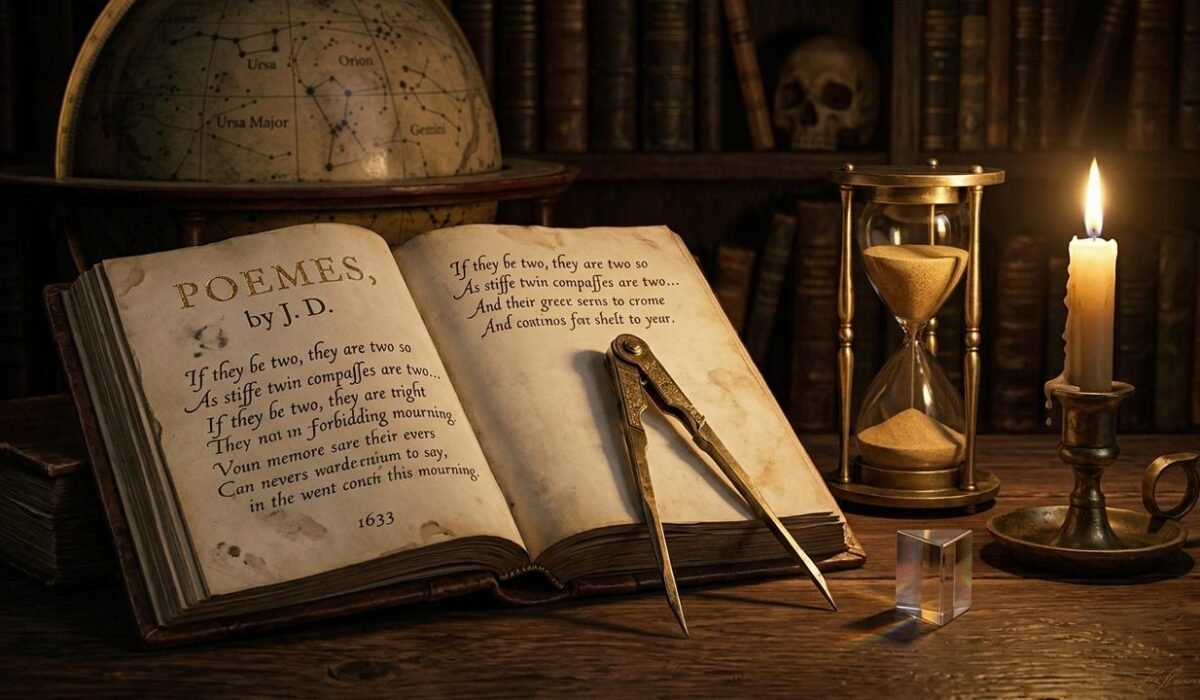
The seventeenth-century Metaphysical Poets—led by John Donne, George Herbert, Andrew Marvell, and Henry Vaughan—revolutionized English lyric poetry through startling intellectual conceits, colloquial speech rhythms, scholastic philosophy, and a profound psychological synthesis of passion and intellect. For candidates preparing for RPSC School Lecturer (First Grade), RPSC Senior Teacher (Second Grade), UGC NET English Paper 2, and state SET exams, this school represents one of the most intellectually rewarding and frequently tested syllabus units.
📌 Exam Overview & Key Takeaways
- High-Frequency Syllabus Topics: Dryden’s initial critique, Dr. Samuel Johnson’s famous definition in Life of Cowley, Sir Herbert Grierson’s 1912 milestone anthology, and T.S. Eliot’s seminal theories of “Unified Sensibility” and the “Dissociation of Sensibility” (1921).
- Core Canonical Texts Tested: John Donne’s Songs and Sonnets (The Sun Rising, Sweetest Love, I Do Not Goe, A Valediction: Forbidding Mourning, The Canonization) and Holy Sonnets (Batter My Heart, Death Be Not Proud), George Herbert’s The Temple, and Andrew Marvell’s carpe diem masterpiece (To His Coy Mistress).
- Theory & Poetics Integration: Connects directly to New Critical analysis in Cleanth Brooks’ The Language of Paradox and core terminology in our 15 Literary Terms Guide.
- Primary Archival Resources: Textual lineages and historic 1633 editio princeps can be referenced via the Poetry Foundation Metaphysical Poets Archive and the British Library Historic John Donne Collection.
Part 1: Nomenclature, Historical Origins & Critical Foundations (Q1–Q10)
The label ‘Metaphysical’ was not chosen by the poets themselves; it was applied retrospectively by later neoclassical critics—often as a term of disparagement—before being rehabilitated by modernists in the twentieth century.
Q1. Who was the very first English literary critic to apply the word ‘metaphysics’ in connection with John Donne’s poetry?
- (A) Dr. Samuel Johnson in Lives of the Poets
- (B) John Dryden in A Discourse Concerning the Original and Progress of Satire (1693)
- (C) Alexander Pope in his Epistles
- (D) Ben Jonson in Conversations with William Drummond
View Correct Answer & Detailed Explanation
Correct Answer: (B) John Dryden in A Discourse Concerning the Original and Progress of Satire (1693)
Textual & Critical Reference: John Dryden was the first to use the term regarding Donne in his 1693 critical essay A Discourse Concerning the Original and Progress of Satire. Dryden famously wrote: ‘He affects the metaphysics, not only in his satires, but in his amorous verses, where nature only should reign; and perplexes the minds of the fair sex with nice speculations of philosophy, when he should engage their hearts.’
Q2. In which biographical essay from Lives of the English Poets (1779) did Dr. Samuel Johnson officially establish and name the ‘Metaphysical School of Poets’?
- (A) Life of Milton
- (B) Life of Dryden
- (C) Life of Cowley
- (D) Life of Waller
View Correct Answer & Detailed Explanation
Correct Answer: (C) Life of Cowley
Textual & Critical Reference: Dr. Samuel Johnson formally coined the designation in his Life of Cowley (1779). He opened the critical evaluation by observing: ‘About the beginning of the seventeenth century appeared a race of writers that may be termed the metaphysical poets.’ He used Abraham Cowley’s verse as the representative subject through which to analyze the entire school.
Q3. Complete Dr. Samuel Johnson’s famous definition of the Metaphysical conceit from the Life of Cowley: ‘The most heterogeneous ideas are ________ by violence together.’
- (A) melded
- (B) yoked
- (C) welded
- (D) braided
View Correct Answer & Detailed Explanation
Correct Answer: (B) yoked
Textual & Critical Reference: Johnson wrote: ‘The most heterogeneous ideas are yoked by violence together; nature and art are ransacked for illustrations, comparisons, and allusions; their learning instructs, and their subtlety surprises; but the reader commonly thinks his improvement dearly bought, and, though he sometimes admires, is seldom pleased.’
Q4. Which landmark 1912 Oxford anthology was instrumental in reviving 20th-century scholarly and creative interest in Metaphysical poetry?
- (A) Francis Turner Palgrave’s Golden Treasury
- (B) Arthur Quiller-Couch’s Oxford Book of English Verse
- (C) Sir Herbert J. C. Grierson’s Metaphysical Lyrics & Poems of the Seventeenth Century
- (D) I.A. Richards’ Principles of Literary Criticism
View Correct Answer & Detailed Explanation
Correct Answer: (C) Sir Herbert J. C. Grierson’s Metaphysical Lyrics & Poems of the Seventeenth Century
Textual & Critical Reference: Sir Herbert J. C. Grierson’s 1912 landmark anthology Metaphysical Lyrics & Poems of the Seventeenth Century: Donne to Butler, accompanied by Grierson’s profound introduction, marked the definitive turning point in modern literary taste, rescuing Donne and his contemporaries from nineteenth-century neglect.
Q5. In his 1921 essay ‘The Metaphysical Poets’, what term did T.S. Eliot coin to describe the psychological and poetic unity where intellect and emotion operated as one in Donne and Chapman?
- (A) Objective Correlative
- (B) Unified Sensibility
- (C) Negative Capability
- (D) Associative Synthesis
View Correct Answer & Detailed Explanation
Correct Answer: (B) Unified Sensibility
Textual & Critical Reference: Eliot formulated the concept of a ‘Unified Sensibility’ (or a mechanism of sensibility which could devour any kind of experience). He celebrated the early seventeenth-century poets because they could ‘feel their thought as immediately as the odour of a rose. A thought to Donne was an experience; it modified his sensibility.’
Q6. According to T.S. Eliot, during which historical period did the disastrous ‘Dissociation of Sensibility’ occur in English poetry, separating intellectual thought from emotional feeling?
- (A) During the Elizabethan Golden Age under Spenser
- (B) In the seventeenth century, specifically under the influence of John Milton and John Dryden
- (C) During the Romantic Revival under Wordsworth and Coleridge
- (D) In the Victorian era under Tennyson and Browning
View Correct Answer & Detailed Explanation
Correct Answer: (B) In the seventeenth century, specifically under the influence of John Milton and John Dryden
Textual & Critical Reference: Eliot argued: ‘In the seventeenth century a dissociation of sensibility set in, from which we have never recovered; and this dissociation, as is natural, was aggravated by the two mightiest poets of the century, Milton and Dryden.’ Milton put feeling into language without intellectual subtlety, while Dryden thought intellectually without emotional resonance.
Q7. What famous critical stricture did Ben Jonson record concerning John Donne during his 1619 conversations with William Drummond of Hawthornden?
- (A) ‘Donne was the greatest master of the English heroic couplet.’
- (B) ‘Donne, for not keeping of accent, deserved hanging.’
- (C) ‘Donne’s language was too simple for royal courts.’
- (D) ‘Donne stole his conceits directly from Italian novellas.’
View Correct Answer & Detailed Explanation
Correct Answer: (B) ‘Donne, for not keeping of accent, deserved hanging.’
Textual & Critical Reference: Ben Jonson remarked to William Drummond: ‘That Done, for not keeping of accent, deserved hanging.’ Jonson also presciently observed that ‘Done himself, for not being understood, would perish.’ Jonson criticized Donne’s irregular, rugged, colloquial meters while nonetheless calling him ‘the first poet in the world in some things.’
Q8. In which posthumous year was the first collected volume of John Donne’s poetry, titled Poems, by J. D. with Elegies on the Authors Death, first published?
- (A) 1611
- (B) 1623
- (C) 1633
- (D) 1667
View Correct Answer & Detailed Explanation
Correct Answer: (B) 1623
Textual & Critical Reference: John Donne died in March 1631. His secular love lyrics and sacred verses had circulated widely in handwritten scribal manuscripts among friends and patrons during his lifetime. The first printed edition of his collected poems was published posthumously in London by John Marriot in 1633.
Q9. What was the dominant intellectual crisis of the early 17th century that deeply colored the skepticism and fractured cosmology of Donne’s poetry?
- (A) The Norman Conquest of Anglo-Saxon lands
- (B) The New Astronomy and scientific discoveries of Copernicus, Kepler, and Galileo undermining the Ptolemaic universe
- (C) The invention of the steam engine and industrial factory labor
- (D) The philosophical rise of French Existentialism
View Correct Answer & Detailed Explanation
Correct Answer: (B) The New Astronomy and scientific discoveries of Copernicus, Kepler, and Galileo undermining the Ptolemaic universe
Textual & Critical Reference: The transition from the comforting, geocentric Ptolemaic-Aristotelian cosmos to the vast, uncertain Copernican heliocentric universe (verified by Galileo’s telescope) shattered scholastic certainty. Donne famously recorded this existential anxiety in An Anatomy of the World: The First Anniversary (1611): ‘And new Philosophy calls all in doubt, / The Element of fire is quite put out; / The Sun is lost, and th’earth, and no man’s wit / Can well direct him where to look for it.’
Q10. How does a ‘Metaphysical Conceit’ fundamentally differ from a conventional ‘Petrarchan Conceit’?
- (A) A Petrarchan conceit uses scientific and scholastic analogies, whereas a Metaphysical conceit uses mythological allusions.
- (B) A Petrarchan conceit relies on familiar, sensory, and decorative comparisons (e.g., eyes like stars, lips like cherries), whereas a Metaphysical conceit constructs an elaborate, intellectual, and startling analogy between two seemingly incompatible realms of experience.
- (C) A Metaphysical conceit is restricted exclusively to religious devotional verse.
- (D) A Petrarchan conceit must always be written in unrhymed blank verse.
View Correct Answer & Detailed Explanation
Correct Answer: (B) A Petrarchan conceit relies on familiar, sensory, and decorative comparisons (e.g., eyes like stars, lips like cherries), whereas a Metaphysical conceit constructs an elaborate, intellectual, and startling analogy between two seemingly incompatible realms of experience.
Textual & Critical Reference: While Petrarchan conceits rely on conventional sensory stereotypes of courtly romance, a Metaphysical conceit is an intellectual exercise (an ‘ingenious conceit’) that forces together disparate fields: geometry, cartography, alchemical distillation, metallurgy, astronomy, and scholastic theology.
Part 2: John Donne’s Secular Love Lyrics & Songs and Sonnets (Q11–Q20)
Donne’s secular poetry departs radically from courtly adoration, presenting love in all its psychological complexity—passionate, cynical, argumentative, physical, and transcendent.
Q11. What is the unique structural paradox regarding the title of John Donne’s famous collection Songs and Sonnets?
- (A) It contains only religious prayers set to church music.
- (B) Despite the word ‘Sonnets’ in the title, not a single poem in the collection is an orthodox 14-line sonnet.
- (C) Every poem is exactly 14 lines long with an identical Italian rhyme scheme.
- (D) It contains no original lyrics, only translations from Francesco Petrarch.
View Correct Answer & Detailed Explanation
Correct Answer: (B) Despite the word ‘Sonnets’ in the title, not a single poem in the collection is an orthodox 14-line sonnet.
Textual & Critical Reference: In the Renaissance, the word ‘sonnet’ was frequently used in its broader etymological sense (from the Italian sonetto, meaning ‘little song’ or short lyric). None of the 54 secular love poems in Donne’s Songs and Sonnets conform to the strict 14-line Petrarca or Shakespearean sonnet form; Donne invented bespoke, irregular stanzaic forms for almost every single poem.
Q12. In The Sun Rising, how does the speaker audaciously address the sun in the famous dramatic opening lines?
- (A) ‘O sacred light of heaven and earth!’
- (B) ‘Busy old fool, unruly sun, / Why dost thou thus, / Through windows, and through curtains call on us?’
- (C) ‘Thou radiant king of golden skies’
- (D) ‘Hail holy light, offspring of Heaven firstborn’
View Correct Answer & Detailed Explanation
Correct Answer: (B) ‘Busy old fool, unruly sun, / Why dost thou thus, / Through windows, and through curtains call on us?’
Textual & Critical Reference: Donne begins in media res with colloquial impudence, scolding the ancient cosmic celestial body as a ‘busy old fool’ and a ‘saucy pedantic wretch’. He commands the sun to go chide late schoolboys and sour apprentices rather than disturb lovers whose private bedroom constitutes the center of the universe.
Q13. What central philosophical conceit governs the third stanza of The Sun Rising: ‘She’s all states, and all princes I, / Nothing else is’?
- (A) The allegory of the cave
- (B) The macrocosm/microcosm conceit, where the lovers’ bed is the center of the world and their room the entire sphere
- (C) The feudal contract between vassal and overlord
- (D) The biological decay of the physical body
View Correct Answer & Detailed Explanation
Correct Answer: (B) The macrocosm/microcosm conceit, where the lovers’ bed is the center of the world and their room the entire sphere
Textual & Critical Reference: Donne employs the Renaissance Renaissance doctrine of Microcosm (the human being/little world) and Macrocosm (the great universe). By arguing that his mistress embodies all kingdoms and he embodies all rulers, the bed becomes the world’s axis; thus, in warming the two lovers, the sun fulfills its entire cosmological duty.
Q14. In The Canonization, which legendary creature is invoked in the third stanza to symbolize the miraculous, self-renewing, and androgynous union of the lovers?
- (A) The Basilisk
- (B) The Salamander
- (C) The Phoenix
- (D) The Griffin
View Correct Answer & Detailed Explanation
Correct Answer: (C) The Phoenix
Textual & Critical Reference: Donne writes: ‘The phoenix riddle hath more wit / By us: we two being one, are it. / So, to one neutral thing both sexes fit. / We die and rise the same, and prove / Mysterious by this love.’ The mythical phoenix dies in flames and resurrects from its own ashes, embodying how sexual consummation (the Renaissance pun on ‘dying’) renews their transcendent spiritual unity.
Q15. What is the famous central conceit in John Donne’s ‘A Valediction: Forbidding Mourning’ that compares the souls of the two separated lovers to a drafting instrument?
- (A) A surveyor’s chain measuring geographical distance
- (B) A pair of stiff twin mathematical compasses
- (C) A mechanical clock’s balance wheel
- (D) A telescope observing orbiting celestial spheres
View Correct Answer & Detailed Explanation
Correct Answer: (B) A pair of stiff twin mathematical compasses
Textual & Critical Reference: In stanzas 7–9 of A Valediction: Forbidding Mourning, Donne introduces one of the most celebrated conceits in world literature: ‘If they be two, they are two so / As stiff twin compasses are two; / Thy soul, the fixed foot, makes no show / To move, but doth, if the other do… Thy firmness makes my circle just, / And makes me end where I begun.’
Q16. In The Flea, what argument does the speaker present to persuade the reluctant lady to yield her virginity?
- (A) That beauty fades rapidly like autumn roses
- (B) That their blood is already mingled inside the flea’s body without sin, shame, or loss of maidenhead
- (C) That celestial astrology has destined their marriage in the stars
- (D) That King James has issued a decree praising free love
View Correct Answer & Detailed Explanation
Correct Answer: (B) That their blood is already mingled inside the flea’s body without sin, shame, or loss of maidenhead
Textual & Critical Reference: The speaker points to the flea: ‘It suck’d me first, and now sucks thee, / And in this flea our two bloods mingled be; / Thou know’st that this cannot be said / A sin, nor shame, nor loss of maidenhead.’ The flea becomes simultaneously their bridal bed and marriage temple (‘This flea is you and I, and this / Our marriage bed, and marriage temple is’).
Q17. In Sweetest Love, I Do Not Goe, what comparison does Donne make to reassure his beloved of his certain and speedy return?
- (A) To a homing pigeon returning to its nest
- (B) To the journey of the sun, noting that he has far more desire and shorter wings/spurs than the sun
- (C) To a merchant ship returning laden with Indian spices
- (D) To the tides of the Thames flowing back to London
View Correct Answer & Detailed Explanation
Correct Answer: (B) To the journey of the sun, noting that he has far more desire and shorter wings/spurs than the sun
Textual & Critical Reference: Donne comforts his weeping mistress: ‘Yesternight the sun went hence, / And yet is here today; / He hath no desire nor sense, / Nor half so short a way: / Then fear not me, / But believe that I shall make / Speedier journeys, since I take / More wings and spurs than he.’
Q18. In The Relic, what startling image found around the lover’s skeletal remains is imagined as a holy relic by future grave-diggers?
- (A) A golden locket containing a lock of braided hair
- (B) ‘A bracelet of bright hair about the bone’
- (C) A silver crucifix engraved with their joint initials
- (D) A ring inscribed with a Latin motto
View Correct Answer & Detailed Explanation
Correct Answer: (B) ‘A bracelet of bright hair about the bone’
Textual & Critical Reference: Donne opens with chilling physical precision: ‘When my grave is broke up again / Some second guest to entertain… And he that digs it, spies / A bracelet of bright hair about the bone, / Will he not let’s alone, / And think that there a loving couple lies?’ (Act III). Future generations will worship them as relics of Mary Magdalene and a holy martyr.
Q19. Which cynical, anti-Petrarchan lyric by Donne begins with impossible tasks, declaring that one will never find ‘a woman true, and fair’?
- (A) The Prohibition
- (B) Song: Go and Catch a Falling Star
- (C) The Apparition
- (D) A Feever
View Correct Answer & Detailed Explanation
Correct Answer: (B) Song: Go and Catch a Falling Star
Textual & Critical Reference: In Go and Catch a Falling Star, Donne commands seven impossible feats: catch a falling star, get with child a mandrake root, tell where all past years are, find who cleft the devil’s foot, teach him to hear mermaids singing, or keep off envy’s stinging. He concludes that even if one rode ten thousand days and nights until age snowed white hairs, he would report that nowhere lives a woman true and fair.
Q20. Literary historians traditionally divide Donne’s career into two contrasting personas: ‘Jack Donne’ and ‘Dr. John Donne’. What marked the profound turning point between these two phases?
- (A) His appointment as Ambassador to France in 1605
- (B) His clandestine, socially ruinous marriage to 17-year-old Anne More in 1601 and his subsequent holy ordination in 1615
- (C) His enrollment as a legal scholar at Lincoln’s Inn
- (D) His conversion from Anglicanism to Roman Catholicism
View Correct Answer & Detailed Explanation
Correct Answer: (B) His clandestine, socially ruinous marriage to 17-year-old Anne More in 1601 and his subsequent holy ordination in 1615
Textual & Critical Reference: In December 1601, Donne secretly married Anne More (daughter of Sir George More, Lieutenant of the Tower), destroying his rising political career under Sir Thomas Egerton. Donne famously summarized the immediate catastrophe: ‘John Donne, Anne Donne, Un-done.’ After years of poverty, he took holy orders in the Church of England in 1615 under King James I’s insistence, eventually becoming the Dean of St. Paul’s Cathedral in 1621.
Part 3: Donne’s Divine Poems, Holy Sonnets & Devotional Prose (Q21–Q30)
In his sacred poetry, Donne redirects the erotic energy, intellectual agility, and colloquial vehemence of his early love lyrics into desperate theological wrestlings with divine mercy, sin, and mortality.
Q21. In Holy Sonnet XIV (‘Batter my heart, three-person’d God’), what three distinct metaphorical roles does the speaker assign to himself and God across the octave and sestet?
- (A) A wounded soldier, a lost sheep, and a pleading pilgrim
- (B) A damaged metal vessel (tinker/blacksmith metaphor), a captured town/viceroy (military siege), and an engaged bride needing ravishment (erotic/marital paradox)
- (C) A barren field, a withered vine, and an untuned lute
- (D) A defaulting debtor, a prisoner of war, and an ungrateful servant
View Correct Answer & Detailed Explanation
Correct Answer: (B) A damaged metal vessel (tinker/blacksmith metaphor), a captured town/viceroy (military siege), and an engaged bride needing ravishment (erotic/marital paradox)
Textual & Critical Reference: In Holy Sonnet XIV, Donne employs three startling conceits: (1) He is a dented vessel that God must break, blow, burn, and make new; (2) He is an usurped town that should be God’s, but Reason (God’s viceroy) is captive; (3) He is betrothed to God’s enemy (Satan) and begs God to divorce, imprison, and ravish him: ‘Except you enthrall me, never shall be free, / Nor ever chaste, except you ravish me.’
Q22. In Holy Sonnet X (‘Death, be not proud’), what is the ultimate logical paradox with which Donne deflates Death’s terrifying power?
- (A) ‘Death is the king of kings and lord of all’
- (B) ‘One short sleep past, we wake eternally, / And death shall be no more; Death, thou shalt die.’
- (C) ‘Death will conquer all except the written verse’
- (D) ‘Death is merely the shadow of an unlit flame’
View Correct Answer & Detailed Explanation
Correct Answer: (B) ‘One short sleep past, we wake eternally, / And death shall be no more; Death, thou shalt die.’
Textual & Critical Reference: Donne systematically demotes Death from a terrifying cosmic tyrant to a humble servant (‘slave to fate, chance, kings, and desperate men’) who keeps company with poison, war, and sickness. Because Christian resurrection guarantees eternal life, the moment a believer dies, Death itself ceases to exist: ‘And death shall be no more; Death, thou shalt die.’
Q23. How many sonnets comprise the traditional sequence of John Donne’s Holy Sonnets in Helen Gardner’s definitive scholarly edition?
- (A) 12
- (B) 14
- (C) 19
- (D) 154
View Correct Answer & Detailed Explanation
Correct Answer: (C) 19
Textual & Critical Reference: There are 19 Holy Sonnets in total. The 1633 edition published 12; the 1635 edition added 4 more (making 16); and three additional sonnets (including ‘Since she whom I loved hath paid her last debt’) were discovered in the Westmoreland manuscript, bringing the definitive modern scholarly canon established by Dame Helen Gardner to 19.
Q24. In ‘A Hymn to God the Father’, what biographical puns does Donne weave into the refrain closing each of the three stanzas?
- (A) Puns on his title of Dean and St. Paul’s Cathedral
- (B) Puns on his own surname ‘Donne’ (done) and his deceased wife Anne’s maiden name ‘More’
- (C) Puns on King James and Prince Charles
- (D) Puns on Oxford and Cambridge universities
View Correct Answer & Detailed Explanation
Correct Answer: (B) Puns on his own surname ‘Donne’ (done) and his deceased wife Anne’s maiden name ‘More’
Textual & Critical Reference: In stanzas 1 and 2, Donne confesses his original sin and habitual sins, repeating the anxious refrain: ‘When thou hast done, thou hast not done, / For I have more.’ In the third stanza, after God swears that His Sun (Christ) shall shine upon him at death, Donne joyfully concludes: ‘And, having done that, Thou hast done; / I fear no more.’ This plays brilliantly on ‘Donne’ and ‘More’.
Q25. In ‘Hymn to God my God, in my Sickness’ (1623/1631), what elaborate scientific conceit does the dying speaker employ to describe his feverish body and his attending physicians?
- (A) A broken clockwork mechanism and watchmakers
- (B) His body is a geographical flat map and the physicians are cosmographers studying his passages
- (C) A besieged fortress and battering rams
- (D) An alchemical crucible and gold distillers
View Correct Answer & Detailed Explanation
Correct Answer: (B) His body is a geographical flat map and the physicians are cosmographers studying his passages
Textual & Critical Reference: Donne writes: ‘Whilst my physicians by their love are grown / Cosmographers, and I their map, whose lie / Flat on this bed, that by them may be shown / That this is my south-west discovery, / Per fretum febris, by these straits to die.’ He compares his painful journey through fever to Ferdinand Magellan sailing through stormy straits to enter the serene Pacific Ocean.
Q26. From which major devotional prose work by John Donne (written in 1623 during a near-fatal bout of relapsing fever) does the celebrated passage ‘No man is an island, entire of itself’ originate?
- (A) Biathanatos
- (B) Pseudo-Martyr
- (C) Devotions upon Emergent Occasions (Meditation XVII)
- (D) Essays in Divinity
View Correct Answer & Detailed Explanation
Correct Answer: (C) Devotions upon Emergent Occasions (Meditation XVII)
Textual & Critical Reference: The passage is from Meditation XVII of Donne’s Devotions upon Emergent Occasions (1624). Hearing the church funeral bell toll, Donne reflects: ‘No man is an island, entire of itself; every man is a piece of the continent, a part of the main… Any man’s death diminishes me, because I am involved in mankind; and therefore never send to know for whom the bell tolls; it tolls for thee.’
Q27. What is the subject of John Donne’s controversial, paradox-laden prose treatise Biathanatos (composed c. 1608)?
- (A) A defense of religious suicide under specific conditions of divine charity
- (B) An attack on the Roman Catholic doctrine of papal supremacy
- (C) A scientific critique of William Harvey’s blood circulation
- (D) A treatise on witchcraft and demonology
View Correct Answer & Detailed Explanation
Correct Answer: (A) A defense of religious suicide under specific conditions of divine charity
Textual & Critical Reference: Biathanatos (from the Greek for ‘violent death’) is a philosophical and theological exploration in which Donne argues that self-homicide (suicide) is not so naturally a sin that it may never be lawful or excusable, citing Jesus Christ’s voluntary yielding of his life on the cross. Donne kept the manuscript strictly private during his life; it was published posthumously in 1647 by his son.
Q28. In 1611 and 1612, Donne composed two long commemorative philosophical poems, An Anatomy of the World and Of the Progress of the Soul (The Anniversaries). On the death of which young girl were these monumental poems written?
- (A) His wife Anne More
- (B) Elizabeth Drury, the 14-year-old daughter of his wealthy patron Sir Robert Drury
- (C) Queen Elizabeth I
- (D) The Countess of Bedford
View Correct Answer & Detailed Explanation
Correct Answer: (B) Elizabeth Drury, the 14-year-old daughter of his wealthy patron Sir Robert Drury
Textual & Critical Reference: Donne wrote The Anniversaries on the death of Elizabeth Drury, whom he had never met in person. He treated her death as a cosmic catastrophe that symbolized the total moral and physical decay of the universe (‘The world’s whole frame is out of joint’).
Q29. What was the title of John Donne’s final sermon, delivered at Whitehall before King Charles I on February 25, 1631, just weeks before his death?
- (A) The Holy State
- (B) Death’s Duell
- (C) A Sermon of Valediction
- (D) The Progress of the Soul
View Correct Answer & Detailed Explanation
Correct Answer: (B) Death’s Duell
Textual & Critical Reference: Donne preached Death’s Duell, or, A Consolation to the Soule, against the dying Life, and living Death of the Body. Observers recorded that the emaciated Dean appeared to be preaching his own funeral sermon. A magnificent frontispiece engraving of Donne wrapped in his burial shroud (drawn from life as he posed on a wooden urn) was prefixed to the printed edition.
Q30. Which Catholic spiritual tradition, identified by scholars like Louis Martz in The Poetry of Meditation (1954), heavily shaped the structural discipline of Donne’s Holy Sonnets?
- (A) The Dominican Order’s Rosary recitations
- (B) The Ignatian Spiritual Exercises of St. Ignatius of Loyola (Composition of Place, Analysis, and Colloquy)
- (C) The Franciscan vow of absolute mendicant poverty
- (D) The Benedictine Rule of manual agricultural labor
View Correct Answer & Detailed Explanation
Correct Answer: (B) The Ignatian Spiritual Exercises of St. Ignatius of Loyola (Composition of Place, Analysis, and Colloquy)
Textual & Critical Reference: Louis Martz proved in The Poetry of Meditation that Donne’s divine poems follow the strict formal tripartite structure of the Jesuit St. Ignatius of Loyola’s Spiritual Exercises: (1) Compositio loci (vivid sensory recreation of a scene, like the Last Judgment), (2) Analysis/Intellectual meditation, and (3) Colloquy (direct, emotional prayer to God or Christ).
Part 4: George Herbert, Andrew Marvell, Vaughan & Crashaw (Q31–Q40)
The metaphysical impulse extended far beyond Donne. George Herbert brought domestic architectural symmetry to devotional verse; Andrew Marvell balanced puritan politics with carpe diem wit; Henry Vaughan chased mystical illumination; and Richard Crashaw embraced baroque Catholic ecstasy.
Q31. What is the title of George Herbert’s celebrated collection of sacred English lyric poetry, published posthumously in 1633 through his friend Nicholas Ferrar?
- (A) Silex Scintillans
- (B) The Temple: Sacred Poems and Private Ejaculations
- (C) Steps to the Temple
- (D) The Church Porch
View Correct Answer & Detailed Explanation
Correct Answer: (B) The Temple: Sacred Poems and Private Ejaculations
Textual & Critical Reference: On his deathbed in 1633, the saintly Anglican priest George Herbert sent his manuscript to Nicholas Ferrar of the Little Gidding religious community. It was published that same year as The Temple: Sacred Poems and Private Ejaculations, organized architecturally into three sections: ‘The Church-porch’, ‘The Church’, and ‘The Church Militant’.
Q32. George Herbert’s poems ‘Easter Wings’ and ‘The Altar’ are classic examples of which poetic form, where lines are graphically arranged on the page to mirror their subject matter?
- (A) Acrostic poetry
- (B) Pattern poetry (Hieroglyphic or Concrete poetry / Carmen figuratum)
- (C) Terza rima
- (D) Spenserian stanzas
View Correct Answer & Detailed Explanation
Correct Answer: (B) Pattern poetry (Hieroglyphic or Concrete poetry / Carmen figuratum)
Textual & Critical Reference: In Easter Wings, the lines expand and contract on the printed page to form two pairs of flying angel/bird wings. In The Altar, the lines create the physical silhouette of a Christian stone altar. This form is known as pattern poetry, concrete verse, or carmen figuratum.
Q33. In George Herbert’s famous allegorical poem ‘The Pulley’, what single divine gift does God withhold in the bottom of the glass when pouring blessings upon mankind?
- (A) Wisdom
- (B) Beauty
- (C) Rest
- (D) Strength
View Correct Answer & Detailed Explanation
Correct Answer: (C) Rest
Textual & Critical Reference: God bestows strength, beauty, wisdom, honor, and pleasure, but keeps back ‘Rest’, reasoning: ‘If I should (said he) / Bestow this jewel also on my creature, / He would adore my gifts instead of me, / And rest in Nature, not the God of Nature.’ Thus, divine weariness serves as a mechanical ‘pulley’ that tosses man to God’s breast.
Q34. In To His Coy Mistress by Andrew Marvell, how does the tripartite rhetorical argument follow the rigorous structure of a classical syllogism?
- (A) Thesis: Love is eternal; Antithesis: War intervenes; Synthesis: Peace returns.
- (B) Major Premise (Had we world enough and time, coyness were no crime); Minor Premise (But we do not: Time’s winged chariot hurries near); Conclusion (Therefore, let us devour time: seize pleasure now).
- (C) Past: We loved in Eden; Present: We suffer in exile; Future: We reign in heaven.
- (D) Induction: Birds love; Deduction: Animals love; Inference: Humans must love.
View Correct Answer & Detailed Explanation
Correct Answer: (B) Major Premise (Had we world enough and time, coyness were no crime); Minor Premise (But we do not: Time’s winged chariot hurries near); Conclusion (Therefore, let us devour time: seize pleasure now).
Textual & Critical Reference: Marvell’s masterpiece is a textbook classical syllogism: Stanza 1 (Had we but world enough, and time – If condition), Stanza 2 (But at my back I always hear / Time’s wingèd chariot hurrying near – But condition), Stanza 3 (Now therefore… let us sport us while we may – Therefore resolution).
Q35. Which famous line from Andrew Marvell’s meditative masterpiece ‘The Garden’ encapsulates the mind’s ability to withdraw from material reality into supreme contemplative tranquility?
- (A) ‘A green thought in a green shade’
- (B) ‘To an endless ring of light’
- (C) ‘A rose of Sharon blooming bright’
- (D) ‘The world in a grain of sand’
View Correct Answer & Detailed Explanation
Correct Answer: (A) ‘A green thought in a green shade’
Textual & Critical Reference: In stanza 6 of The Garden, Marvell describes how the mind retreats from physical fruit into pure contemplation: ‘The mind, that ocean where each kind / Does straight its own resemblance find… Annihilating all that’s made / To a green thought in a green shade.’
Q36. In ‘An Horatian Ode upon Cromwell’s Return from Ireland’ (1650), how does Andrew Marvell famously describe the dignified execution of King Charles I at Whitehall?
- (A) ‘He wept bitterly and cursed the roundhead rebels’
- (B) ‘He nothing common did or mean / Upon that memorable scene, / But with his keener eye / The axe’s edge did try’
- (C) ‘He fled the scaffold like a coward’
- (D) ‘He bowed his knee and begged Parliament for clemency’
View Correct Answer & Detailed Explanation
Correct Answer: (B) ‘He nothing common did or mean / Upon that memorable scene, / But with his keener eye / The axe’s edge did try’
Textual & Critical Reference: Despite supporting Oliver Cromwell and serving as John Milton’s Latin Secretary under the Commonwealth, Marvell’s Horatian ode maintains astonishing poise, giving Charles I the most noble tragic depiction in English verse: ‘He nothing common did or mean / Upon that memorable scene, / But with his keener eye / The axe’s edge did try; / Nor call’d the gods with vulgar spite / To vindicate his helpless right.’
Q37. What is the title of the Welsh Metaphysical poet Henry Vaughan’s primary two-part collection of devotional poems, published in 1650 and 1655?
- (A) Steps to the Temple
- (B) Silex Scintillans: Sacred Poems and Private Ejaculations
- (C) The Mistress
- (D) Poems of Felicity
View Correct Answer & Detailed Explanation
Correct Answer: (B) Silex Scintillans: Sacred Poems and Private Ejaculations
Textual & Critical Reference: Henry Vaughan published Silex Scintillans (Latin for ‘The Flashing Flint’ or ‘Sparks from the Flintstone’). The emblematic title represents the hard, flinty human heart struck by the divine steel of God’s grace to emit sparks of holy fire. Vaughan openly acknowledged George Herbert as his chief spiritual master.
Q38. Which celebrated opening lines belong to Henry Vaughan’s apocalyptic and mystical visionary poem ‘The World’?
- (A) ‘I saw Eternity the other night, / Like a great ring of pure and endless light, / All calm, as it was bright’
- (B) ‘When God at first made man, / Having a glass of blessings standing by’
- (C) ‘Had we but world enough, and time, / This coyness, lady, were no crime’
- (D) ‘Happy those early days, when I / Shined in my angel-infancy!’
View Correct Answer & Detailed Explanation
Correct Answer: (A) ‘I saw Eternity the other night, / Like a great ring of pure and endless light, / All calm, as it was bright’
Textual & Critical Reference: Vaughan opens The World with breathtaking visionary grandeur: ‘I saw Eternity the other night, / Like a great ring of pure and endless light, / All calm, as it was bright; / And round beneath it, Time in hours, days, years, / Driv’n by the spheres / Like a vast shadow moved; in which the world / And all her train were hurl’d.’
Q39. Which Catholic Metaphysical poet was heavily influenced by Continental Counter-Reformation Baroque aesthetics, writing ecstatic hymns to Saint Teresa in Steps to the Temple (1646)?
- (A) Thomas Carew
- (B) Richard Crashaw
- (C) Sir John Suckling
- (D) Richard Lovelace
View Correct Answer & Detailed Explanation
Correct Answer: (B) Richard Crashaw
Textual & Critical Reference: Richard Crashaw converted to Roman Catholicism, fled to Paris and Italy during the English Civil War, and died at Loreto. His poetry—particularly The Flaming Heart and A Hymn to the Name and Honour of the Admirable Saint Teresa—exhibits lush, sensory, baroque religious ecstasy filled with bleeding hearts, ecstatic wounds, and flaming darts.
Q40. How do the 17th-century ‘Cavalier Poets’ (such as Robert Herrick, Richard Lovelace, Sir John Suckling, and Thomas Carew) fundamentally differ in style and thematic focus from the ‘Metaphysical Poets’?
- (A) Cavalier poets wrote dense philosophical sonnets, whereas Metaphysical poets wrote simple drinking songs.
- (B) Cavalier poets (‘Sons of Ben’) modeled their verse on classical Roman lyricists (Horace, Catullus), emphasizing elegance, lucidity, symmetrical form, royalist loyalty, and courtly gallantry, avoiding the obscure, knotty, and scholastic conceits of the Metaphysicals.
- (C) Cavalier poets supported Oliver Cromwell, whereas Metaphysical poets supported King Charles I.
- (D) Cavalier poets wrote exclusively in Latin hexameters.
View Correct Answer & Detailed Explanation
Correct Answer: (B) Cavalier poets (‘Sons of Ben’) modeled their verse on classical Roman lyricists (Horace, Catullus), emphasizing elegance, lucidity, symmetrical form, royalist loyalty, and courtly gallantry, avoiding the obscure, knotty, and scholastic conceits of the Metaphysicals.
Textual & Critical Reference: While Metaphysical poets engaged in intellectual wrestling, complex philosophical metaphors, and rough colloquial meters, the Cavalier poets (followers of Ben Jonson) prioritized polished ease, melodic sweetness, clarity, royalist politics, and carefree carpe diem motifs (‘Gather ye rosebuds while ye may’).
Part 5: 20th-Century Critical Revival & UGC NET Advanced Traps (Q41–Q50)
The modern critical reception of Metaphysical poetry forms an indispensable component of UGC NET English, involving New Criticism, historical formalism, and ideological reappraisals.
Q41. In The Well Wrought Urn: Studies in the Structure of Poetry (1947), which New Critic opened his book with the foundational essay ‘The Language of Paradox’, using John Donne’s The Canonization as his prime textual exhibit?
- (A) W.K. Wimsatt
- (B) Cleanth Brooks
- (C) Monroe Beardsley
- (D) R.P. Blackmur
View Correct Answer & Detailed Explanation
Correct Answer: (B) Cleanth Brooks
Textual & Critical Reference: Cleanth Brooks famously argued that ‘the language of poetry is the language of paradox.’ He demonstrated that Donne’s The Canonization is not merely a witty display of clever figures, but a profoundly unified work of art where profane sexual love and sacred sainthood interpret and validate one another through organic paradox.
Q42. In Seven Types of Ambiguity (1930), which pioneering critic analyzed the syntactical compression and multi-layered wordplay of seventeenth-century Metaphysical poets?
- (A) William Empson
- (B) F.R. Leavis
- (C) I.A. Richards
- (D) Kenneth Burke
View Correct Answer & Detailed Explanation
Correct Answer: (A) William Empson
Textual & Critical Reference: William Empson (a student of I.A. Richards at Cambridge) wrote Seven Types of Ambiguity at age 23. Empson showed how the deliberate ambiguities, syntactic tensions, and theological puns in Donne, Herbert, and Marvell enrich poetic meaning rather than obscuring it.
Q43. In which poem did T.S. Eliot pay direct homage to John Donne’s visceral awareness of mortality with the famous lines: ‘Donne, I suppose, was such another / Who found no substitute for sense, / To see the skull beneath the skin’?
- (A) The Waste Land
- (B) The Love Song of J. Alfred Prufrock
- (C) Whispers of Immortality
- (D) Gerontion
View Correct Answer & Detailed Explanation
Correct Answer: (C) Whispers of Immortality
Textual & Critical Reference: In his 1920 poem Whispers of Immortality, Eliot contrasts seventeenth-century poets (John Webster and John Donne), who possessed an acute physical awareness of skeletal death, with modern people who reduce experience to sterile, abstract intellect.
Q44. In The Flaming Heart (1958), which scholar demonstrated that English Metaphysical wit was deeply indebted to Continental Baroque emblem books and Italian concettismo?
- (A) Mario Praz
- (B) E.M.W. Tillyard
- (C) C.S. Lewis
- (D) Northrop Frye
View Correct Answer & Detailed Explanation
Correct Answer: (A) Mario Praz
Textual & Critical Reference: Italian comparative scholar Mario Praz proved that Metaphysical conceits were not an isolated English eccentricity, but part of a wider European Baroque movement of concettismo (practiced by Giambattista Marino in Italy and Luis de Góngora in Spain) and Jesuit emblem literature.
Q45. In Elizabethan and Metaphysical Imagery (1947), scholar Rosemond Tuve challenged modern New Critical readings by demonstrating that Metaphysical conceits were grounded in which academic discipline of Renaissance universities?
- (A) Kantian Epistemology
- (B) Ramist Logic and Classical Renaissance Rhetoric
- (C) Marxist Political Economy
- (D) Modern Depth Psychology
View Correct Answer & Detailed Explanation
Correct Answer: (B) Ramist Logic and Classical Renaissance Rhetoric
Textual & Critical Reference: Rosemond Tuve demonstrated that Metaphysical conceits were not spontaneous psychological leaps (as T.S. Eliot and the New Critics claimed), but rigorous, disciplined exercises governed by the formal logic and dialectic of Petrus Ramus (Ramism) and Renaissance rhetorical handbooks taught at Oxford and Cambridge.
Q46. In his provocative biographical study John Donne: Life, Mind and Art (1981), what psychological trauma does John Carey identify as the master key to Donne’s entire poetic and religious output?
- (A) Guilt and psychological displacement over his apostasy from Roman Catholicism to the Anglican Church
- (B) Severe childhood physical abuse by his stepfather
- (C) Claustrophobia resulting from his brief imprisonment in the Fleet prison
- (D) Frustration with his Scottish accents during King James’s reign
View Correct Answer & Detailed Explanation
Correct Answer: (B) Severe childhood physical abuse by his stepfather
Textual & Critical Reference: Oxford critic John Carey argued that Donne’s abandonment of his family’s persecuted Roman Catholic faith (which had martyred his relatives, including his brother Henry Donne who died in Newgate Prison) left him with lifelong guilt and apostate anxiety. This inner betrayal fueled his obsession with treason, changeability, secret contracts, and violent surrender in both his love and divine poetry.
Q47. In Romantic Image (1957), which eminent English critic famously dismantled T.S. Eliot’s historical thesis of the ‘Dissociation of Sensibility’, calling it an unhistorical myth designed to justify modern Symbolist poetry?
- (A) Frank Kermode
- (B) Terry Eagleton
- (C) Raymond Williams
- (D) Harold Bloom
View Correct Answer & Detailed Explanation
Correct Answer: (A) Frank Kermode
Textual & Critical Reference: Sir Frank Kermode demonstrated that Eliot’s historical timeline for the ‘dissociation’ was completely arbitrary—critics had placed similar ‘dissociations’ in 5th-century Athens, the late Middle Ages, the Baconian scientific revolution, and the Romantic era. Kermode argued that Eliot invented the concept backwards to legitimize the aesthetic demands of French Symbolism and modernist poetic practice.
Q48. Match the Metaphysical poet with the signature collection/work for which he is renowned in English literary history:
- (A) 1-Herbert (Silex Scintillans); 2-Vaughan (The Temple); 3-Crashaw (Steps to the Temple); 4-Cowley (The Mistress)
- (B) 1-Herbert (The Temple); 2-Vaughan (Silex Scintillans); 3-Crashaw (Steps to the Temple); 4-Cowley (The Mistress)
- (C) 1-Herbert (The Temple); 2-Vaughan (The Mistress); 3-Crashaw (Silex Scintillans); 4-Cowley (Steps to the Temple)
- (D) 1-Herbert (Steps to the Temple); 2-Vaughan (The Temple); 3-Crashaw (The Mistress); 4-Cowley (Silex Scintillans)
View Correct Answer & Detailed Explanation
Correct Answer: (B) 1-Herbert (The Temple); 2-Vaughan (Silex Scintillans); 3-Crashaw (Steps to the Temple); 4-Cowley (The Mistress)
Textual & Critical Reference: Correct canonical pairings: George Herbert = The Temple (1633); Henry Vaughan = Silex Scintillans (1650/1655); Richard Crashaw = Steps to the Temple (1646); Abraham Cowley = The Mistress (1647).
Q49. Which 17th-century Metaphysical poet’s manuscripts remained largely undiscovered in London street stalls until Bertram Dobell identified and published his Poetical Works (1903) and Centuries of Meditations (1908)?
- (A) Thomas Traherne
- (B) Edward Taylor
- (C) John Cleveland
- (D) Henry King
View Correct Answer & Detailed Explanation
Correct Answer: (A) Thomas Traherne
Textual & Critical Reference: Thomas Traherne’s ecstatic devotional prose and poetry lay in absolute oblivion for over two centuries until bookseller Bertram Dobell purchased anonymous handwritten notebooks discovered on a London street book barrow in the winter of 1896–1897 and established Traherne’s authorship, adding a major voice of luminous mystical innocence to the Metaphysical canon.
Q50. Which seventeenth-century English poet and Anglican Bishop wrote the touching metaphysical elegy ‘The Exequy’ upon the premature death of his young wife Anne Berkeley?
- (A) Henry King
- (B) John Cleveland
- (C) Thomas Stanley
- (D) Sir Richard Fanshawe
View Correct Answer & Detailed Explanation
Correct Answer: (A) Henry King
Textual & Critical Reference: Dr. Henry King, Bishop of Chichester and a close personal friend of John Donne (who served as an executor of Donne’s will), composed the deeply moving metaphysical funeral poem The Exequy (c. 1624). The poem compares his sorrowful march through life to a slow, methodical journey toward the grave where his deceased wife awaits him.
High-Yield Master Tables: Conceits, Critical Timeline & Poetic Schools
Table 1: Landmark Metaphysical Conceits (Tenor & Vehicle)
The essence of metaphysical wit lies in linking an abstract emotional or theological concept (the tenor) to an unlikely physical or scientific object (the vehicle):
| Poet & Poem Title | The Abstract Tenor | The Unlikely Vehicle | Conceptual & Thematic Significance |
|---|---|---|---|
| John Donne A Valediction: Forbidding Mourning | Spiritual unity of separated lovers | A pair of stiff twin mathematical compasses | Though distant in body, the fixed foot (beloved) anchors the roving foot (traveler), completing a perfect circle. |
| John Donne The Flea | Physical sexual consummation | A parasitic insect containing their mingled blood | Since blood has already mixed harmlessly within the flea, physical union carries no sin or loss of maidenhead. |
| John Donne Holy Sonnet XIV | A sinner yearning for divine grace | A dented metal kettle / A besieged town / An adulterous betrothed bride | God must violently break, batter, divorce, and ravish the speaker to restore spiritual chastity. |
| George Herbert The Pulley | Divine weariness and restless human anxiety | A mechanical pulley / lifting machine | By withholding the gift of ‘Rest’, God ensures that earthly dissatisfaction tosses man back to His divine breast. |
| Andrew Marvell To His Coy Mistress | Growing, patient amorous courtship | Slow vegetative growth (‘Vegetable love’) | Unchecked by mortality, love would grow vaster than empires, but death’s impending void demands instant urgency. |
| Henry Vaughan The World | Divine Timelessness and Eternity | A great ring of pure and endless light | Contrasts the serene circular perfection of Eternity with the chaotic, shadowy movement of worldly time. |
Table 2: Historical Evolution of Metaphysical Criticism
Review how the critical reception of Metaphysical poetry evolved across three centuries—from neoclassical censure to modernist triumph:
| Critic & Date | Key Critical Work | Evaluation | Core Argument / Impact |
|---|---|---|---|
| John Dryden (1693) | A Discourse Concerning… Satire | Critical / Censuring | Accused Donne of ‘affecting the metaphysics’ in love poetry and perplexing women with nice philosophy. |
| Dr. Samuel Johnson (1779) | Life of Cowley (Lives of the Poets) | Skeptical / Ambivalent | Named the ‘Metaphysical Poets’; criticized forced conceits (‘heterogeneous ideas yoked by violence together’). |
| Sir Herbert Grierson (1912) | Metaphysical Lyrics & Poems | Scholarly Rehabilitation | Historic Oxford anthology that revived textually rigorous appreciation of 17th-century lyricism. |
| T.S. Eliot (1921) | The Metaphysical Poets | Pioneering Modernist Celebration | Formulated ‘Unified Sensibility’ and ‘Dissociation of Sensibility’; established Donne as a central precursor to Modernism. |
| Cleanth Brooks (1947) | The Well Wrought Urn | New Critical Canonical Peak | Established ‘The Language of Paradox’ via The Canonization; made close reading of conceits the benchmark of poetic structure. |
| Rosemond Tuve (1947) | Elizabethan and Metaphysical Imagery | Historical Formalism | Proved that conceits derived from Renaissance Ramist logic and formal academic disputation rather than psychological accidents. |
Frequently Asked Questions (FAQs) on Metaphysical Poetry for Competitive Exams
Who coined the term ‘Metaphysical Poets’?
John Dryden first applied the word ‘metaphysics’ to describe John Donne’s love poetry in 1693. However, Dr. Samuel Johnson officially established and named the ‘Metaphysical School of Poets’ in his 1779 critical work Life of Cowley (part of Lives of the English Poets).
What is T.S. Eliot’s theory of ‘Dissociation of Sensibility’?
In his 1921 essay The Metaphysical Poets, T.S. Eliot argued that poets like Donne and Chapman possessed a ‘Unified Sensibility’—an ability to feel their thoughts as immediately as the odor of a rose. In the late seventeenth century, under the influence of John Milton and John Dryden, a ‘Dissociation of Sensibility’ set in, causing intellect and emotion to split into separate poetic modes.
How do Metaphysical poets differ from Cavalier poets?
Metaphysical poets (Donne, Herbert, Marvell, Vaughan) wrote intellectual, knotty, introspective verse featuring scientific conceits, irregular meters, and theological/philosophical debate. Cavalier poets (Herrick, Lovelace, Suckling, Carew), known as the ‘Sons of Ben’, favored classical Roman models (Horace), smooth musical lyrics, courtly elegance, and royalist themes of love and gallantry.
Mastering these 50 multiple-choice questions, foundational definitions, and critical doctrines ensures high accuracy across seventeenth-century literature sections in RPSC School Lecturer, Senior Teacher, and UGC NET exams. To reinforce individual poem studies, explore our detailed companion analyses on The Sun Rising, Batter My Heart, and To His Coy Mistress.
About the Author
Mukesh Kumar is a Vice Principal & English Educator at GSSS Muklawa (Rajasthan), a Fulbright DAI fellow, author of over 40 educational books, and founder of LitGram. He specializes in designing evidence-based, high-yield study resources for competitive English literature examinations including RPSC School Lecturer, Senior Teacher, and UGC NET.