A Thing of Beauty by John Keats is Poem 3 of the Class 12 NCERT book Flamingo. Its first line gives the message: “A thing of beauty is a joy forever”. Beautiful things never fade from the mind, and they give us hope in spite of sorrow and gloom. This guide gives the line-by-line meaning in English and Hindi, NCERT answers, MCQs and a free PDF.
About the poet and the poem
John Keats (1795-1821) was an English Romantic poet. NCERT notes that he trained to be a surgeon but gave his life to poetry. He died of tuberculosis at 25.
The 24 lines in Flamingo are the opening of his long poem Endymion: A Poetic Romance (1818). It is based on a Greek legend: Endymion, a young shepherd and poet on Mount Latmos, sees Cynthia, the Moon Goddess, in a vision and wanders through the forest and under the sea to find her. The poem is on the CBSE English Core and RBSE Class 12 syllabus.
A Thing of Beauty summary
A beautiful thing gives joy that lasts for ever. Its loveliness grows each time we think of it, and it never passes into nothingness. Like a shady bower (a leafy shelter), it keeps a quiet place for us, with sweet dreams, health and calm breathing.
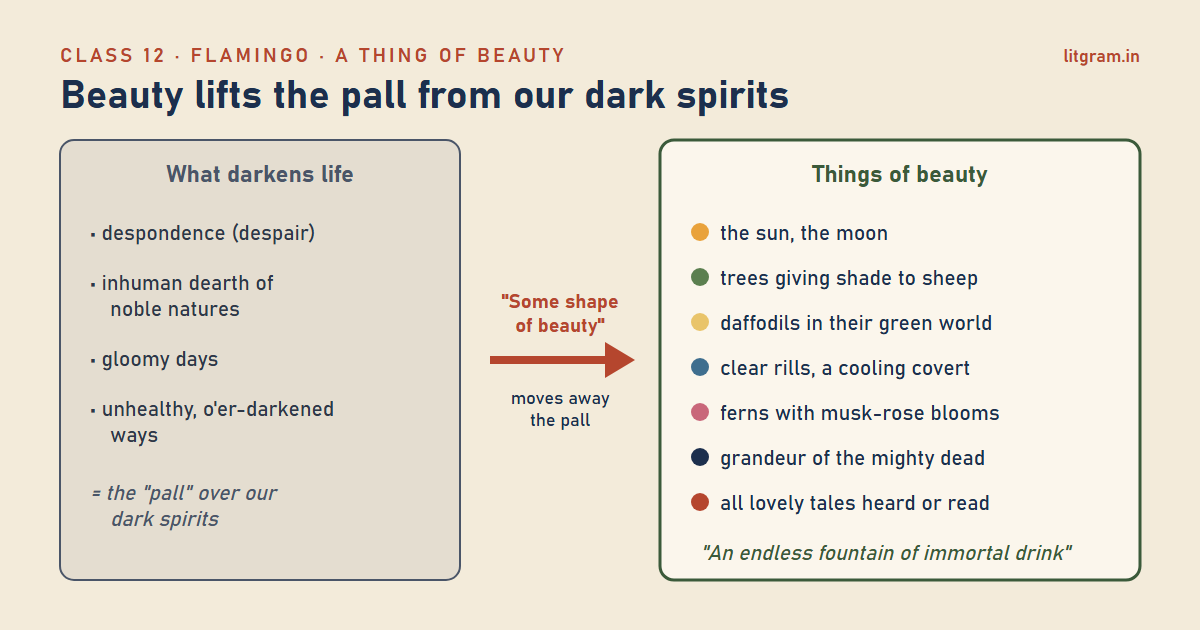
So every morning we weave a “flowery band” that ties us to the earth. We need it, because life is full of despair, a lack of noble people, gloomy days and dark, unhealthy ways. In spite of all this, some shape of beauty lifts the dark cloth of sadness from our spirits.
The poet then lists such beautiful things: the sun and the moon, old and young trees giving shade to sheep, daffodils in their green world, clear streams that make a cool shelter in summer, ferns sprinkled with musk-roses, the grand stories of great men who died, and all the lovely tales we have heard or read. Together they are “An endless fountain of immortal drink”, poured on us from heaven.
Download the A Thing of Beauty summary PDF
For quick revision, download the two-page A Thing of Beauty summary PDF. It has the line-by-line meaning, the list of beautiful things and sorrows, devices, word meanings, common mistakes and practice answers.
Line-by-line explanation with Hindi meaning
Lines 1-5: beauty is a joy forever
“A thing of beauty is a joy forever / Its loveliness increases, it will never / Pass into nothingness”. A beautiful thing gives lasting joy. Each time we remember it, it seems lovelier. It will “keep / A bower quiet for us”: a shady, peaceful place in the mind, with “a sleep / Full of sweet dreams, and health, and quiet breathing.”
हिंदी अर्थ: सुंदर वस्तु हमेशा आनंद देती है। उसकी सुंदरता बढ़ती ही जाती है, वह कभी शून्य में नहीं मिटती। वह हमारे लिए एक शांत कुंज बनाए रखती है, जहाँ मीठे सपनों से भरी नींद, स्वास्थ्य और शांत साँसें हैं।
Lines 6-13: a flowery band in spite of sorrow
“Therefore, on every morrow, are we wreathing / A flowery band to bind us to the earth”. Every day we weave a garland of beautiful things that ties us to life. We need it “Spite of despondence” (despair), “of the inhuman dearth / Of noble natures” (the cruel lack of good people), of gloomy days, and of “the unhealthy and o’er-darkened ways / Made for our searching”. Yet “Some shape of beauty moves away the pall / From our dark spirits.” A pall is the dark cloth spread over a coffin; beauty removes this cover of sadness.
हिंदी अर्थ: इसलिए हर सुबह हम फूलों की माला गूँथते हैं जो हमें धरती से बाँधे रखती है, निराशा, अच्छे लोगों की कमी, उदास दिनों और अँधेरे रास्तों के बावजूद। कोई न कोई सुंदर रूप हमारी उदास आत्मा से दुख का काला पर्दा हटा देता है।
Lines 13-18: beauty in nature
“Such the sun, the moon, / Trees old, and young, sprouting a shady boon / For simple sheep”. The sun, the moon and trees that give shade (a “boon”, a gift) to sheep are things of beauty. “and such are daffodils / With the green world they live in”, and “clear rills / That for themselves a cooling covert make / ‘Gainst the hot season”: small streams that make a cool shelter in summer.
हिंदी अर्थ: सूरज, चाँद, पुराने और नए पेड़ जो भोली भेड़ों को छाया का वरदान देते हैं; अपनी हरी दुनिया में खिले डैफोडिल फूल; और साफ छोटी धाराएँ जो गर्मी में अपने लिए ठंडी छाँव बना लेती हैं, ये सब सुंदर वस्तुएँ हैं।
Lines 18-24: the forest, great lives and lovely tales
“the mid forest brake, / Rich with a sprinkling of fair musk-rose blooms”: thick ferns in the forest dotted with musk-roses. Then beauty in human things: “the grandeur of the dooms / We have imagined for the mighty dead”, the glorious fate we imagine for great people who died, and “All lovely tales that we have heard or read”. All of this is “An endless fountain of immortal drink, / Pouring unto us from the heaven’s brink.”
हिंदी अर्थ: जंगल के बीच घनी झाड़ियाँ जिन पर कस्तूरी गुलाब बिखरे हैं; महान मृत लोगों के गौरव की कहानियाँ; और वे सब सुंदर कथाएँ जो हमने सुनीं या पढ़ीं। ये सब अमृत का एक अनंत झरना है जो स्वर्ग के किनारे से हम पर बरस रहा है।
Things of beauty and things that cause pain
| Things of beauty (NCERT Q1) | Things that cause suffering (NCERT Q2) |
|---|---|
| The sun and the moon | Despondence (despair) |
| Old and young trees giving shade to sheep | The inhuman dearth of noble natures |
| Daffodils with the green world they live in | Gloomy days |
| Clear rills (small streams) | Unhealthy and o’er-darkened ways |
| Forest ferns with musk-rose blooms | The pall over our dark spirits |
| The grandeur of the mighty dead; lovely tales |
Themes in A Thing of Beauty
| Theme | Where it shows |
|---|---|
| Beauty gives lasting joy | “A thing of beauty is a joy forever” |
| Beauty heals sorrow | “moves away the pall / From our dark spirits” |
| Love of nature | Sun, moon, trees, sheep, daffodils, rills, musk-roses |
| Bond with life | “A flowery band to bind us to the earth” |
| Beauty in art and memory | “All lovely tales that we have heard or read” |
| Beauty as a divine gift | “Pouring unto us from the heaven’s brink” |
Poetic devices and rhyme scheme
The poem is written in rhyming couplets: pairs of lines that rhyme (forever / never, keep / sleep, breathing / wreathing, earth / dearth). Each pair of lines rhymes, so the scheme runs aa bb cc and so on. The lines are iambic pentameter, about ten syllables each. NCERT asks students to notice this regular rhyme and line length.
| Device | Line | Explanation |
|---|---|---|
| Metaphor | “A flowery band to bind us to the earth” | Beautiful things are a garland tying us to life |
| Metaphor | “moves away the pall / From our dark spirits” | Sadness is a pall, the cloth over a coffin |
| Metaphor | “An endless fountain of immortal drink” | Beauty is nectar from heaven |
| Imagery | “a sprinkling of fair musk-rose blooms” | A picture of colour and scent |
| Alliteration | “band to bind”; “simple sheep” | Repeated first sounds |
| Enjambment | “it will never / Pass into nothingness” | The sentence runs over the line end |
| Inversion | “on every morrow, are we wreathing” | Word order changed for rhyme and stress |
Word meanings
| Word | Meaning | हिंदी |
|---|---|---|
| bower | shady shelter under trees | कुंज |
| morrow | next day, morning | आने वाला दिन |
| wreathing | weaving into a garland | माला गूँथना |
| despondence | loss of hope | निराशा |
| dearth | lack, shortage | कमी |
| pall | dark cloth over a coffin; gloom | कफ़न का कपड़ा, उदासी |
| boon | blessing, gift | वरदान |
| rills | small streams (NCERT) | छोटी धाराएँ |
| covert | shelter, hiding place | छिपने की जगह |
| brake | a thick mass of ferns (NCERT) | घनी झाड़ी |
| dooms | fate, destiny | नियति |
| brink | edge | किनारा |
A Thing of Beauty question answers
Think it out (NCERT)
3. What does “Therefore are we wreathing a flowery band to bind us to earth” suggest?
Every day we gather beautiful things and experiences, like flowers woven into a garland. This bond of beauty keeps us attached to life and the earth, in spite of sorrows.
4. What makes human beings love life in spite of troubles?
Things of beauty. Some shape of beauty removes the pall of sadness from our dark spirits and gives us hope and joy.
5. Why is “grandeur” associated with the “mighty dead”?
Great people who died did noble deeds and left a lasting name. We imagine a glorious fate for them, and their stories inspire us. That greatness is a form of beauty.
6. Do we experience beauty only for short moments, or does it leave a lasting impression?
It leaves a lasting impression. Its loveliness increases and it never passes into nothingness; it stays in memory as a joy forever.
7. What image does the poet use for the bounty of the earth?
“An endless fountain of immortal drink, / Pouring unto us from the heaven’s brink”: beauty as nectar pouring from heaven without end.
Short answers (40-50 words)
How does a thing of beauty give us “a sleep full of sweet dreams”?
The memory of a beautiful thing is like a shady bower where the mind rests. It brings peace, sweet dreams, health and quiet breathing. In a troubled life, beauty is a calm shelter that refreshes us and keeps our spirits healthy.
Long answer (120-150 words)
How does Keats show that beauty is a source of lasting joy and hope?
Keats opens with the claim that “A thing of beauty is a joy forever”. Its loveliness grows and never fades, and it keeps a quiet bower for us full of sweet dreams and health. He admits that life is hard: there is despondence, a lack of noble people, gloomy days and dark paths. But some shape of beauty removes the pall from our dark spirits. That is why we weave a flowery band each day to bind us to the earth. He lists the sources: the sun and moon, shady trees, daffodils, cool streams and musk-roses, and also the grandeur of the mighty dead and lovely tales. In the end he calls beauty an endless fountain of immortal drink from heaven. So beauty is not a passing pleasure; it is what makes life worth living.
Poetry extract practice
“yes, in spite of all, / Some shape of beauty moves away the pall / From our dark spirits.”
(a) What does “all” refer to? The despondence, lack of noble natures, gloomy days and dark ways of life.
(b) What is a “pall”? The dark cloth over a coffin; here, gloom and sadness.
(c) Name the device in “moves away the pall”. Metaphor.
What examiners look for, and common mistakes
Answer pattern. CBSE gives a poetry extract with several short parts, plus 40-50 word short answers. Match the length to your paper. Quote two or three words from the lines in each answer.
- The poem is an excerpt from Endymion, not a complete poem. Say so in “about the poem” answers.
- “Pall” is the cloth over a coffin, not a ball or a “pool”. “Brake” is a mass of ferns, not a stop.
- The “mighty dead” are great people from the past, not dead soldiers only.
- The rhyme scheme is aabb (couplets), not abab.
- “Wreathing a flowery band” is a metaphor; there is no real garland.
- In NCERT Q1, do not list only nature. Keats also counts human things as beauty: “the grandeur of the dooms” of the mighty dead and “All lovely tales that we have heard or read”.
Memory trick for the list of beautiful things, “Sun Moon Tree Daffodil Rill Rose Tale”: say it in the order the poem gives them, from the sky down to the forest and then to human stories.
A Thing of Beauty MCQs
- From which poem is “A Thing of Beauty” taken?
Answer: Endymion: A Poetic Romance. - What did Keats train to be?
Answer: A surgeon. - What does a thing of beauty keep for us?
Answer: A quiet bower. - What do we wreathe every morning?
Answer: A flowery band to bind us to the earth. - What does “dearth” mean?
Answer: Lack. - To whom do the trees give a “shady boon”?
Answer: Simple sheep. - What do the rills make for themselves?
Answer: A cooling covert against the hot season. - What is “brake” in the poem?
Answer: A thick mass of ferns. - What is the rhyme scheme?
Answer: Rhyming couplets (aabb). - What image ends the poem?
Answer: An endless fountain of immortal drink.
Score guide: 9-10 correct, you know the poem; below 9, read the line-by-line explanation again.
Related Class 12 guides
All Flamingo chapters and poems are listed on our Class 12 English Flamingo and Vistas guide. Also read the other Flamingo poems My Mother at Sixty-six by Kamala Das and Keeping Quiet by Pablo Neruda, and for another Romantic poet on the RBSE book, Kubla Khan by Coleridge. From Flamingo prose, see The Last Lesson summary in Hindi. For the poet’s life, see John Keats on Britannica.