Keeping Quiet by Pablo Neruda is Poem 2 of the Class 12 NCERT book Flamingo. The poet asks everyone to count to twelve and stay still, so that in a moment of silence people stop hurting nature and each other and begin to understand themselves. This Keeping Quiet guide gives the stanza-wise explanation, Hindi meaning, devices, NCERT answers, MCQs and a free PDF.
About the poet
Pablo Neruda (1904-1973) is the pen name of Neftali Ricardo Reyes Basoalto, born in Parral, Chile. He won the Nobel Prize for Literature in 1971. He wrote in Spanish; the poem in Flamingo is an English translation. NCERT says the poem is about “the necessity of quiet introspection” (looking into your own mind) and mutual understanding among people.
The poem is on the CBSE English Core and RBSE Class 12 syllabus. In the CBSE paper, Flamingo poetry comes as the poetry extract (Question 7) and in short answers.
Keeping Quiet summary
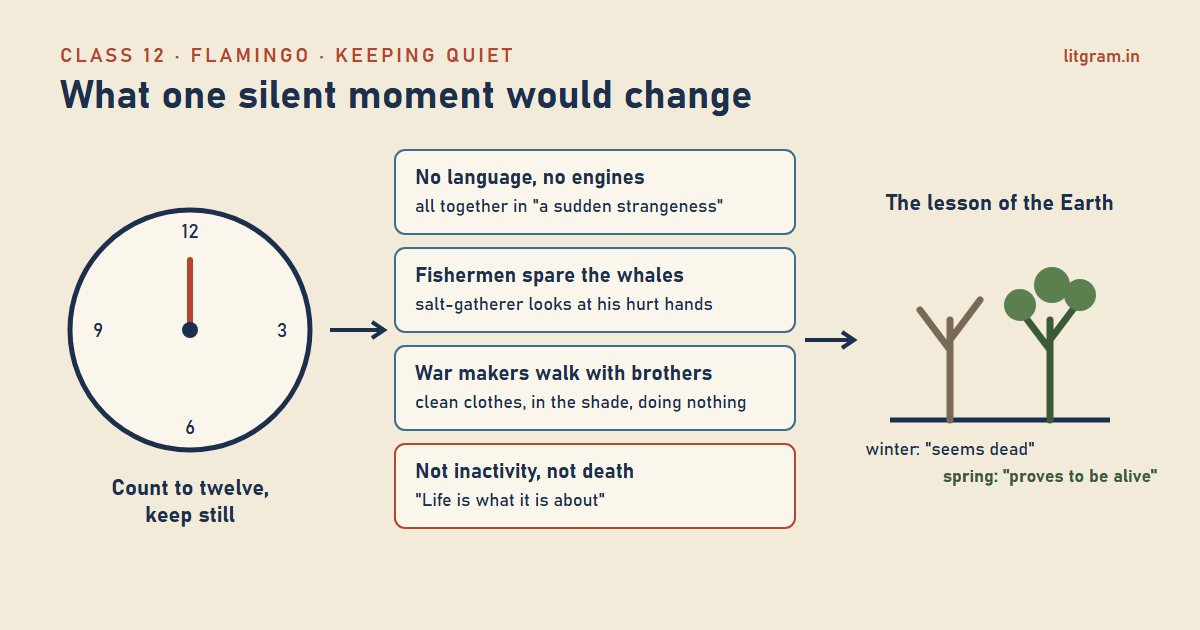
The speaker says, “Now we will count to twelve” and asks the whole world to keep still. For one second nobody should speak any language or move their arms so much. This would be an “exotic moment”, strange and new, “without rush, without engines”.
In that silence, fishermen would not harm whales, and the salt-gatherer would look at his own hurt hands. The people who prepare wars would put on clean clothes and walk with their brothers in the shade, doing nothing.
The poet then makes clear that he does not want “total inactivity”. He wants life, not death: “I want no truck with death.” We are so busy keeping our lives moving that we never understand ourselves. A huge silence might end this sadness. The Earth teaches the same lesson: in winter everything seems dead and “later proves to be alive”. The poem ends where it began: he will count to twelve, and we should keep quiet while he goes.
Download the Keeping Quiet summary PDF
For quick revision, download the two-page Keeping Quiet summary PDF. It has the stanza-wise meaning, devices, word meanings, common mistakes and practice answers.
Stanza-wise explanation with Hindi meaning
Stanza 1: count to twelve and keep still
The poem opens with an instruction: “Now we will count to twelve / and we will all keep still.” Twelve is a whole cycle: twelve hours on the clock, twelve months in a year. The pause is short but complete.
हिंदी अर्थ: कवि कहता है कि हम बारह तक गिनेंगे और सब चुप और स्थिर रहेंगे। बारह घड़ी के घंटों और साल के महीनों जैसा एक पूरा चक्र है।
Stanza 2: no language, no movement
For once on the face of the Earth, we should not speak in any language. Languages divide people; silence is the same for everyone. We should stop for one second and not wave our arms about, a picture of busy, restless people.
हिंदी अर्थ: एक बार पूरी धरती पर कोई किसी भी भाषा में न बोले, और हम एक पल के लिए हाथ-पैर चलाना बंद कर दें। भाषाएँ लोगों को बाँटती हैं, मौन सबको जोड़ता है।
Stanza 3: an exotic moment
That moment would be “exotic”, unusual and fresh, “without rush, without engines”. No traffic, no machines, no hurry. We would all be together “in a sudden strangeness”, sharing one new experience.
हिंदी अर्थ: वह पल अनोखा होगा, बिना भागदौड़ और बिना मशीनों के। अचानक आई इस अजीब शांति में हम सब एक साथ होंगे।
Stanza 4: the fisherman and the salt-gatherer
The fishermen in the cold sea “would not harm whales”: man would stop hurting nature. The man gathering salt “would look at his hurt hands”: for once he would notice his own pain. Silence brings kindness to others and care for ourselves.
हिंदी अर्थ: ठंडे समुद्र में मछुआरे व्हेल को नुकसान नहीं पहुँचाएँगे, और नमक इकट्ठा करने वाला अपने घायल हाथों को देखेगा। मौन में हम प्रकृति को चोट पहुँचाना बंद करेंगे और अपने दुख को पहचानेंगे।
Stanza 5: the war makers
Those who prepare “green wars” (wars against the environment), wars with gas and fire, and “victory with no survivors”, would put on clean clothes and walk with their brothers in the shade, doing nothing. “Clean clothes” suggests hands clean of blood. “Brothers” shows enemies becoming one family.
हिंदी अर्थ: जो लोग पर्यावरण के विरुद्ध, गैस और आग से युद्ध की तैयारी करते हैं, जिनकी जीत में कोई जीवित नहीं बचता, वे साफ कपड़े पहनकर अपने भाइयों के साथ छाँव में टहलेंगे। दुश्मन भाई बन जाएँगे।
Stanza 6: not inactivity, not death
The poet warns us not to misread him: what he wants should not be confused “with total inactivity”. “Life is what it is about”. He wants to have nothing to do with death. NCERT glosses “to have no truck with” as to refuse to deal with or tolerate something.
हिंदी अर्थ: कवि कहता है कि उसकी बात को पूरी तरह निष्क्रिय हो जाना न समझा जाए। उसकी कविता जीवन के बारे में है; वह मृत्यु से कोई संबंध नहीं रखना चाहता।
Stanza 7: the sadness of not understanding ourselves
We are too “single-minded / about keeping our lives moving”. If for once we could do nothing, a huge silence might interrupt “this sadness / of never understanding ourselves” and of threatening ourselves with death. The sadness is the loneliness of busy people who never look inward, and the fear of war we create ourselves.
हिंदी अर्थ: हम जीवन को लगातार चलाते रहने में इतने लगे रहते हैं कि खुद को कभी नहीं समझ पाते। एक बड़ा मौन इस उदासी को तोड़ सकता है: खुद को न समझ पाने और खुद को मौत से डराने की उदासी।
Stanza 8: the lesson of the Earth
“Perhaps the Earth can teach us / as when everything seems dead / and later proves to be alive.” In winter trees are bare and the ground looks dead, yet in spring life returns. Stillness is not death; it is rest before new life.
हिंदी अर्थ: शायद धरती हमें सिखा सकती है। सर्दियों में सब कुछ मरा हुआ लगता है, पर बसंत में फिर जीवित हो उठता है। शांति मृत्यु नहीं, नए जीवन की तैयारी है।
Stanza 9: the poet leaves
“Now I’ll count up to twelve / and you keep quiet and I will go.” The change from “we” to “you” and “I” leaves the reader alone with the silence. The poem ends by asking us to practise what it says.
हिंदी अर्थ: अब कवि बारह तक गिनेगा, हम चुप रहें और वह चला जाएगा। अब मौन का अभ्यास पाठक को स्वयं करना है।
Theme and message
| Theme | Where it shows |
|---|---|
| Introspection (looking within) | “never understanding ourselves”; the salt-gatherer looks at his hurt hands |
| Peace and brotherhood | War makers walk “with their brothers / in the shade” |
| Harm to nature | “would not harm whales”; “green wars” |
| Unity beyond language | “let’s not speak in any language” |
| Life, not death | “I want no truck with death”; the Earth that “proves to be alive” |
| Busy modern life | “without rush, without engines”; “keeping our lives moving” |
Poetic devices in Keeping Quiet
| Device | Line | Why |
|---|---|---|
| Free verse | Whole poem | No rhyme scheme; lines of different lengths, like speech |
| Repetition (anaphora) | “wars with gas, wars with fire” | Stresses the many ways men destroy |
| Paradox | “victory with no survivors” | A victory where everyone dies is no victory |
| Oxymoron / contrast | “green wars” | Green (nature, life) joined to war (death) |
| Alliteration | “would put on clean clothes”; “single-minded / about keeping” | Sound links the words |
| Symbol | The Earth after winter; counting to twelve | Life under stillness; a complete cycle |
| Enjambment | “this sadness / of never understanding ourselves” | The thought runs on into the next line |
Word meanings
| Word | Meaning | हिंदी |
|---|---|---|
| exotic | strange and new | अनोखा |
| strangeness | unfamiliar feeling | अजनबीपन |
| green wars | wars against nature | पर्यावरण के विरुद्ध युद्ध |
| survivors | people left alive | जीवित बचे लोग |
| inactivity | doing nothing at all | निष्क्रियता |
| no truck with | nothing to do with | कोई संबंध नहीं |
| single-minded | focused on one aim | एक ही धुन में लगे |
| introspection | looking into one’s own mind | आत्मचिंतन |
Keeping Quiet question answers
Think it out (NCERT)
1. What will counting up to twelve and keeping still help us achieve?
It will give us a moment of silence and calm. In it we can look into ourselves, stop harming nature and each other, feel our common humanity, and understand ourselves better.
2. Do you think the poet advocates total inactivity and death?
No. He says clearly that his wish should not be confused with total inactivity, and that he wants “no truck with death”. He wants a short pause that leads to fuller, wiser living.
3. What is the ‘sadness’ the poet refers to?
The sadness of never understanding ourselves, and of threatening ourselves with death through war and violence. Busy, single-minded people never stop to look within.
4. What symbol from Nature shows there can be life under apparent stillness?
The Earth. In winter everything seems dead, but it “later proves to be alive” in spring.
Short answers (40-50 words)
Why does the poet want us not to speak in any language?
Languages divide people into groups and cause misunderstanding. In silence everyone is equal and shares the same experience. Not speaking for one second would let all people, across countries and tongues, be “together”, feel their brotherhood and listen to their own inner selves.
How would the “exotic moment” change the fishermen and the salt-gatherer?
The fishermen would stop harming whales, so man would stop exploiting nature. The salt-gatherer would look at his hurt hands, so he would notice his own suffering. The pause brings kindness to other creatures and care for oneself.
Long answer (120-150 words)
How is Keeping Quiet a poem about peace, not inactivity?
Neruda asks us to count to twelve and keep still, but he warns that this must not be confused with total inactivity, and he wants “no truck with death”. The silence is meant to change what we do. Fishermen would spare whales, the salt-gatherer would notice his hurt hands, and the makers of green wars and wars with gas and fire would walk in the shade with their brothers. The pause would interrupt the sadness of never understanding ourselves and of threatening ourselves with death. The image of the Earth sums it up: in winter it seems dead, then it “proves to be alive”. So stillness is a rest that prepares new life. The poem is a call for reflection, brotherhood and peace, which can begin with a single moment of quiet.
Poetry extract practice
“Perhaps the Earth can teach us / as when everything seems dead / and later proves to be alive.”
(a) What can the Earth teach us? That stillness is not death; life continues under apparent inactivity.
(b) When does everything seem dead? In winter, when trees are bare.
(c) Name the device. Symbolism (the Earth as a symbol of renewal).
What examiners look for, and common mistakes
Answer pattern. CBSE gives a poetry extract with several short parts, plus 40-50 word short answers. Match the length to your paper. In an extract answer, quote two or three words from the lines as proof.
- The poet does not want inactivity or death. Many students write that he wants everyone to stop working. Quote “total inactivity” and “no truck with death”.
- “Green wars” are wars against the environment, not wars fought in green fields or by armies in green uniform.
- The salt-gatherer looks at his own hurt hands; he does not stop working forever.
- The “sadness” is not grief for someone who died. It is not understanding ourselves and threatening ourselves with death.
- The poem is free verse: say “no fixed rhyme scheme”, not “ABAB”.
- Neruda was Chilean and wrote in Spanish. He won the Nobel Prize in 1971.
Memory trick, “12 Fishermen Salt War”: Twelve (count), Fishermen (whales), Salt (hurt hands), War (brothers in the shade), then “not death” and “the Earth”.
Keeping Quiet MCQs
- Up to what number does the poet ask us to count?
Answer: Twelve. - Which country was Neruda from?
Answer: Chile. - Whom would the fishermen not harm?
Answer: Whales. - What would the man gathering salt look at?
Answer: His hurt hands. - What are “green wars”?
Answer: Wars against the environment. - “Victory with no survivors” is an example of…
Answer: Paradox. - What does the poet not want his wish confused with?
Answer: Total inactivity. - What does “to have no truck with” mean?
Answer: To refuse to deal with or tolerate something. - What symbol shows life under stillness?
Answer: The Earth, which seems dead in winter and comes alive again. - What form is the poem written in?
Answer: Free verse.
Score guide: 9-10 correct, you know the poem; below 9, read the stanza-wise explanation again.
Related Class 12 guides
All Flamingo chapters and poems are listed on our Class 12 English Flamingo and Vistas guide. The poem before this one is My Mother at Sixty-six by Kamala Das. From Flamingo prose, read The Last Lesson summary in Hindi and Indigo by Louis Fischer. For Neruda’s life, see the Nobel Prize biography of Pablo Neruda.